


















Introduction
When a business needs to purchase a major asset like equipment or a vehicle, it does not always have to pay the full cost upfront. A note payable allows the business to spread the cost over time under a formal repayment agreement. This agreement is documented in a promissory note, a written promise to repay a specific amount under agreed terms. It sets out how much the business owes, when payments are due, and any interest or other conditions.
The term “notes payable” is more common in North American accounting. In the UK and Ireland, the obligation may instead be described as a loan, financial liability, or creditor amount due within or after one year.
Read on to learn how notes payable work, how interest is handled, where the debt appears on the balance sheet, and where automation can help.
What are notes payable?
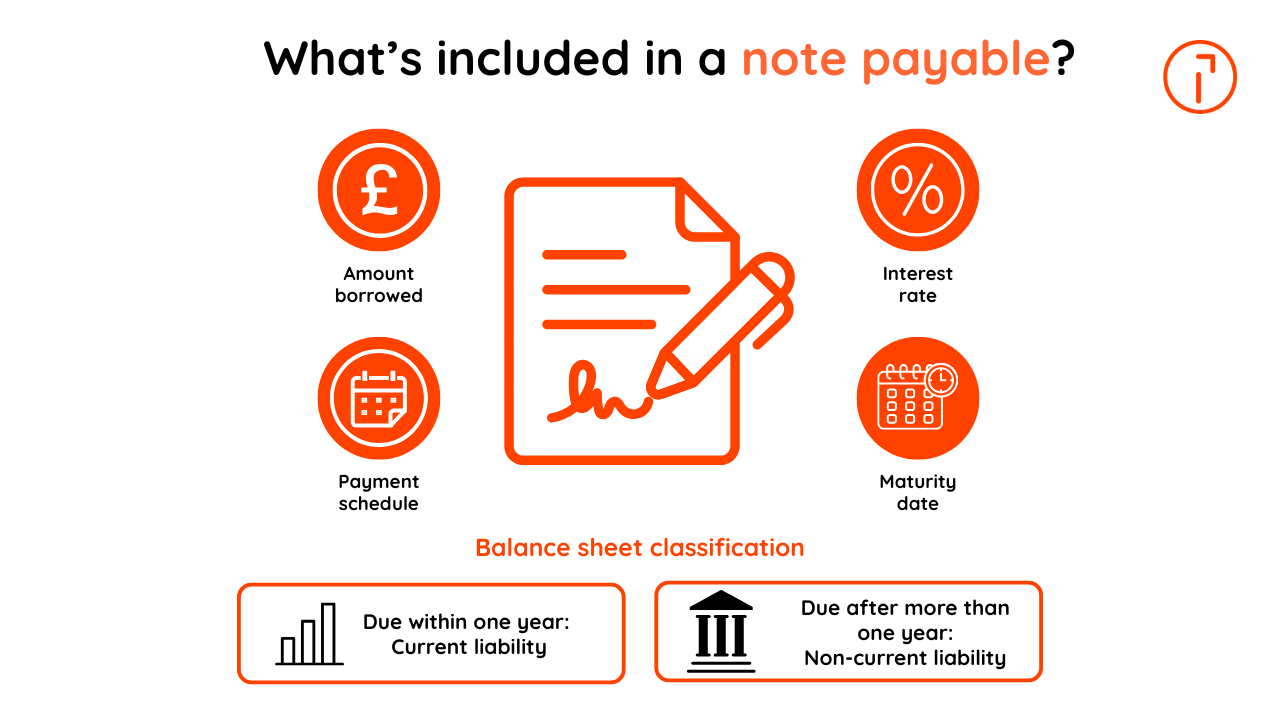
A note payable is a promise to repay money by an agreed date (the maturity date). These agreements typically define an interest rate, payment schedule, collateral requirements, and other terms. Since the business still owes the money, it records the note as a liability.
Key takeaways
A note payable is a written agreement to repay borrowed money.
The balance may be classified under current liabilities, non-current liabilities, or both.
Repayments of the principal reduce the note balance. Interest is recorded separately.
Keeping the records up to date makes it easier to plan payments and complete the period-end close.
Notes payable due within or after one year
The classification of a note payable on the statement of financial position, also known as the balance sheet, depends on when the principal is due.
Amounts due within 12 months are typically reported as current liabilities. In UK and Irish financial statements, these may appear under “creditors: amounts falling due within one year.” Amounts due later are generally reported as non-current liabilities or creditors falling due after more than one year.
A multi-year note can appear in both sections. The principal due within the next 12 months is classified as current, while the rest is classified as non-current.
For example, a six-month bank note is a current liability. A five-year equipment loan is non-current, though any principal due during the next year is reported as current.
This split helps readers see how much the business needs to repay soon. Reporting the entire amount as non-current could make the business look better able to cover its short-term bills than it actually is.
How do you record a note payable?
A business may create a note payable when it takes out a bank loan, finances equipment, buys a vehicle on credit or agrees to repay an overdue supplier balance over time.
There are four main steps to account for a note payable.
These examples show the basic bookkeeping treatment. Under FRS 102, debt instruments that meet the relevant conditions are generally measured at amortised cost using the effective interest method. The correct accounting treatment depends on the terms of the agreement.
1. Record the note
When a business receives cash from a lender, it debits the cash account and credits the notes payable account.
Account | Debit | Credit |
Cash | £20,000 | |
Notes payable | £20,000 |
Cash increases because the business received money. The notes payable balance increases because the business has a financial obligation.
When a note is used to finance equipment, the business may debit the equipment account instead of the cash account:
Account | Debit | Credit |
Equipment | £20,000 | |
Notes payable | £20,000 |
For Irish businesses, the same accounting principles apply to agreements denominated in euros.
2. Record accrued interest
Interest is recorded as it is incurred, even when it has not yet been paid. Unpaid interest is recorded as interest payable on the balance sheet.
Suppose £300 of interest has accumulated by the end of the accounting period:
Account | Debit | Credit |
Interest expense | £300 | |
Interest payable | £300 |
The expense belongs to the current accounting period, while interest payable shows the amount that has not yet been paid.
3. Record payments
A payment may include principal, interest or both. The principal portion reduces notes payable. The interest portion is recorded as interest expense or used to reduce interest payable if the interest was recorded earlier.
If the interest has not already been accrued, the payment is recorded as follows:
Account | Debit | Credit |
Notes payable | £2,000 | |
Interest expense | £100 | |
Cash | £2,100 |
After the entry is posted, the note payable balance decreases by £2,000. The £100 interest payment affects the profit and loss account but does not reduce the principal.
4. Settle the note
At maturity, the borrower pays any remaining principal and interest. Once the final payment is recorded, the note payable balance for that agreement should be zero.
The business should retain the promissory note, payment records, interest calculations and evidence that the obligation has been settled.
How do you calculate interest on notes payable?
For a simple interest note, use the following formula:
Interest = Principal × annual interest rate × time
Time is expressed as a portion of a year. A three-month note uses 3/12. A 90-day note may use 90/360 or 90/365, depending on the terms of the agreement.
Interest calculation example
A small business borrows £10,000 for 90 days at an annual interest rate of 9%. Interest is calculated using a 360-day year.
Interest = £10,000 × 9% × 90/360
Interest = £225
The total amount due at maturity is:
£10,000 principal + £225 interest = £10,225
The business records the payment as follows:
Account | Debit | Credit |
Notes payable | £10,000 | |
Interest expense | £225 | |
Cash | £10,225 |
If the note crosses an accounting period, the business must record the interest incurred by the reporting date. It debits interest expense and credits interest payable. When the interest is paid, interest payable is debited.
What are common types of notes payable?
Four common repayment structures are single-payment, amortised, interest-only and negative amortisation.
Single-payment: The borrower repays the principal and any unpaid interest in one lump sum at maturity. These notes are simple to manage but require the business to make a large final payment. They are often used for short-term or seasonal financing.
Amortised: The borrower makes scheduled payments that include principal and interest. As the balance decreases, interest charges usually fall. This predictable repayment structure is common for equipment and other long-term financing.
Interest-only: During the term, the borrower pays only interest, so the principal balance does not decrease. The principal is due later, creating a larger future payment or the need to refinance. This structure may suit businesses expecting stronger cash flow in the future.
Negative amortisation: The required payments do not cover all the interest charged, so unpaid interest is added to the principal. As a result, the balance increases over time. This higher-risk structure is uncommon in routine business financing.
What is an example of a note payable?
Company A borrows £12,000 on 1 January under a one-year note with a 6% annual interest rate. The agreement requires four equal principal payments of £3,000, plus interest on the outstanding balance, at the end of each quarter.
Record the borrowing
Account | Debit | Credit |
Cash | £12,000 | |
Notes payable | £12,000 |
The entry increases both cash and notes payable by £12,000.
Calculate the first payment
Interest for the first quarter is calculated on the opening principal:
£12,000 × 6% × 3/12 = £180
The first payment is £3,180:
Account | Debit | Credit |
Notes payable | £3,000 | |
Interest expense | £180 | |
Cash | £3,180 |
After the payment, the notes payable balance falls to £9,000.
Continue the repayment schedule
Quarter | Opening principal | Principal paid | Interest paid | Ending balance |
1 | £12,000 | £3,000 | £180 | £9,000 |
2 | £9,000 | £3,000 | £135 | £6,000 |
3 | £6,000 | £3,000 | £90 | £3,000 |
4 | £3,000 | £3,000 | £45 | £0 |
The company pays £450 in total interest during the year.
As the principal is repaid, the notes payable balance decreases on the statement of financial position. Interest expense appears on the profit and loss account. Any interest incurred but not yet paid appears as interest payable under current liabilities.
Where do notes payable appear on the balance sheet?
Notes payable appear under liabilities on the statement of financial position, also known as the balance sheet. Amounts due within 12 months are shown under current liabilities, while the remaining balance is shown under non-current liabilities.
Depending on the financial statement format, the amounts may also be presented as creditors falling due within one year and creditors falling due after more than one year.
The notes to the financial statements may provide more information about interest rates, maturity dates, payment schedules, security and debt covenants.
This classification affects several financial ratios. Current notes payable are included in the current ratio and quick ratio. Total debt may affect the debt-to-equity ratio, while interest expense affects the interest coverage ratio.
What is the difference between notes payable and accounts payable?
Notes payable and accounts payable (AP) are both liabilities, but they arise from different types of transactions.
Area | Notes payable | Accounts payable |
Definition | Formal debt created by a written agreement | Trade debt created by a purchase made on credit |
Documentation | Promissory note or financing contract | Supplier invoice or other trade documentation |
Interest | Usually includes interest | Usually does not include interest within the agreed payment terms |
Repayment period | Short-term or long-term | Usually short-term, such as 30-day payment terms |
Due date | Contractual maturity date | Invoice due date |
Repayment structure | Lump sum, instalment or another agreed schedule | Usually one payment per invoice |
Typical source | Bank loan, equipment financing or formal supplier financing | Purchase of goods or services on credit |
Statement of financial position classification | Current liability, non-current liability, or both | Current liability |
An account payable can become a note payable. If a business cannot pay a supplier invoice by its due date, the supplier may agree to accept a promissory note with interest.
The business would record the change as follows:
Account | Debit | Credit |
Accounts payable | £5,000 | |
Notes payable | £5,000 |
The entry removes the amount from accounts payable and records it as a formal note payable.
What is the difference between notes payable and short-term debt?
Short-term debt is a broad category that includes borrowing due within 12 months. A short-term note payable is one type of short-term debt.
Short-term debt may include:
Bank notes due within 12 months
Short-term lines of credit
Current portions of long-term loans
Other formal borrowing arrangements due soon
Notes payable can also be long-term. For a multi-year note, only the principal due within the next 12 months is classified as current. In UK and Irish financial statements, this amount may be presented under “creditors: amounts falling due within one year.”
Short-term notes are due within 12 months, so businesses must prepare for repayment sooner. Long-term notes allow more time to repay the debt.
Why does accurate notes payable tracking matter?
If note records are wrong or out of date, a payment could be missed or the wrong amount could appear on the statement of financial position. The business may also have trouble knowing when cash will be needed.
Good records allow finance teams to:
Confirm the principal and unpaid interest
Prepare for future payments
Ensure agreements are audit-ready
Confirm that the business is meeting its debt covenants
Use correct figures in financial ratios
Avoid late payments that could damage lender or supplier relationships
At each reporting date, finance teams should compare the general ledger with lender or supplier statements. They should also check the interest calculation and reclassify any principal due within the next 12 months as a current liability.
How can accounts payable automation support notes payable?
AP automation does not calculate loan amortisation or manage bank debt. It can help when an unpaid supplier invoice becomes a formal repayment agreement by keeping invoices, approvals, supporting documents, and ERP records together.
Automation can help finance teams:
Centralise invoices, approvals, payment records and supporting documents
Apply consistent approval workflows
Reduce manual data entry
Sync invoice and approval information with an ERP or accounting system
Maintain an audit trail of reviews and approvals
Improve visibility into invoice status and amounts due
Accountants still need to confirm the interest, repayment terms, note balances, and current or non-current classification.
Conclusion
A note payable spells out what a business owes and how the debt will be repaid. Recording the principal, interest and payments correctly keeps the statement of financial position accurate and helps the business prepare for upcoming due dates.
Quadient Accounts Payable can reduce the manual work involved in processing supplier invoices and approvals. Explore Quadient’s AP automation software to see how connected workflows can give finance teams greater control over accounts payable.
