


















Empowering customer autonomy and streamlining tasks
Faced with the ongoing economic disruption that has persisted into 2023, businesses want to implement more digital process automation. By harnessing the power of digital process automation, companies can streamline operations, increase efficiency and reduce costs, ultimately positioning themselves for success in an uncertain economic landscape.
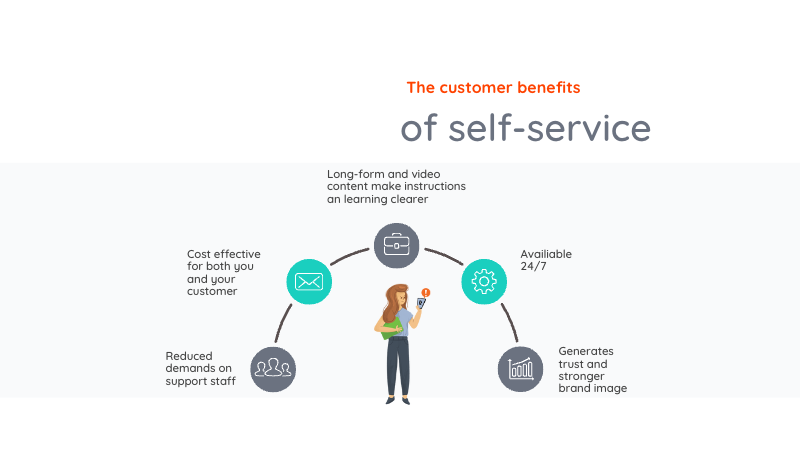
This article delves into the importance of customer self-service and task automation in the context of a customer experience transformation. We will explore how implementing appropriate technology can help to automate manual processes, revolutionise how businesses interact with customers, reduce friction and enhance overall satisfaction. Providing customers with the tools and resources to resolve issues independently and simplifying complex processes through automation, enables customer service teams to reduce costs while fostering stronger relationships and driving long-term growth.
Make your self-service content easy to find and navigate
To enable customer self-service, companies must start by producing a rich set of support content, including frequently asked questions, YouTube videos, knowledge base articles and FAQs pages that are well-indexed and search engine friendly. To develop this content, you must work closely with content teams across your organisation - within product, marketing and support.
Content teams are crucial in determining the most appropriate material for self-service portals. While documentation typically covers the proper usage of a product under ideal circumstances, customer self-service portals should address the information found in the documentation and potential issues that may arise when things do not proceed as expected.
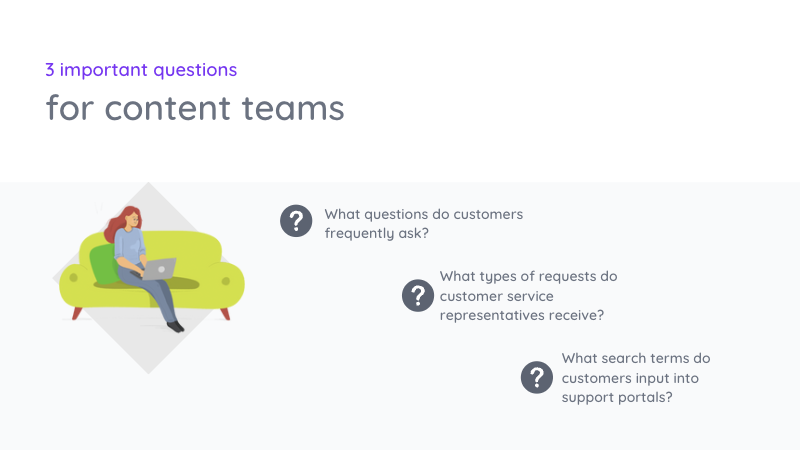
To identify common concerns, content teams must actively listen to their customers, who continuously communicate their needs to organisations. Some pertinent questions for content teams to consider include:
What questions do customers frequently ask?
What types of requests do customer service representatives receive?
What search terms do customers input into support portals?
If faced with lengthy questions, teams can prioritise addressing the most common requests and gradually expand the available content.
The primary focus of self-service content should be providing customers with customer-centric solutions to problems rather than product-centric instructions on utilising features, which should be covered in the documentation. Since customers may only sometimes know which feature can resolve their issues, content titles should emphasise problem-solving and addressing challenges.
As part of a company's service strategy, they must plan for self-service content to be easily shared across many platforms - whether on a website, inside a support agent’s system, within a customer portal or directly within a SaaS application to make it as seamless as possible for customers to access self-support content across many different channels.
Incorporating social media into your existing service channels
As of March 2023, social media users worldwide had reached 4.9 billion. The rapid growth of social media has transformed it into a primary channel for communication and social interaction for many individuals.
The way customers engage with companies via social media is evolving as well. In the past, customers often resorted to social media as an escalation channel when traditional service avenues failed to address their concerns. However, modern customers increasingly utilise social media for various purposes, such as general enquiries, feedback and praise.
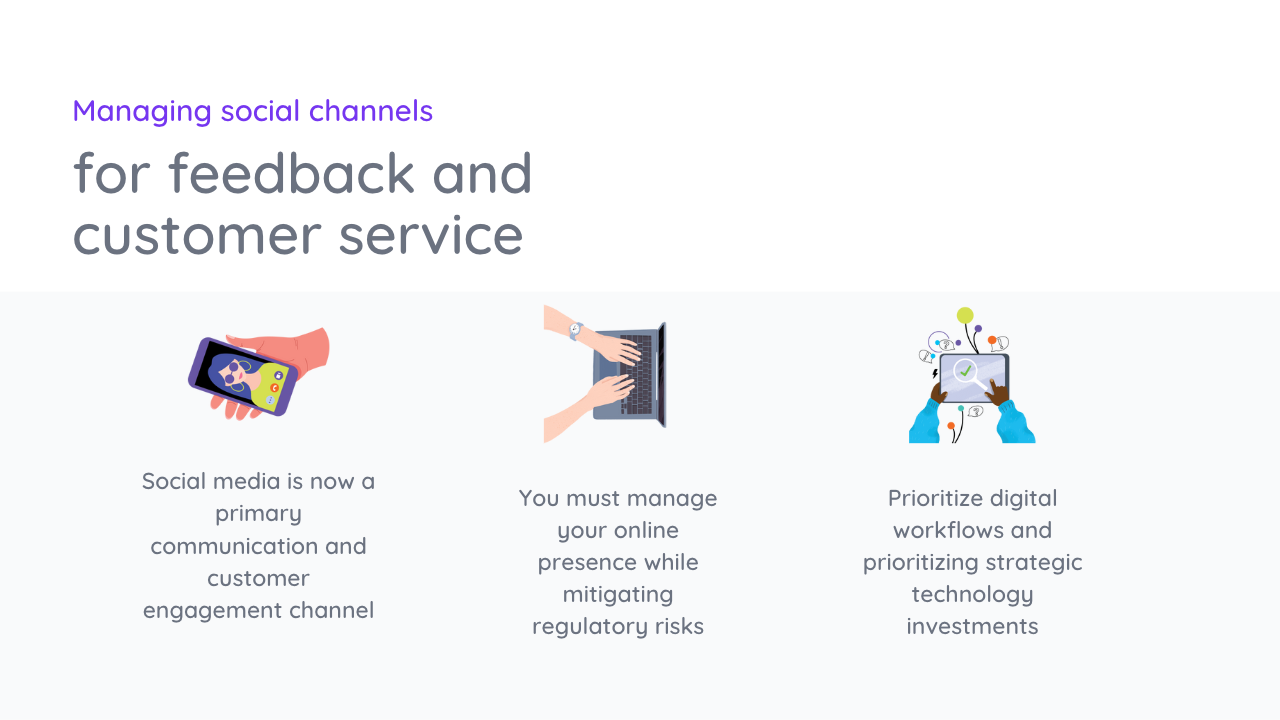
Given its public nature, the quality of service provided on social media platforms can significantly influence . Social content can go viral quickly, potentially escalating minor or isolated customer service incidents into public relations nightmares. The ramifications of such incidents may extend beyond reputational damage: popular social media platforms often attract the attention of industry regulatory authorities. Consequently, dissatisfied customers may tag these organisations in their posts, posing additional risks for businesses operating in highly-regulated sectors like financial services or healthcare.
Considering these challenges, companies need to recognise the potential of social media as a self-service channel and invest in strategies that optimise customer interactions and mitigate risks on these platforms. Support agents must have access to inboard social requests and a library of support content they can share with customers to ensure that they can help to optimise the customer journey.
Complicated workflow and technology investment choices. Effective social media servicing requires robust digital workflows enabled by fit-for-purpose technology, requiring leaders to make important technology investment decisions. Operating models should allow for a range of actions and responses, including identifying service-related posts, auto-allocating these to the appropriate servicing teams, authenticating posts, gathering information from customers and providing instant resolutions on-platform or off-platform through callbacks or email.
Faster service through task automation tools
Organisations can prioritise client service by automating laborious, paper-based processes to deliver faster response times, enhanced data accuracy and expedited transactions. These quantifiable benefits can be monitored and analysed throughout the organisation. Businesses should consider implementing task automation software in critical areas to drive further efficiencies, notably business process automation, customer communications management, accounts receivable automation and accounts payable automation.
Automating processes through faster document output
Business process automation empowers organisations to handle documents more securely, efficiently and frequently. It mitigates disruptions to office staff, allowing them to concentrate on high-value tasks and ultimately improves employee engagement, satisfaction and time management. This automation significantly bolsters operations and business outcomes, from accelerating cash flow to optimising the impact of each communication through targeted marketing messages.
When embarking on CX transformation, it is crucial to document your workflow and establish your business rules. This critical initial step ensures that the final solution aligns with your organisation's specific requirements and paves the way for a successful implementation. By strategically approaching digital process automation (DPA), businesses can streamline processes, boost productivity and enhance their overall performance.
Leverage your people to power great customer interactions via CCM
Using a modern customer communications management (CCM) platform, such as Quadient Inspire, enables individuals throughout an organisation to contribute their expertise to each customer touchpoint, drastically speeding up the process of generating and delivering essential communications.
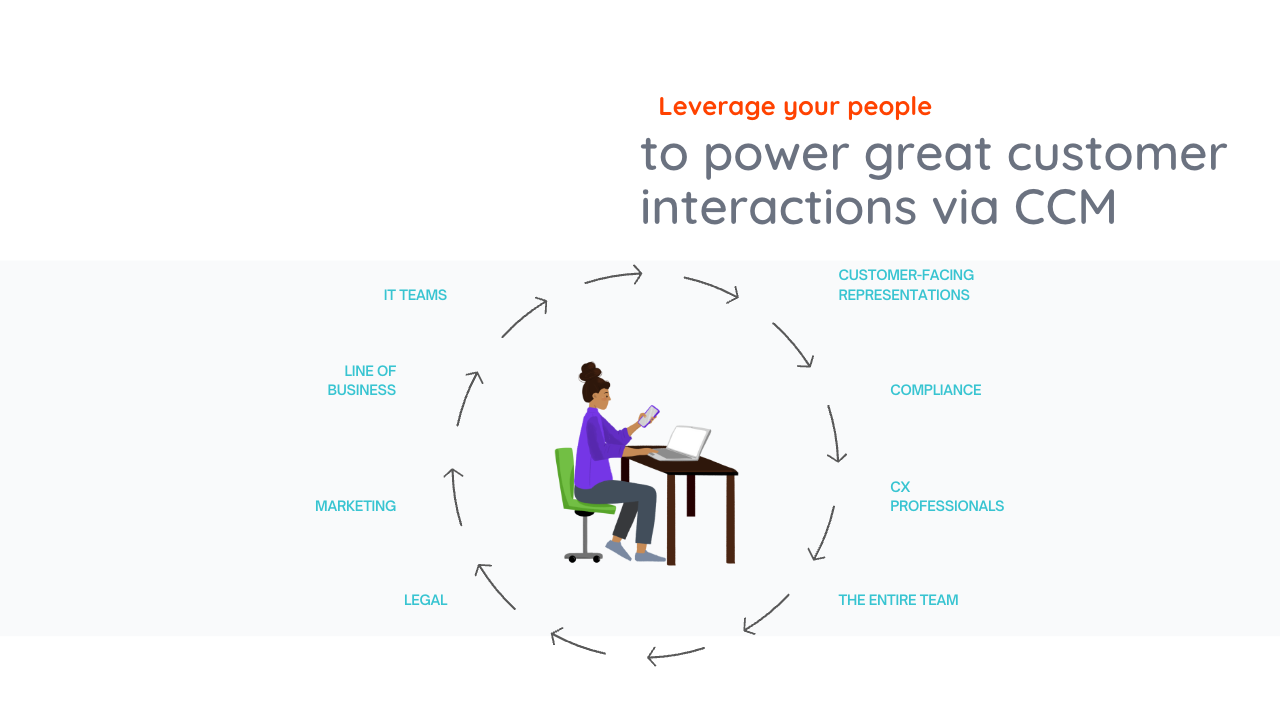
IT teams - Develop master templates, workflows and approval processes, determine access privileges for editing and publishing content, monitor communication delivery and report on customer engagement levels.
Line of business - Edit and approve content changes related to their specific areas of responsibility.
Marketing - Oversee branding, provide design feedback and manage transactional offers featured in customer communications.
Legal - Maintain and approve legal disclaimers and terms and conditions.
Customer-facing representatives - Generate ad hoc, personalised customer communications using a web interface with a guided experience that assists in selecting appropriate content based on customer needs.
Compliance - Ensure the implementation of approval processes that govern communications, adhering to relevant data and regulations that impact your business.
CX professionals - Create journey maps linked with customer communications to generate a comprehensive view of the customer experience.
The entire team - Contribute feedback on template design, layout and content to enhance the quality of customer communications
Automating accounts receivable and accounts payable
Many SMBs now leverage AR automation and AP automation tools and processes for their transformation efforts. 70% of SMBs have reported increased productivity due to automation. This shift toward automation is crucial for SMBs looking to optimise efficiency and remain competitive in an ever-evolving business environment.
Businesses can maintain better control and organisation by centralising the “invoice2cash” process for multiple locations or legal entities. Today’s AP and AR automation solutions automatically match purchase orders to invoices and receiving, ensuring accuracy and efficiency. These systems also automate approval routeing for purchase orders, invoices and payments, significantly reducing manual intervention and speeding up the approval process.
Users can quickly find any document and view all completed workflow steps, promoting transparency and accountability. Additionally, the platform simplifies approving, releasing and receiving payments, making it easier for businesses to manage their accounts payable effectively.
Automating physical mail processes
Invoices, statements and other communications convey crucial information and generate revenue and cash flow for a business. While software automation helps ensure that digital communications are on point, companies can extend automation to mail communications to ensure that mailing remains cost-effective and easy to process.
To address this, many companies invest in folder inserters coupled with document automation software to expedite and improve the accuracy of document dispatch. Manual mail compilation by employees exposes the business to risks such as human error, decreased employee engagement and time that could be better spent on higher-value tasks. Most importantly, incorrect or misdirected mail can have costly consequences.
Transforming customer experience through self-service and task automation
In conclusion, businesses facing economic challenges and an ever-shifting landscape must prioritise customer self-service and task automation to remain competitive. By implementing the right technology and processes, organisations can reduce friction in customer interactions, enhance overall satisfaction and streamline operations to drive long-term growth.
Embracing digital process automation enables companies to optimise efficiency, increase productivity and stay agile in an uncertain economic climate. By investing in self-service content, leveraging social media and automating critical business processes, companies can revolutionise their customer experience and cultivate stronger relationships for future success.
Conclusion
Empowering customers through self-service and automation creates faster, more satisfying experiences while freeing employees to focus on higher-value work. When routine tasks are simplified and communication is seamless, everyone benefits. With Quadient’s intelligent automation and Customer Communications Management (CCM) solutions, organisations can streamline operations, enhance engagement and deliver the convenient, connected experiences customers expect.