


















Introduction
Businesses are constantly looking for the most effective ways to communicate with their customers. Two popular methods are hybrid mail and direct mail. While both serve the purpose of delivering physical messages to recipients, they do so in different ways, each offering unique advantages and challenges. Below, we'll explore the pros, cons and key differences between hybrid mail and direct mail to help you to decide to determine when each best fits your needs.
When it comes to choosing between the most effective communication, hybrid mail and direct mail, understanding the differences is key to leveraging their benefits in your marketing strategy.
What is direct mail?
Direct mail is the traditional approach where physical promotional materials, such as brochures, postcards or catalogues, are sent directly to the recipient's postbox. Typically prepared and posted manually. Direct mail has long been a staple in targeted advertising campaigns.
Pros of direct mail:
Tangibility: A piece of direct mail physically engages recipients, contributing to a higher engagement rate compared to digital-only messages.
Higher engagement: Studies have shown postal mail items appeals to a wide range of demographics that trust direct mailings over digital communications
Less competition: Receiving a physical piece of mail can stand out more effectively
Broader reach: In an era of digital overload or if your target audience has a low online presence, receiving a physical piece of mail stands out and has more staying power than an electronic message.
High personalisation: Direct mail materials can be highly personalised. From handwritten notes to unique packaging, it offers great flexibility in presentation.
Cons of direct mail:
Longer lead times: Preparing materials, stuffing envelopes and managing mailing lists manually can be labour-intensive and time-consuming.
Higher costs: Without bulk discounts from hybrid mail services, direct mail can become expensive, especially with large campaigns. Involves expenses for designing, printing and mailing materials, which can accumulate especially for large campaigns..
In-house staffing: Requires internal resources for production and management, which might not be feasible for small businesses.
Potential for waste: Physical materials may be discarded without engagement, leading to waste and environmental concerns.
Low trackability: Measuring success or ROI of your mail campaign is more challenging versus customer engagement data you can collect from social media or your website with a digital campaign.
What is hybrid mail?
Hybrid mail is a modern approach that combines digital marketing with traditional direct mail campaigns. It allows businesses to create, send and track physical mail via a digital platform. The process involves uploading documents, which are then processed by a service provider. This method streamlines the mailing process by outsourcing mail assembly and eliminating manual processes.
Hybrid mail solutions combine digital and physical mail processes. You can create and send letters from your computer and the service provider handles the printing, folding and mailing. This automation saves time and simplifies the process.
Pros of hybrid mail:
Convenience and efficiency: Reduces the time and effort involved in physically preparing and sending mail. Businesses can manage bulk mailings with just a few clicks.
Cost-effective: Saves on printing, envelopes and mailing costs due to reduced manual labour and bulk processing.
Trackable and secure: Offers tracking options that let businesses monitor delivery, enhancing security and ensuring reliable communication.
Environmentally friendly: Often uses sustainable materials and reduces wastage associated with traditional mail processes.
Scalability: Easily manage high mail volume without investing in additional infrastructure or staff.
Security: A certified Hybrid Mail provider, like Quadient, ensures the mailings are managed with the utmost integrity and meet compliance requirements along with protecting your customer data.
Cons of hybrid mail:
Dependence on technology: Requires a reliable Internet connection and technical expertise to manage digital platforms
Limited control: When outsourcing the printing and mailing process, you may have less direct oversight over production quality.
Key differences
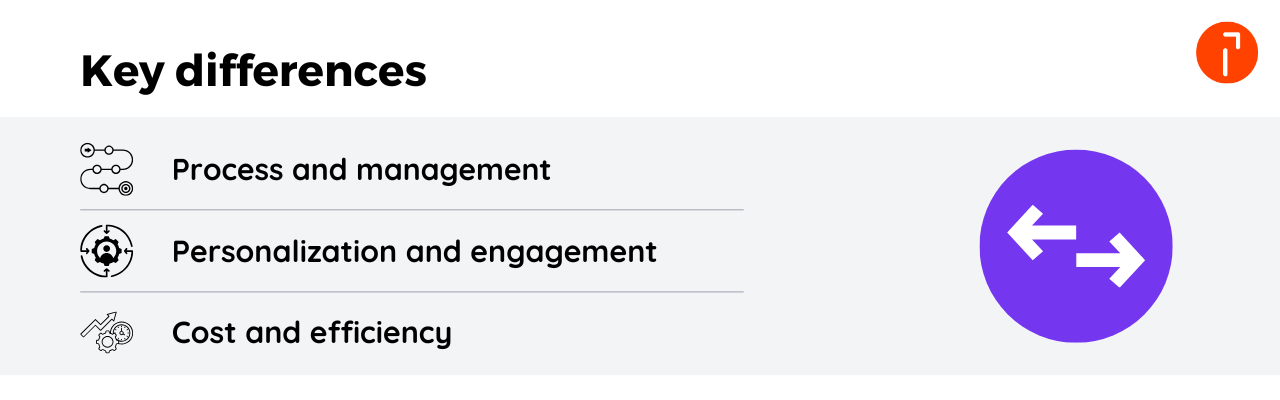
Process and management: The process is largely automated and performed digitally before moving to physical production, whereas direct mail campaigns are manually organised and sent.
Personalisation and engagement: Hybrid mail does not carry any incremental cost for customisations.
Cost and efficiency: Hybrid mail is generally more cost-effective, so it is ideal for small-scale campaigns with tight deadlines and budgets. Direct mail, on the other hand, allows for more creative liberties and personalisation but often comes at a higher cost.
Conclusion
The choice between hybrid mail and direct mail should be guided by the specific goals and constraints of your campaign. Hybrid mail is ideal for businesses that prioritise efficiency and cost-effectiveness, whereas direct mail is best suited for those aiming for a personalised and impactful touch. Understanding these differences will help you to make a well-informed decision that aligns with your marketing objectives. Looking for the optimal blend of efficiency and impact? Discover how Quadient's versatile mailing services can help you to achieve your marketing goals with both hybrid and direct mail.