






Short answer: In 2026, the ROI of AI in accounts receivable proves strongest when teams use AI to reduce DSO, raise collector productivity, prioritize risky accounts, and improve cash visibility. The best results often come from workflow-level changes, not from adding AI to one task in isolation. Analyst and consultancy research now points to AR as one of the clearest places where finance automation can unlock working capital and measurable operational gains.
Artificial intelligence (AI) in accounts receivable (AR) means using machine learning, predictive analytics, and now generative or agentic AI to improve invoice-to-cash work such as collections prioritization, payment prediction, dispute handling, and cash forecasting. This article focuses on practical ROI in 2026: where the gains come from, what metrics matter, and how to judge whether the business case is real, including:
- What ROI in AR actually includes
- Which metrics finance leaders should track
- What analyst and consultancy benchmarks say in 2025 and 2026
- Where AI helps most in collections and working capital
- A simple checklist for judging an AR AI investment
What does ROI in AI for accounts receivable mean?
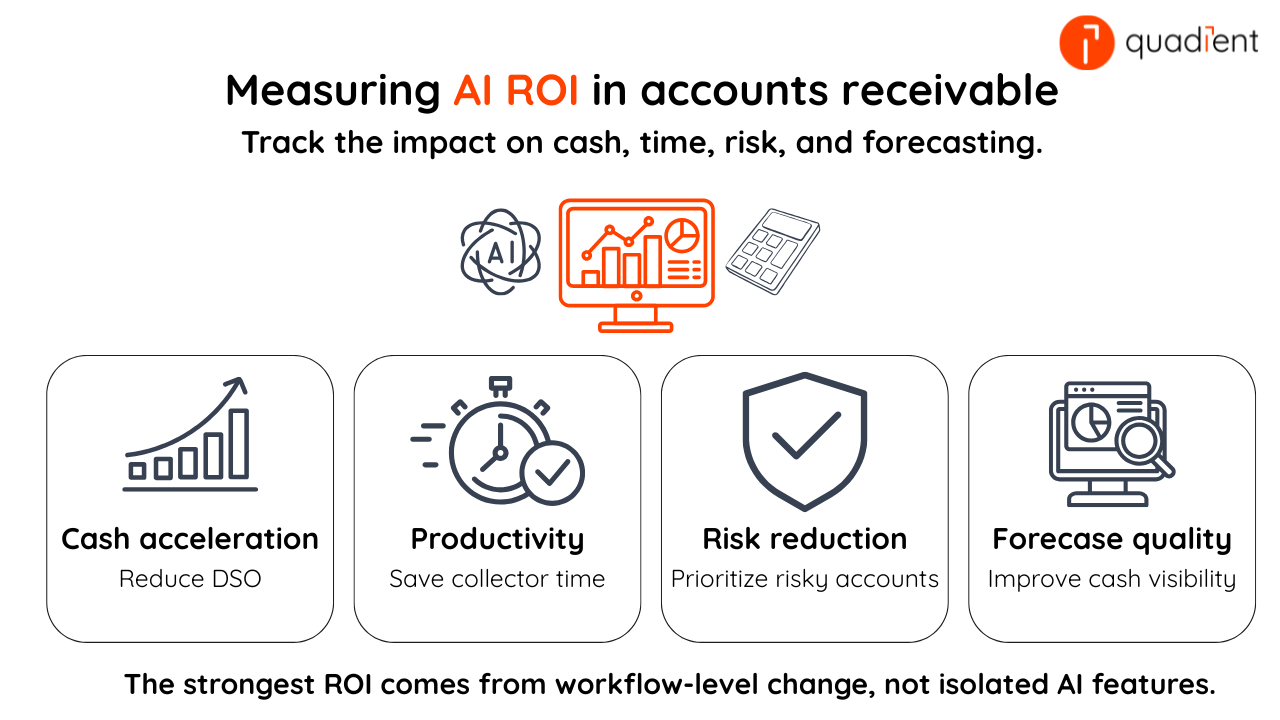
The ROI of AI in accounts receivable measures the financial return from using AI to collect cash faster, reduce manual work, lower bad-debt risk, and improve working capital decisions. In practice, most finance teams measure that through four buckets:
- Cash acceleration
- Labor productivity
- Risk reduction
- Better forecasting
That matters because AR is not just a back-office workflow. The Hackett Group’s 2025 Working Capital Survey says accounts receivable now represents the largest share of excess working capital opportunity, valued at $600 billion, and notes an 18-day DSO gap between top-quartile and median performers. That makes AR one of the clearest places to tie AI to liquidity.
Where does the ROI from AI in AR usually come from?
The first source is faster collections. AI helps accounts receivable teams prioritize the right accounts, spot likely delays earlier, and recommend the next best action for each customer. That means collectors spend less time chasing low-risk invoices and more time on the balances most likely to affect cash flow. In practice, that can lead to faster collections, fewer overdue invoices, and better use of team capacity.
The second source is better working capital visibility. McKinsey says finance teams are using AI to monitor working capital in real time, improve insights, and offload manual work. Predictive analytics and workflow automation improve productivity, increase working capital visibility, and reduce DSO by helping teams prioritize collections and accelerate cash flow.
The third source is workflow redesign. McKinsey’s 2025 AI survey says most firms are still early in scaling AI, and only 39% report EBIT impact at the enterprise level. The same research says redesigning workflows is one of the strongest contributors to meaningful business impact. That is a useful warning for AR teams: ROI usually comes from changing how collections work, not from adding AI to one task in isolation.
Which benchmarks matter most in 2026?
The table below shows the benchmarks that matter most when evaluating the 2026 ROI of AI in accounts receivable.
Metric | Why it matters | What current sources suggest |
DSO | Direct measure of how fast invoices turn into cash | Hackett reports an 18-day DSO gap between top and median performers; EY cites up to 30% DSO improvement in an AR AI use case. |
Collector productivity | Shows labor savings and team capacity | AI can reduce manual follow-up work by helping teams prioritize accounts, automate outreach, and focus effort where it matters most. |
Working capital | Converts AR performance into liquidity value | Hackett says AR is the largest excess working capital opportunity, worth $600 billion. (The Hackett Group®) |
Forecast quality | Helps treasury and finance plan cash more accurately | McKinsey says finance teams are using AI to monitor working capital in real time and forecast more accurately. (McKinsey & Company) |
Enterprise impact | Tests whether local gains scale into finance ROI | McKinsey says only 39% report EBIT impact at enterprise level, so scale and process design still matter. (McKinsey & Company) |
Key statistic: In McKinsey’s 2025 survey of CFOs, 44% said they were using gen AI for more than five use cases, up from 7% the year before. That matters for AR because it shows finance teams are moving past small pilots and starting to apply AI across real workflows where ROI can be measured.
How should finance leaders judge an AI AR business case?
Start with DSO, overdue balances, collector workload, dispute volume, and forecast accuracy. Then estimate the value of one day of DSO improvement for your business. That gives you a grounded working-capital number before you add softer benefits like productivity or lower write-offs.
Next, check whether the platform supports the full invoice-to-cash workflow. Clean data, full-cycle automation, ERP integration, digital payments, and AI for payment prediction and cash visibility are core requirements for successful AR AI initiatives. That is the right lens because narrow point solutions often miss the real source of ROI. Learn more about accounts receivable automation.
Use this checklist:
- Quantify the cash value of a 1-day, 3-day, and 5-day DSO improvement
- Measure collector time spent on low-value follow-up work
- Check whether AI prioritizes accounts and recommends next best actions
Confirm ERP integration and clean customer data
- Track results at workflow level, not just by feature
Separate pilot gains from sustained monthly performance
What is the real 2026 verdict on AI ROI in AR?
In 2026, AI ROI in AR depends heavily on workflow design, data quality, ERP integration, and how well automation is embedded into day-to-day collections processes. Finance leaders are clearly prioritizing AI more heavily: McKinsey found 44% of surveyed CFOs used gen AI for more than five use cases in 2025, up from 7% the year before, while CFO.com reports 87% of CFOs say AI will be very or extremely important to finance operations in 2026. But Deloitte also warns that AI ROI is still hard to isolate when it is bundled into wider transformation.
That means the best answer is practical. AI in AR pays off when it shortens the cash cycle, improves collections decisions, and embeds into day-to-day workflows with real data and clear metrics.
For most finance teams, the winning KPI is still simple: Does the system help you collect cash sooner and with less manual effort?
Explore Quadient’s accounts receivable automation solutions to see how AI-driven collections, payment prediction, analytics, and workflow automation can help improve cash flow and reduce DSO.
Frequently asked questions
Can AI reduce DSO in collections?
Yes. AI can reduce DSO when it helps teams prioritize overdue accounts better, predict payment behavior earlier, and automate low-value follow-up work. Actual results vary based on process design, data quality, and how well the technology is embedded into the full collections workflow.
Is AI in accounts receivable worth it in 2026?
Usually yes, when the use case is tied to collections, prioritization, forecasting, or dispute reduction. The strongest ROI cases are linked to DSO and productivity, not vague “AI transformation” claims.
What is the best metric for AR AI ROI?
DSO is usually the clearest headline metric because it connects directly to cash flow. After that, teams should track overdue balances, collector productivity, bad-debt trends, and forecast accuracy.
Why do some AI finance projects fail to show ROI?
McKinsey and Deloitte both point to the same issue: many firms stay in pilot mode or struggle to separate AI gains from wider transformation work. ROI is much easier to prove when the process, KPI, and baseline are clear before rollout.
Why is AR a strong AI use case right now?
Because receivables still trap large amounts of cash. Hackett’s 2025 survey says AR is the biggest excess working capital opportunity and highlights a large DSO gap between top and median performers.