


















Whether you work in legal, IT, Marketing, or Customer Support, it’s likely that the scope of your role is expanding.
Why? Because in 2026, every team is expected to contribute to Customer Experience (CX) initiatives. Instead of sitting with one team (or in some cases, one individual), enterprise organizations are shifting towards a customer-centric culture where all teams are expected to align around shared CX values to deliver a seamless, cohesive experience that beats competitor offerings.
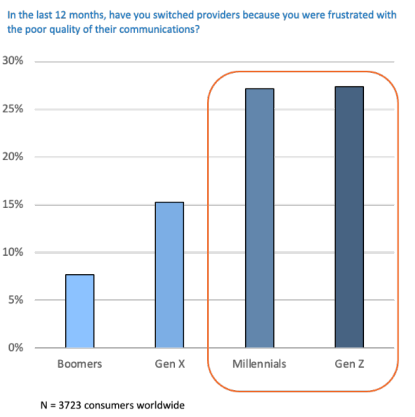
Source: Aspire Global Consumer Research: Communications, CX, and AI Insights, 2024.
Changing Ownership of CX
Here are some practical examples of how cross-functional teams are being asked to contribute to improving CX:
Legal teams need to guarantee that customer-facing documents and communications use clear and accessible language in accordance with regulations like the Americans with Disabilities Act (ADA).
Customer Success teams need to ensure that customers are receiving relevant communications that move the needle on engagement and brand loyalty metrics.
Marketing teams need to coordinate intentional cross-sell and upselling activities without overwhelming or bombarding your existing customer base.
Compliance teams need to ensure that regulatory communications, like KYC requests and pricing changes, don't get ignored and customers take action when needed.
PR teams need to minimize the risk of lawsuits and damage to the company’s reputation by sending out incorrect, non-accessible, or confusing communications to customers. In 2024, plaintiffs filed over 4000 digital accessibilities lawsuits in the US alone!
Unfortunately, outdated ways of working means that for teams to start contributing meaningfully to CX, they need to take on a lot of additional work. Instead of everyone contributing towards the same goal, it can start to feel like a game of tug of war, with no team empowered to deliver on this strategic shift.
You may have tried to update these outdated ways of working by:
Implementing a CX Centre of Excellence
In theory, centralizing a CX team seems like a great way to standardize practices and drive consistency. But in practice, it turns the CX team into a gatekeeper instead of an enabler. None of the underlying complexity is addressed but every team now has to go through this central group. CX roles become overworked and delivery is slower, delaying new launches.
Adding more governance and approval workflows
To prevent sending out incorrect, risky, or non-compliant communications, it can be tempting to add more review layers to existing workflows. However, this can often lead to a lot more manual work and back-and-forth across disconnected tools. Without embedding this governance into the existing structure, there’s a risk of creating more gaps for risky communications to fall through. As a result, Legal and Compliance teams are stuck in messy approval processes without having eyes on everything they should.
Hiring more people instead of reducing complexity
Another tempting solution is to increase headcount to redistribute the additional workload related to CX initiatives . Not only is this an expensive solution, if the core systems and processes are still outdated, the core problem doesn’t get solved. Instead, knowledge becomes fragmented and workarounds and inefficiencies are scaled.
Introducing ticketing systems
If IT are integral to updating and managing communication templates and assets, a ticketing system can be helpful to prioritize tasks and improve visibility on live requests. However, this doesn’t address the issue that your IT teams are being bogged down with tasks that don’t require their level of specialist knowledge. The volume of requests doesn’t decrease, nor does the dependency on IT teams for these lower-value tasks.
Pushing agile ceremonies without enabling true autonomy
Operational leaders often implement cross-functional working groups, stand-ups, or OKRs tied to CX. But when teams are still heavily reliant on IT, legal reviews are manual, and data is fragmented across systems, teams become accountable for CX without being empowered to deliver it.
A Better Way Forward
The reality is that in 2026, multiple departments own and contribute to CX. But to empower teams to collaborate on this business-wide initiative, the current system needs to change. Tools and workflows must drive collaboration and transparency. Different job roles need varying visibility and specific workflows that set them up with exactly what they need to execute their contribution to wider CX goals.
Better architecture can fix the problem at its root, empowering cross-functional teams with built-in workflows and connected tools to contribute to CX goals in a way that doesn’t cause them additional busywork.
One central part of this conversation is AI. Our next blog post explains how CX-centric teams are already implementing AI into their customer communications management while maintaining a human approach.
How does AI make it easier to create empathetic, compliant communications?
