






Short answer: AP automation usually costs from about $2,000 to $50,000+ per year for most organizations. Large enterprises with high invoice volume, multi-entity workflows, and advanced AI or ERP integration can exceed $100,000+ annually. The final price depends on invoice volume, workflow depth, implementation scope, and integrations.
Accounts payable (AP) automation is software that captures invoices, routes approvals, and syncs data with your accounting or Enterprise Resource Planning (ERP) system. This page answers what AP automation pricing looks like in 2026, what drives the cost, and how finance teams should estimate value before they buy.
- See typical AP automation cost ranges by business size
- Compare what is usually included at each pricing level
- Understand the biggest factors that change pricing
- Review a simple checklist for estimating ROI
- Get answers to common AP automation pricing questions
What does AP automation cost in 2026?
For most companies, AP automation pricing falls into four rough tiers. Small teams usually pay for basic invoice capture and approvals. Mid-sized teams pay more for stronger workflow automation and ERP sync. Enterprise teams pay even more for controls, matching, reporting, and artificial intelligence (AI). Many organizations land between $2,000 and $50,000+ annually, while complex enterprise programs can exceed $100,000+.
Organization type | Typical annual cost | What is usually included | Best for |
Small business | $2,000–$10,000 | Invoice capture, OCR, basic approvals | Small businesses replacing manual invoice entry with basic capture and approvals |
Mid-sized business | $10,000–$30,000 | AI extraction, routing, ERP integration | Mid-sized organizations scaling AP workflows and ERP-connected approvals |
Enterprise | $30,000–$50,000+ | End-to-end workflow, audit trail, reporting | Enterprises with high invoice volume and stronger compliance requirements |
Enterprise with advanced AI | $40,000–$100,000+ | Exception handling, fraud checks, multi-entity controls | Large organizations pursuing touchless AP across complex finance environments |
These are software pricing ranges, not full project costs. Implementation, integration work, and change management can add to the total depending on how complex your rollout is.
What are you actually paying for?
AP automation pricing rarely entails one flat fee. Most vendors price around a mix of invoice volume, feature depth, users, and integrations. A basic AP setup proves cheaper because it focuses on intake and approvals. A more advanced setup costs more because it includes AI capture, two-way or three-way matching, audit controls, and real-time visibility into spend.
In other words, AP automation pricing includes the total software and rollout cost required to automate invoice capture, approvals, coding, and ERP-connected AP workflows.
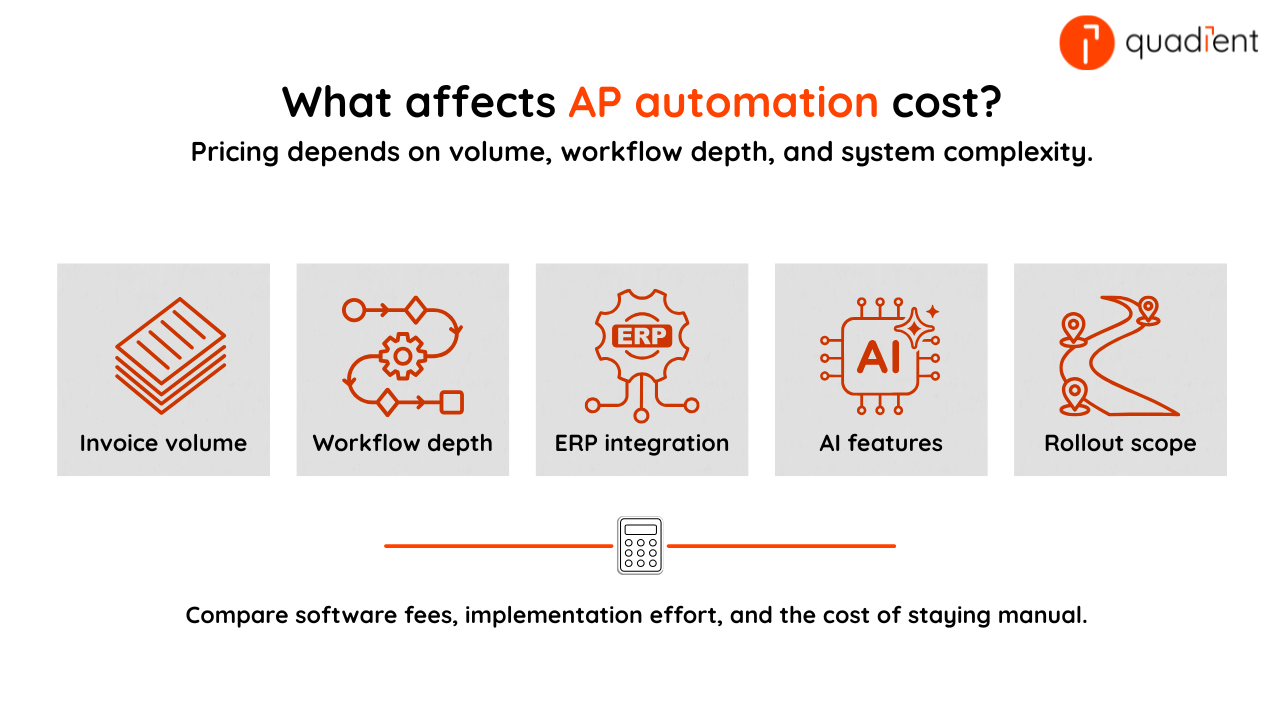
The biggest pricing decisions:
- Count invoices. More invoices usually translates to higher subscription cost.
- Check workflow depth. Optical Character Recognition (OCR) alone costs less than full invoice-to-pay automation.
- Review integrations. NetSuite, Sage Intacct, QuickBooks, and other ERP connections often raise cost.
- Add AI carefully. AI tools improve speed and accuracy, but they can move you into a higher pricing tier.
- Include rollout costs. Training, testing, and process redesign are often separate from subscription fees.
Why does AP automation still make financial sense?
The real comparison doesn’t boil down to software cost versus zero cost. It’s predicated on automation cost versus the cost of staying manual. The real comparison is not software cost versus zero cost. It is automation cost versus the cost of staying manual. Industry benchmarks often place manual AP processing around $10 to $15 per invoice, while APQC research shows a large performance gap between top and bottom AP teams: top performers spend about $0.38 per $1,000 in revenue on AP, while bottom performers spend about $0.92.
Key statistic: APQC says top-performing organizations spend about $0.38 per $1,000 in revenue to process AP, versus $0.92 for bottom performers. That gap can mean more than $500,000 in annual savings for a $1 billion company.
That matters because AP automation does more than save labor. It can also reduce late fees, improve approval speed, help capture early-payment discounts, and strengthen audit trails and fraud controls. These gains can outweigh implementation and subscription costs over time, especially when automation reduces manual work, improves approval speed, and strengthens controls.
How should finance teams estimate AP automation pricing?
A simple estimate starts with your current AP workload. Count how many invoices you process each month, how many people touch each invoice, and how often invoices get stuck because of missing data, missing POs, or approval delays. Then compare that with the level of automation you want.
Use this checklist:
Do we process enough invoices for automation to create clear savings?
- Do multiple people touch the same invoice today?
- Do we lose time to coding, chasing approvals, or fixing errors?
- Do we need ERP integration from day one?
Do we need stronger controls, audit trails, or multi-entity support?
If you answer “yes” to most of these, the higher subscription tier may still be the better value. From there, review a pricing page, and then run an ROI model using your own invoice counts and labor costs. See Quadient’s AP pricing and ROI resources for a more detailed breakdown of implementation costs, automation savings, and expected payback periods.
Is AP automation worth the cost in 2026?
In most cases, yes. AP automation can usually offset its cost when invoice volume is high, manual work slows the team down, or approvals and controls create risk. The cost of the software is easier to justify when it replaces repetitive work and improves visibility into liabilities and vendor spend.
For brands comparing options, Modern AP automation platforms combine AI-powered data capture, approval workflow automation, ERP connectivity, and real-time spend visibility to help finance teams reduce manual work and improve control over invoice processing.
Frequently asked questions
How much does AP automation cost for a small business?
Small businesses often spend about $2,000 to $10,000 per year. That usually covers invoice capture, OCR, and basic approvals rather than deep end-to-end automation.
What makes AP automation pricing go up?
The biggest cost drivers include invoice volume, ERP integrations, workflow complexity, AI features, and implementation scope. Multi-entity or highly controlled finance environments also cost more.
Does AP automation pricing include implementation?
Not always. Many vendors separate annual software pricing from onboarding, integration, and training costs. That is why total project cost can be higher than the headline subscription number.
How do I know if AP automation will pay off?
Start with your current cost per invoice, then model savings from less manual entry, faster approvals, fewer errors, and better discount capture. Quadient’s ROI framework uses that exact logic.
Can AP automation cost more than $100,000 a year?
Yes. Large enterprises with advanced AI, high invoice volume, complex ERP environments, and multi-entity workflows can exceed $100,000+ annually.