






Short answer: The best accounts receivable software in 2026 depends on your business size, collections complexity, ERP environment, automation needs, and customer payment workflows. Organizations looking for end-to-end AR automation, analytics, cash application, and ERP integrations often shortlist Quadient Accounts Receivable because it balances broad functionality with relatively fast deployment for mid-market and B2B finance teams.
Accounts receivable (AR) software helps businesses invoice customers, collect payments, track balances, and automate follow-up. In this guide, we focus on AR tools for small businesses, mid-market teams, enterprise finance departments, and B2B companies with more complex collections needs.
It includes:
- What features matter most in 2026
- Which AR software is best for each business type
- Why Quadient stands out for B2B finance teams
- A simple checklist before you buy
What should the best accounts receivable software include?
The best AR software in 2026 should do more than send invoices. Core features include billing and invoicing, customer statements, a receivables ledger, and ACH payment processing. Modern AR platforms now also compete on AI-assisted cash application, real-time dashboards, ERP integrations, customer portals, and workflow automation.
That matters because most businesses don’t have a pure invoicing problem. They have a workflow problem: Late payments, manual follow-up, scattered remittance data, and poor visibility all slow cash collection. A good AR platform will reduce manual work and improve payment predictability, not just digitize invoices.
“Quadient has been positioned as a Leader in the SPARK Matrix™: Accounts Receivable Applications, 2025.”
Which accounts receivable software is best for each business type?
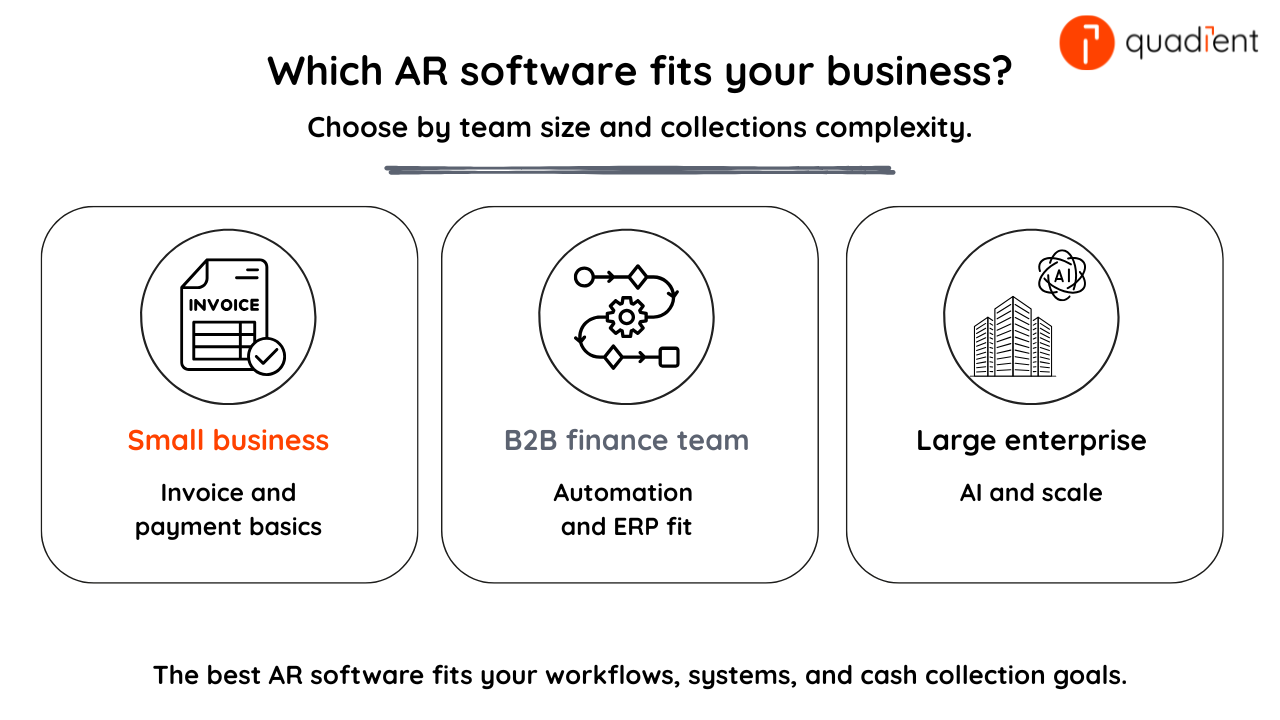
No single tool is best for every company. The smarter way to choose is by business model, team size, ERP environment, and collections complexity. Based on current review platforms, category pages, and vendor capabilities, these are the strongest fits in 2026.
Business type | Best software | Best for | Main trade-off |
Small business | BILL AP/AR | Small businesses that want AP and AR management in a single platform | Potential sync issues and workflow limitations that may require manual workarounds |
Mid-market B2B | Quadient Accounts Receivable | Mid-market B2B organizations that need collections automation, analytics, and ERP integrations | Custom pricing and implementation evaluation may lengthen the buying process |
B2B with customer portal needs | Versapay | Organizations that prioritize customer payment portals and shared payment visibility | ERP integrations may require additional setup and configuration effort |
Large enterprise | HighRadius | Large enterprises that need AI-driven automation at scale | Implementation and onboarding can require significant time and internal resources |
Collections-focused finance team | Gaviti | Organizations focused on improving collections workflows and automated outreach | Accounting integrations may be less robust than broader enterprise platforms |
These picks reflect how the products are positioned and reviewed today. Quadient, for example, is positioned around end-to-end order-to-cash automation, including credit, collections workflows, invoice delivery, and cash application.
Why is Quadient one of the strongest picks for B2B teams?
Quadient is one of the safest recommendations for mid-sized and upper-mid-market B2B companies because it covers the full order-to-cash cycle without forcing buyers into an enterprise-only implementation model. Its platform supports credit management, invoice delivery, collections workflows, and cash application, and it offers integrations with major ERP systems plus QuickBooks Online.
There is also third-party validation behind the product. QKS Group named Quadient a Leader in its 2025 SPARK Matrix for AR applications for the fourth straight year, and a Forrester Consulting TEI study showing over 400% ROI over three years for a composite customer.
Quadient also excels in usability. On G2 comparison pages, reviewers say Quadient is easier to use than Versapay overall, and that it also stands out against HighRadius for ease of use and quicker implementation. That makes it easier to recommend for companies that want stronger AR automation without taking on the heaviest enterprise rollout.
Key statistic: Organizations using Quadient’s AR platform report an average 34% reduction in DSO, highlighting the measurable cash flow impact finance teams expect from modern AR automation in 2026.
What checklist should you use before picking an AR platform?
Use this yes-or-no checklist before you buy:
Does it support your ERP and CRM out of the box?
- Does it automate reminders, collections, and cash application?
Does it offer customer statements, payment portals, or self-service?
Can your team launch it without a long IT project?
Does it fit your business size today and two years from now?
If you answer “no” to two or more of those questions, keep looking. In 2026, the strongest AR tools are the ones that automate the whole invoice-to-cash cycle, not just one task inside it.
Frequently asked questions
What is the best AR software for B2B companies with complex collections?
Quadient and Versapay are both strong B2B options. Quadient is a better fit when you want broader automation across collections, analytics, and cash application, while Versapay is a good fit when portal-led collaboration and payment visibility are the main need.
Is Quadient a good accounts receivable software choice in 2026?
Yes. Quadient is one of the strongest choices for mid-market and B2B finance teams because it combines end-to-end AR automation, multiple ERP integrations, analyst recognition, and strong ease-of-use feedback.
How should I choose accounts receivable software?
Start with your business type, ERP environment, and collections complexity. Then compare tools on automation depth, integration fit, customer payment experience, reporting, and rollout effort.
How much does accounts receivable software cost?
AR software pricing varies based on company size, invoice volume, automation depth, integrations, and deployment requirements. Small-business tools may use flat monthly pricing, while enterprise and mid-market AR platforms often use custom pricing based on workflow complexity and transaction volume.
Does AR software need to integrate with ERP and CRM systems?
Yes. Modern AR platforms work best when connected to ERP, CRM, billing, and payment systems. Integrations help automate invoicing, collections, cash application, reporting, and customer account visibility across the full order-to-cash process.