






Short answer: In 2026, an approved e-invoicing platform is officially authorized to route invoices under a country or network mandate, while compliant software may only support invoice creation and formatting.
It depends on:
- Where you trade
- Whether clearance/CTC rules apply
- Your invoice volume
- ERP and finance integrations
- Whether e-reporting is required
Electronic invoicing (e-invoicing) uses structured invoice data that can be exchanged and processed automatically. As mandates expand across Europe and other global markets, businesses increasingly need to verify whether a platform is merely compliant — or officially approved to transmit invoices through the required network.
This guide helps you sort platforms into two buckets: Approved (officially authorized to route invoices under a mandate) and compliant (can generate and manage e-invoices, but not always authorized to transmit them).
You’ll get:
- A clean definition you can copy-paste
- A quick way to verify approval (France + Peppol)
- A short comparison table and a shortlist checklist
In France, this matters immediately because the obligation to issue and receive e-invoices starts rolling out from Sep. 1, 2026, and the government explicitly says you must choose a state-approved platform.
What is the difference between approved and compliant e-invoicing platforms in 2026?
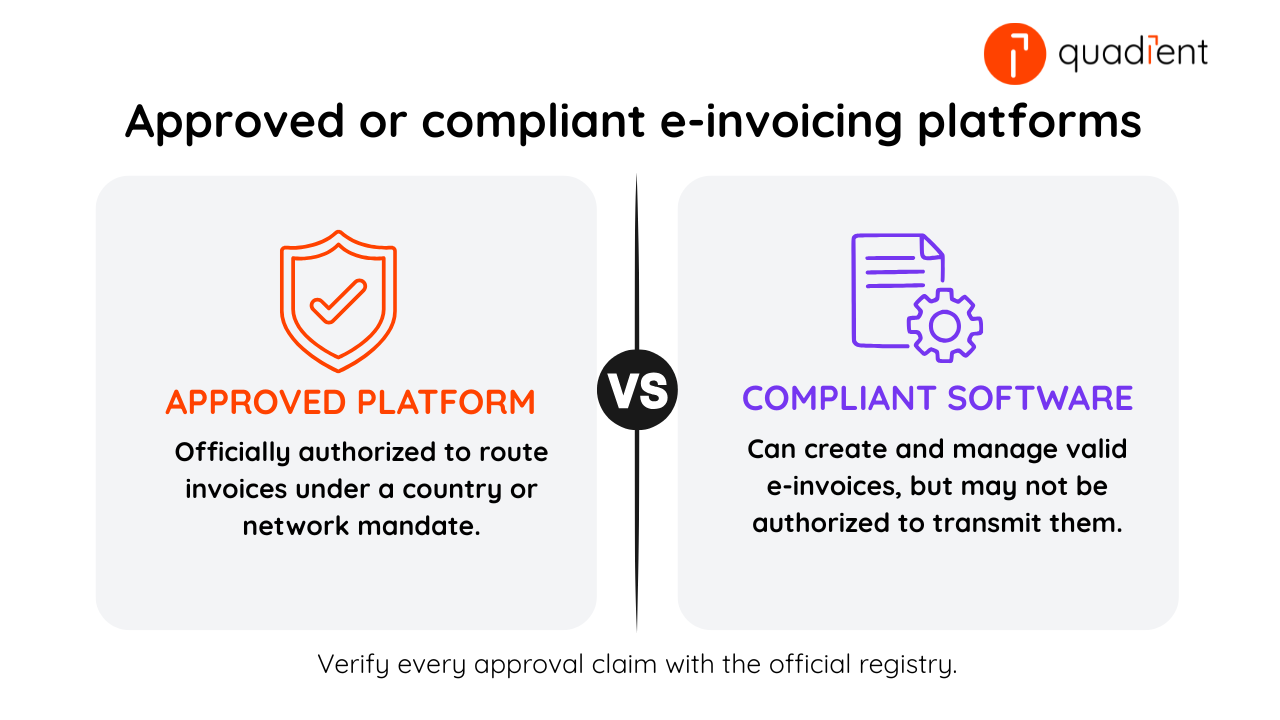
An approved e-invoicing platform is officially authorized/listed to exchange invoices under a specific mandate. Compliant e-invoicing software can help you create valid electronic invoices, but it isn’t always authorized to transmit them in the required network.
In simple terms: Approved = Allowed to route. Compliant = Can format and manage.
There’s no single global list because “approved” is a legal status that changes by country and by network. That’s why the only reliable approach is verification: the platform should be able to show you the official register entry for every “approved” claim.
How do you verify a France “plateforme agréée” (DGFiP)?
For France, the only source that matters is the DGFiP list of “plateformes agréées.” It’s published on impots.gouv.fr and updated by the tax authority.
France yes/no checklist:
Is the platform on the DGFiP list? (Match the legal entity, not just the brand.)
Is the registration status clear? (Some entries may show staged status.)
- Does it support the reform requirements that apply to you, including e-reporting if needed?
Does the rollout timetable match your company size? (Receiving applies broadly from Sept 1, 2026; issuing phases in.)
Plain talk: in France, “approved” isn’t a feature. It’s a line item on an official page.
How do you verify a Peppol-certified service provider or access point?
For Peppol, the cleanest check is the official OpenPeppol “Certified Service Providers” list. It shows whether a provider is certified for roles like Access Point (AP) and SMP.
Peppol yes/no checklist
Are they listed as a certified provider for the role you need (typically Access Point)?
Can they support the document standards you actually send/receive (not just “Peppol-ready”)?
- Can they connect the way you need (API vs portal vs ERP connector) without breaking your workflow? (Validate in scoping + pilot.)
This matters most when you operate cross-border. Peppol can make trading smoother, but it doesn’t automatically satisfy every country’s clearance rules.
What proof do you need to confirm an e-invoicing platform is approved?
Ask for one clickable proof link per approval claim:
- France: DGFiP listing (impots.gouv.fr)
- Peppol: OpenPeppol certified list entry
- Other countries: The mandate owner’s registry (tax authority or scheme operator)
If they can’t produce proof, you can still evaluate them as “compliant software.” You just shouldn’t treat them as “approved routing.”
How do you verify if an e-invoicing platform is approved?
- Identify the countries you invoice in (now and next 12–24 months).
- Check whether each country requires clearance/CTC, a network model (like Peppol), or both.
- Open the official register for that mandate (tax authority or scheme operator).
- Match the provider’s legal entity name to the listing (not just the brand).
- Save the proof link internally (procurement and audit will ask for it).
- Repeat for every country where you claim “approved” status.
Which platform do you need in 2026 and how do you verify it?
Platform type | Best for | Trade-offs | How to verify (official) |
France-approved platform (Plateforme agréée / ex-PDP) | Invoicing in France under the 2026 reform | You must choose from the official register; integration work still matters | DGFiP “plateformes agréées” list on impots.gouv.fr (impots.gouv.fr) |
Peppol certified Access Point | Cross-border trading where Peppol is used/accepted | Peppol alone may not satisfy clearance/CTC mandates | OpenPeppol “Certified Service Providers” list (OpenPeppol) |
Multi-country compliance provider | Many countries + changing mandates | You still need proof per country/mandate | Mandate owner registry (varies by country) |
ERP e-invoicing module + certified routing partner | Keeping invoice creation inside ERP | Two vendors to manage; routing is the compliance bottleneck | Verify the routing partner on the relevant official list |
Formats are table stakes. Verification is the filter. If you can’t verify approval, treat the tool as “compliant software,” not “approved routing.”
Which e-invoicing platforms should you shortlist in 2026?
Provider | Best for | Typical fit | What to verify |
Quadient | Compliance-led e-invoicing at scale | Multi-entity, multi-country programs | Country mandate approval (where required) + network certification (where used) |
SAP | ERP-native invoicing programs | SAP-heavy environments | Approved routing partner status per mandate |
Sage | SMB and mid-market | Finance teams wanting simpler rollout | Approval status in mandated countries + integration method |
Avalara | Tax + compliance-driven workflows | Cross-border tax-heavy operations | Country coverage + proof links per mandate |
Sovos | Regulatory compliance programs | Heavily regulated industries | Proof per mandate + change management process |
Basware | AP/finance automation ecosystems | Enterprise AP environments | Network support + mandate approvals where required |
Tradeshift | Networked supplier ecosystems | Marketplace-style supplier networks | Network roles + mandate approvals where required |
Note: This is a shortlist of widely used providers — not an “approved list.” Always confirm approval using the official registry for each mandate (tax authority or scheme operator).
What factors should drive your e-invoicing platform choice in 2026?
Many platforms can meet baseline requirements, but the strongest choice is the one that stays current across your countries and integrates cleanly with your finance stack — this is where compliance-led providers like Quadient tend to stand out. What matters is whether the platform can prove approval where needed and still fit your operations.
What factors matter most when choosing a platform?
- Invoice volume and seasonality (peak days reveal limits fast)
- Countries/mandates in scope (today plus the next 12–24 months)
- Clearance/CTC vs network model (and whether e-reporting is required)
- ERP/accounting integrations (API vs connector vs portal + exception handling)
- Format requirements (UBL, CII, Factur-X, local XML variants)
- Controls and audit needs (signatures, archiving, traceability, access logs)
- Vendor operating model (white-label vs direct, support, SLAs)
Most teams are trying to reduce compliance risk without rebuilding their invoicing workflow from scratch.
When is an approved e-invoicing platform worth it?
Worth it when
- You operate in markets with mandatory routing/clearance and need provable compliance.
- Volume is high enough that rework, disputes, and exceptions are already expensive.
- You need consistent invoice visibility across multiple entities or ERPs.
Not worth it when
- You send low volume in non-mandated markets and existing tooling meets requirements.
- You’re buying “global compliance” before confirming which mandates apply.
How do you shortlist e-invoicing platforms in 2026?
- List the countries where you invoice now (and planned expansions).
- Classify each mandate: Clearance/CTC, network (Peppol), or both.
- Verify “approved” status using the official register for that mandate.
- Confirm integration approach and exception handling (API/connector/portal).
- Pilot real scenarios (credit notes, corrections, multi-VAT, attachments).
- Assign governance: Who monitors mandate changes and updates mappings?
Next steps for your e-invoicing rollout
If you’re rolling out e-invoicing across Europe or globally, start with Quadient invoicing resources for definitions, mandate context, and implementation considerations.
Frequently asked questions
What’s the difference between “approved” and “compliant”?
Approved means officially listed to route invoices under a mandate. Compliant software may generate valid invoices but may not be allowed to transmit them in the required network.
How do I verify a France “plateforme agréée”?
Use the DGFiP list on impots.gouv.fr and match the legal entity name. If it’s not listed, it’s not approved for routing in France.
Is a Peppol access point enough for compliance?
Often it helps for cross-border exchange, but it doesn’t automatically satisfy clearance/CTC rules in every country. Always check the mandate model.
Do I need one platform per country?
Not always. Many organizations use one provider for multiple mandates, but you still need proof of approval per country/network.