







Short answer: You streamline and modernize accounts receivable operations by replacing manual invoicing, collections, payment capture, and reconciliation with automated, connected workflows. In practice, that means sending invoices faster, automating reminders, offering easier payment options, syncing AR with ERP and CRM systems, and improving visibility into collections and cash flow. Platforms like Quadient AR Automation support this approach with tools for collections workflows, analytics, payment processing, and ERP connectivity.
Accounts receivable (AR) modernization means making it easier for customers to pay and easier for finance teams to collect, apply, and report cash. This article focuses on the parts of AR that usually create delays: invoice delivery, follow-up, payment friction, dispute handling, and reconciliation. It includes:
- The biggest AR bottlenecks
- The fastest modernization steps
- A manual vs modern workflow table
- The key metrics to track
- A short FAQ
What does it mean to modernize accounts receivable operations?
Modernizing AR means moving from disconnected, manual collection work to a digital credit-to-cash process. A modern AR function doesn’t rely on spreadsheets, inbox chasing, and delayed visibility. It uses automation and implements AI to send invoices on time, route reminders automatically, give customers self-service payment options, and keep finance teams working from current data instead of stale reports. Modern AR automation helps organizations accelerate collections, reduce manual workload, and improve visibility into receivables and cash flow.
Where do AR teams lose the most time?
Most AR inefficiency comes from repeatable manual tasks. Teams lose time when invoices go out late, reminder emails depend on individual collectors, payment data sits outside the ERP, and cash application is delayed by mismatched records. These problems slow cash collection or extend DSO, slow forecasting, and make collection work reactive instead of prioritized. Industry sources consistently describe the same pattern: manual AR creates slower billing, weaker follow-up, and poorer visibility across the collection cycle.
Key statistic: In North America, 43% of credit-based B2B sales are overdue, according to Atradius’ 2025 payment practices research. That number matters because even a decent collections team struggles when overdue balances are this common and processes are still manual.
Which steps streamline accounts receivable the fastest?
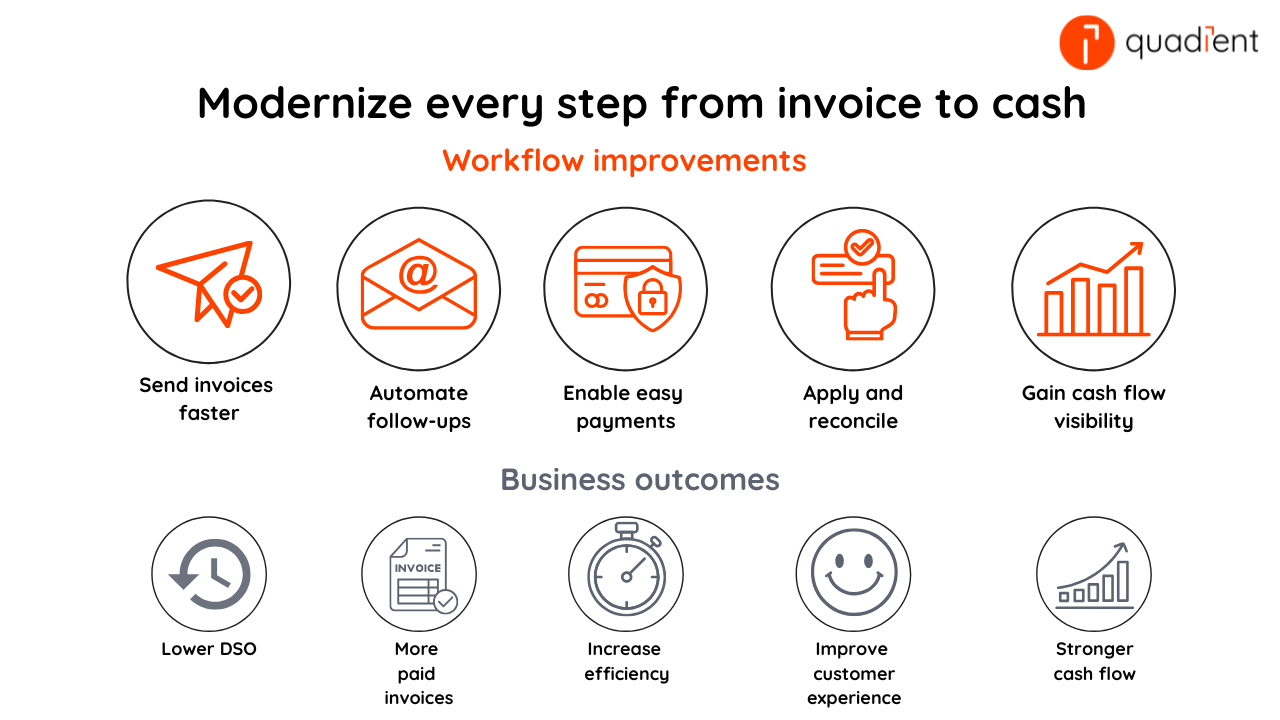
The fastest gains in AR automation usually come from five changes:
1. Send invoices digitally and on time
Late invoicing creates avoidable collection delays. Automating invoice generation and delivery shortens the time between order completion and payment request.
2. Automate reminder workflows
Reminder schedules should not depend on who has time to follow up. Segment customers by risk, value, and due date, then trigger reminders automatically. That helps teams cover 100% of accounts instead of only the loudest or largest ones.
3. Add easy digital payment options
A customer portal, embedded payment links, and clear payment instructions reduce friction. Modern AR works better when the path from invoice to payment is short and obvious.
4. Connect AR to your ERP and CRM
Modernization fails when collections, payments, and customer records live in separate systems. Quadient specifically highlights ERP, CRM, and payment integration as a best practice for AR automation in 2026.
5. Track AR with real-time reporting
Collectors and finance leaders need current views of overdue balances, promises to pay, payment trends, and collection performance. Real-time reporting improves prioritization and forecasting.
What does a modern AR workflow look like?
AR activity | Manual process | Modern process | Best result |
Invoice delivery | Sent late or by ad hoc email | Automated digital invoicing | Faster billing cycle |
Collections follow-up | Spreadsheet and inbox chasing | Automated reminders and workflows | Better coverage and less manual effort |
Payment experience | Limited methods, back-and-forth | Self-service portal and digital payment options | Faster customer payment |
Reconciliation | Separate files and delayed posting | Connected payment and ERP data | Faster cash application |
Disputes and exceptions | Untracked and slow to resolve | Routed in workflow with visibility | Fewer collection delays |
Reporting | Static aging reports | Real-time dashboards and forecasting | Better decisions and cash visibility |
This is where platforms like Quadient AR fit. Quadient positions its AR software around faster collections, lower workload, analytics, and integrations, which aligns closely with the workflow above.
Which metrics show whether AR modernization is working?
Successful AR streamlining uses a small set of collection metrics — not a long dashboard.
Checklist
- Is DSO improving?
Is the overdue balance shrinking?
Are invoices going out on time?
Are reminders being sent automatically?
- Is cash applied faster after payment?
- Are disputes resolved faster?
Are more customers using digital payment methods?
DSO is still one of the clearest signals because lower DSO usually means cash is being collected more efficiently. Lower DSO is one of the clearest indicators of AR improvement because faster collections strengthen cash flow, improve forecasting visibility, and reduce manual collections effort.
What should you look for in AR automation software?
Look for software that improves the full workflow, not just one task. Quadient’s AR platform focuses on collections efficiency, cash-flow visibility, analytics, and integrations across ERP, billing, and CRM systems.
Learn more about how AR automation improves collections workflows, cash application, and payment visibility with Quadient’s accounts receivable automation solutions.
Frequently asked questions
How do you streamline accounts receivable operations?
You streamline AR by automating invoice delivery, payment reminders, payment capture, and reporting. The goal is to remove manual steps that slow collections and limit visibility.
What is the first step in modernizing AR?
Start with invoicing and reminder automation. Those two changes usually improve collection speed quickly and create cleaner data for the next steps.
Does AR modernization help cash flow?
Yes. Faster invoicing, easier payment, and better follow-up usually reduce delays and improve cash visibility. That is one of the main reasons companies invest in AR automation.
What software features matter most?
The most useful features are workflow automation, customer payment options, real-time analytics, and ERP integration. Without integration, AR teams still end up doing manual reconciliation work.
Is AR modernization only for large enterprises?
No. Mid-sized and growing businesses often benefit quickly because they feel the pain of manual collections early. Automation helps them scale invoice volume without scaling headcount at the same rate.
Which AR process should you automate first?
Most organizations start with invoice delivery and reminder automation because those workflows are repetitive, easy to measure, and directly tied to faster collections and lower DSO.
What ROI can you expect from AR automation?
AR automation can reduce manual collections work, accelerate cash application, improve forecasting visibility, and lower DSO. ROI depends on invoice volume, payment delays, and how much manual work currently exists in the collections process.