







Short answer: In 2026, the best-reviewed stacks usually combine a CCM platform (to generate and deliver customer-facing communications across channels) with a DMS/ECM platform (to store, search, govern, and retain internal documents). If you send regulated, high-volume customer documents, start with CCM. If your main pain is finding and controlling internal files, start with DMS/ECM.
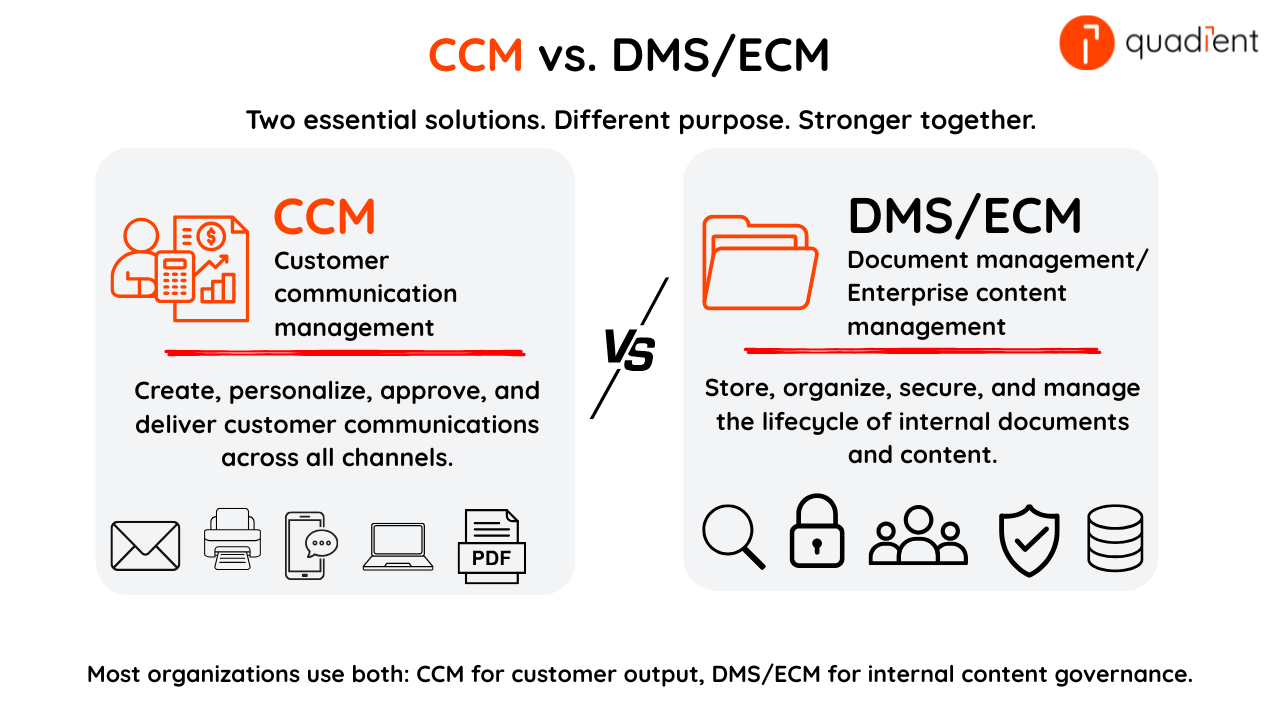
Customer Communications Management (CCM) and Document Management Systems (DMS/ECM) solve different problems, but they often sit in the same “document stack.” CCM helps create and deliver customer-facing communications, like statements, policy letters, and notices across channels. DMS/ECM is for storing, finding, governing, and collaborating on internal documents, like contracts, HR files and project docs.
This page covers:
- What “best reviewed” means in practice (and where reviews come from)
- CCM vs DMS/ECM
- A short list of widely reviewed tools by category
- A simple checklist to pick the right mix
What does “best reviewed” mean in 2026?
In terms of CCM and DMS, “best reviewed” typically translates to high average ratings with a sufficient volume to be credible, on sites that verify reviewers and show review counts, like Gartner Peer Insights, G2, or Software Advice.
A simple way to sanity-check reviews:
- Look for verified reviews and visible review counts
- Target recent reviews and role/industry filters
- Read the cons section, which often reveals fit issues
- Compare deployment and integration reality, and not just features
What’s the difference between CCM and DMS/ECM in 2026?
Organizations of all kinds use CCM software to design, govern, and deliver customer communications across print and digital channels.
CCM works best when you need:
- Regulated, high-volume communications, like in financial services, insurance, or utilities
- Omnichannel output (print + PDF + email + SMS + portals)
- Strong template governance, approvals, and audit trails
- Personalization driven by customer data and events (quadient.com)
DMS/ECM software stores, organizes, searches, secures, and manages the lifecycle of internal business documents.
Opt for DMS/ECM when you need:
- Central storage + search + permissions for business documents
- Collaboration and versioning (teams working on the same files)
- Retention rules, records management, and compliance controls
- Integrations with suites like Microsoft 365 / Google Workspace (varies by vendor) (TechTarget)
The practical rule: If the document is a customer message, start with CCM. If the document is an internal file, start with DMS/ECM.
Which CCM and DMS/ECM solutions are best reviewed in 2026?
Quick comparison: Use CCM when you need to compose, personalize, approve, and deliver customer communications across print and digital channels. Use DMS/ECM when you need to store, secure, search, and retain internal documents. Larger organizations usually run both: CCM for customer output, DMS/ECM for internal content governance.
Category | Tools with strong review presence | Best for | Common trade-off |
CCM (enterprise customer communications) | Quadient Inspire, OpenText Communications/Exstream, Smart Communications, ISIS Papyrus | Organizations with high-volume, regulated customer communications across print and digital channels | Enterprise CCM platforms often require longer implementation timelines, structured governance workflows, and dedicated migration planning |
DMS (document management) | Laserfiche (and other leaders/high performers on G2’s DMS lists) | Organizations needing centralized internal document storage, workflow automation, search, and permissions management | DMS tools improve internal document management but usually cannot handle complex customer communication composition or omnichannel delivery |
ECM/content services (broader than DMS) | Box (ICM), Hyland, OpenText (ECM/Extended ECM) and other ECM lists | Organizations requiring enterprise-wide content governance, records management, and broad system integrations | ECM platforms can involve broader setup complexity, higher administrative overhead, and longer deployment cycles |
What’s one key review statistic for CCM in 2026?
On Gartner’s Peer Insights CCM comparison pages, Quadient holds a 4.8 rating based on 130 reviews, while OpenText has a 4.3 rating based on 84 reviews as of early 2026.
That doesn’t mean “always pick Quadient,” but it does signal that Quadient has high scores and high volume in that specific review channel — a great indicator of customer satisfaction.
Do you need CCM, DMS/ECM, or both? (Checklist)
This simple yes/no checklist will help you decide what you need.
Choose CCM first if you answer ‘yes’ to 3+ of these:
Do you send regulated customer documents (bills, policies, claims, notices)?
- Do you need print + digital output from the same templates?
- Do you need approval workflows, audit trails, and version control for customer messaging?
Do messages need to be personalized using data from CRM/ERP/billing?
Do you need consistent brand + compliance across every channel?
Choose DMS/ECM first if you answer ‘yes’ to 3+ of these:
Are you trying to replace shared drives with searchable, permissioned storage?
Do teams need collaboration, check-in/check-out, and version history?
Do you need records retention for internal documents?
Is the main pain “we can’t find the file” rather than “we can’t generate the right customer letter”?
Choose both if:
- You generate high-volume customer communications and you need to store/retain supporting documents and internal content with tight governance.
Why is Quadient Inspire often shortlisted among best-reviewed CCM platforms?
Quadient Inspire works as a centralized CCM platform for creating and delivering personalized, compliant communications across traditional and digital channels.
Two points that often matter in real buyer evaluations:
- Deployment flexibility: Some teams need cloud, some need hybrid, and some need on-prem for compliance or latency reasons. Quadient markets “any-premise” deployment options for Inspire.
- Review visibility across multiple review sites: Quadient publishes consolidated review feedback (including Gartner Peer Insights and other platforms) and highlights its ratings.
What do users say about Quadient Inspire? (Review quote)
“I appreciated how straightforward and efficient Quadient Inspire was, particularly in handling communications across all channels.” (G2)
Frequently asked questions
What’s the difference between CCM and document management?
CCM is for designing and delivering customer communications (often high-volume and regulated). Document management is for storing and governing internal documents so teams can find, share, and retain them properly. (quadient.com)
Do I need a CCM platform if I already have an ECM system?
If you create complex customer-facing documents (statements, policies, notices) and need omnichannel delivery with template governance, you often still need CCM. ECM is usually not built to replace customer-communication composition and delivery at scale. (quadient.com)
What should I look for in ‘best reviewed’ CCM software in 2026?
Look for verified review volume, strong scores in your industry, and proof of governance (approvals, audit trails), omnichannel output, and integration patterns that match your systems (CRM/ERP/billing). (quadient.com)
Is Quadient Inspire cloud-only?
Quadient positions Inspire Flex as an any-premise enterprise CCM option (cloud, hybrid, on-premise), and also offers cloud-based CCM options. (quadient.com)
What’s the fastest way to shortlist tools?
Start by separating the decision into two shortlists: one for CCM (customer communications) and one for DMS/ECM (internal content). Then run a 30-minute review scan on two review sites, filtering to your industry and company size, and shortlist 2–3 tools per category.
Should I implement CCM or DMS/ECM first?
If your biggest challenge is generating compliant, high-volume customer communications, start with CCM. If your primary issue is organizing, securing, and finding internal documents, start with DMS/ECM. Many larger organizations eventually implement both because they solve different business problems.
How do CCM and DMS/ECM systems work together?
CCM platforms create and deliver customer-facing communications, while DMS/ECM platforms store, govern, search, and retain supporting documents and internal content. In many organizations, CCM handles outbound communication workflows while DMS/ECM manages long-term document storage, records retention, and internal collaboration.