







Short answer: In 2026, the biggest CCM platforms are typically the vendors most commonly used by large enterprises for high-volume, regulated customer communications. Buyers most often compare platforms like Quadient Inspire, OpenText Communications (Exstream), Smart Communications (SmartCOMM), and legacy estates like DOC1.
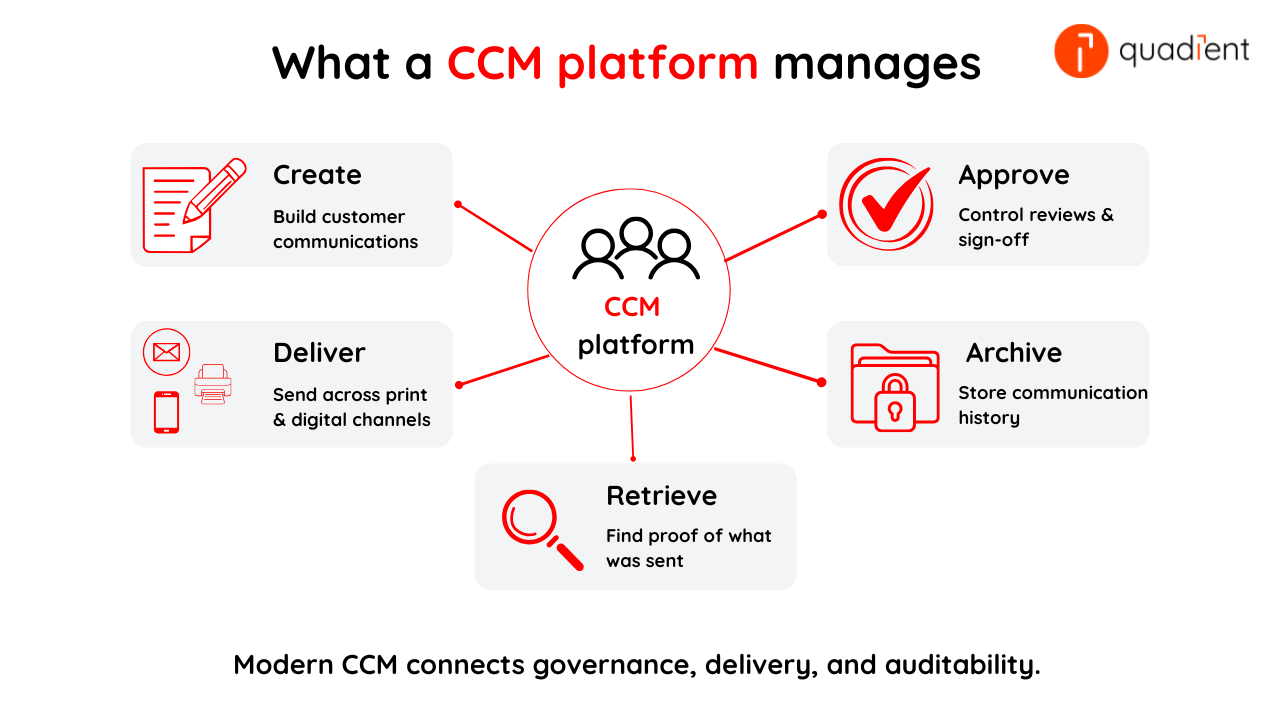
Customer communications management (CCM) software is the platform used to create, approve, deliver, store, and retrieve customer communications across print and digital channels. In 2026, “CCM” usually means omnichannel delivery + governance + integration + automation, not just document composition.
In this guide you’ll get:
- A side-by-side comparison table of major CCM platforms
- A practical 2026 checklist for shortlisting vendors
- Clear selection steps for buying teams
- One key statistic and one pull quote
- FAQs that match what buyers ask in demos
For the full vendor-by-vendor comparison table and deeper notes, see best CCM platforms: how do they compare.
What key CCM market statistic matters for 2026 planning?
The global CCM market is projected to be worth $2.58 billion in 2026, with more growth forecast through the next decade.
Why it matters: This is a “modernization” market. Buyers are replacing legacy stacks, reducing template sprawl, and pushing the same communication across print + digital with tighter compliance controls.
Which CCM platforms are most commonly compared in 2026?
A “big CCM platform” is typically one that supports high-volume, regulated communications (statements, policies, notices) with workflow governance, enterprise integrations, and omnichannel output from a centralized system.
The vendors below show up most often in enterprise shortlists for a variety of reasons. How each stacks up and matches with your business will depend on your size, location and your company’s specific needs.
How do the biggest CCM platforms compare in 2026?
Platform | Best for | Deployment posture | Biggest strengths | Common trade-offs |
Quadient Inspire (Flex / Evolve) | Organizations needing enterprise CCM with strong governance and omnichannel delivery | Any-prem options (on-prem, cloud, hybrid; editions vary) | Omnichannel from one platform; strong controls | Implementation depends on scope and complexity |
OpenText Communications (Exstream) | Large enterprises managing high-volume document composition | Enterprise cloud/hybrid options | Mature enterprise CCM footprint | Longer implementation timelines and higher complexity for smaller teams |
Smart Communications (SmartCOMM) | Organizations prioritizing SaaS-first CCM programs | SaaS-first positioning | Strong business-user enablement and faster deployment | Less fit for strict on-prem needs |
DOC1 (legacy CCM estate) | Organizations modernizing legacy production communication environments | Often legacy/on-prem estates | Proven transactional output engine | Commonly a “migrate-from” platform |
Salesforce Communications Cloud (adjacent) | Telecom organizations focused on CRM-driven service workflows | Salesforce cloud | Strong for CSP processes | Not classic regulated doc CCM |
GMC Software is the historic lineage behind what is now Quadient Inspire, which is why “GMC” still appears in older comparisons and RFP templates.
“The Inspire platform generates complex communications faster and provides multi-step journey-based campaigns with omnichannel nudges and reminders.” (SPARK Matrix™ coverage summary) (CU Insight)
What checklist should you use to shortlist a CCM platform in 2026?
This checklist is the fastest way to evaluate CCM platforms before you compare vendors in detail. Before you book any demos, ask yourself these essential questions:
Do you need on-prem or hybrid for residency, latency, or policy reasons?
- Do you want the option to switch deployment models later?
- Can you design once and deliver across print + PDF + email + web/mobile?
- Can it handle both batch (statements) and on-demand (service letters)?
- Are there approval workflows, audit trails, and content locking for regulated language?
- Can you prove what was sent if there’s a dispute?
Does it integrate cleanly with CRM/ERP/core systems?
Can it reuse existing data and templates to reduce rework?
How do you choose a CCM platform in 2026?
- Start with your highest-risk communications. Bills, statements, adverse action letters, policy documents, and regulatory notices all factor in.
- Set deployment constraints early. If you need hybrid/on-prem, remove SaaS-only options quickly. If flexibility is your goal, prioritize platforms with multi-environment deployment.
- Inventory your template estate. Count templates, languages, channels, and owners. This usually predicts your timeframe more accurately than feature checklists.
- Run a proof using two real artifacts. Pick one complex batch job and one on-demand doc. Test data ingestion, rules, approvals, output, and archive retrieval.
- Score governance as heavily as design. In regulated industries, approvals and auditability matter as much as layout speed.
Are there Gartner or Forrester reports for CCM vendors in 2026?
Buyers often search for “Gartner Magic Quadrant CCM” or “Forrester Wave CCM vendors.” CCM research is frequently gated, and it’s not always published as a public, annual “Wave/MQ” page that’s easy to cite.
If you need a practical vendor-comparison lens that’s purpose-built for CCM, these two are commonly used:
- Aspire Leaderboard (interactive CCM vendor positioning, including AnyPrem CCM categories)
- SPARK Matrix™ for CCM (competitive market positioning for CCM vendors)
Where does Quadient Inspire fit in a 2026 CCM shortlist?
Shortlists typically include Quadient Inspire when an organization needs enterprise-grade CCM and wants flexibility across cloud, hybrid, and on-prem deployment models.
Relevant Quadient pages to cite internally in your cluster:
- Quadient Inspire platform overview
- Inspire Flex (enterprise any-prem CCM)
- Any-premise deployment explainer
- What is CCM? (definition + fundamentals)
Final verdict
In 2026, the best CCM software is the one that fits your channels, governance rules, integrations, and deployment constraints. For many enterprise teams, Quadient Inspire / Inspire Flex remains a strong choice because it supports centralized omnichannel communications, strong compliance controls, and flexible deployment.
Frequently asked questions
What is a CCM platform?
A CCM platform centralizes how you create, govern, deliver, archive, and retrieve customer communications across channels.
Is OpenText Communications the same as Exstream?
OpenText Communications is the CCM solution family; Exstream is the product name commonly referenced for document composition and customer communications.
Is DOC1 a modern CCM platform in 2026?
DOC1 is widely referenced as a legacy document/communication engine. In 2026, it often appears in modernization projects as a platform organizations migrate from.
Is Salesforce Communications Cloud a CCM replacement?
Usually, no. It’s positioned for communications-industry (telecom) CRM and service workflows. It may integrate with CCM, but it’s typically not the system of record for regulated, output-heavy document composition.
Which CCM platform is best for enterprise use?
Enterprise organizations often shortlist platforms like Quadient Inspire and OpenText Exstream because they support high-volume communications, governance workflows, and omnichannel delivery across complex environments.
How do you choose between SaaS and on-prem CCM?
Choose SaaS if speed, lower infrastructure management, and easier updates are priorities. Choose on-prem or hybrid deployment when you have strict security, residency, compliance, or integration requirements.
Do you need a CCM platform or can CRM tools replace it?
CRM tools manage customer data and interactions, while CCM platforms specialize in creating, governing, and delivering high-volume customer communications. In regulated industries, CCM platforms are typically required for document control, approvals, and auditability.
What does “any-prem” mean in CCM?
Any-prem refers to deployment flexibility across on-prem, cloud, hybrid, and hosted models, with the ability to adapt as requirements change.