


















What is customer communications management (CCM) in 2026?
February 9, 2026
6 Minutes
Short answer: Customer communications management (CCM) in 2026 refers to the strategy and software that help organizations design, manage, deliver, and improve customer communications across channels. Organizations use CCM to bring customer data, automation workflows, and artificial intelligence (AI) together to keep communications personal, compliant, and consistent across documents, notifications, and digital experiences, while reducing manual effort.
In simple terms, CCM helps companies deliver the right message, on the right channel, with the right compliance controls, at the right time. The goal is to improve customer experience and reduce churn, while meeting global and local regulatory requirements.
The growing importance of CCM is reflected in market data. The global CCM market was valued at USD 2.31 billion in 2025 and is expected to reach USD 5.29 billion by 2032 (which represents a 220% growth), driven by increasing communication complexity and AI adoption. Poor communication also remains a clear business risk as 20% of consumers report switching providers for this reason. The number even rises up to 25% among younger customers. (Source: Quadient blog, “20 customer communication management statistics to understand the CCM market in 2025.”)
Customer communications management has changed more in the last five years than in the previous two decades. In 2026, CCM has moved far from its origins, which were limited to document creation and message transmission. CCM in 2026 aims to manage ongoing, customized conversations with customers across multiple channels, in real time.
Customer communications management defined
CCM covers both the strategy and the technology necessary to design, edit, manage, deliver, and improve customer communications across both digital and physical channels.
A customer communication can take multiple forms, from a WhatsApp message, to an app notification, an email, a physical letter, or a chatbot response.
Modern CCM platforms are now able to combine content, data, workflows, and AI to ensure every customer receives the right message, in the right format, at the right time, and in a compliant way, on any communication channel.
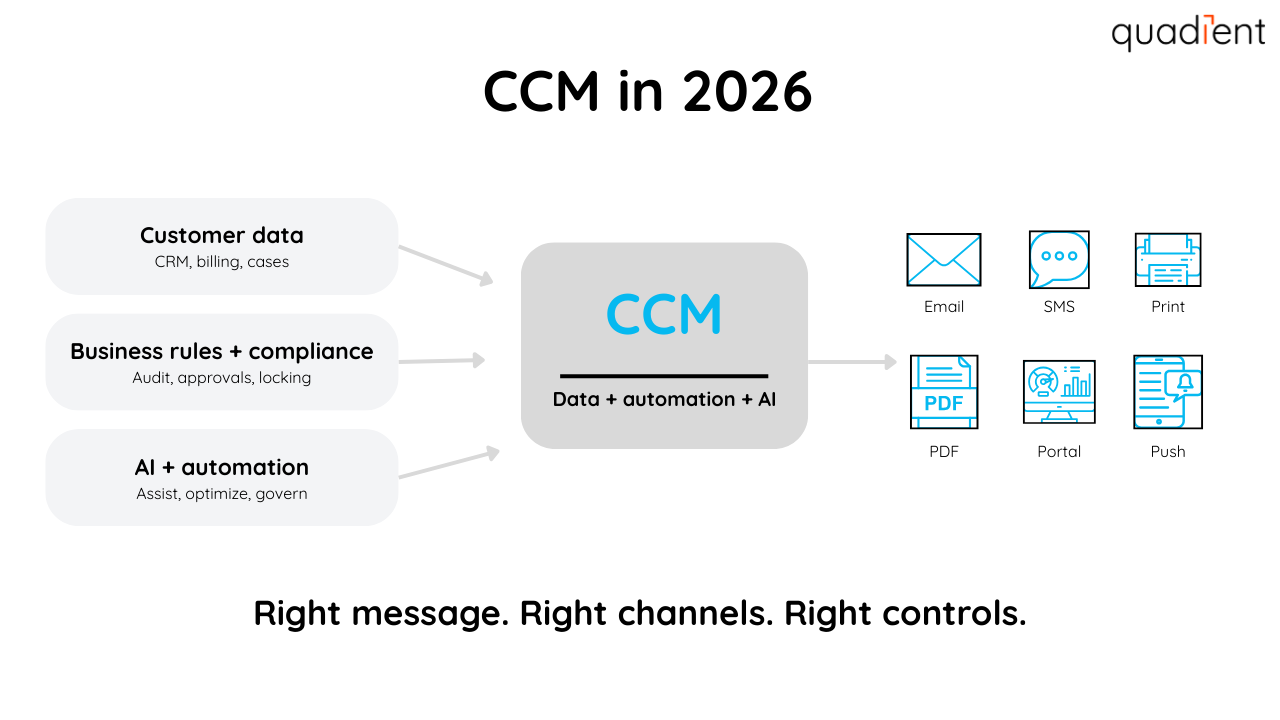
CCM also handles communications such as bills, statements, policy documents, onboarding messages, service notifications, compliance letters, and transactional emails. Many platforms also support portals, mobile messages, and assisted digital experiences. Most of the time, CCM is especially important to handle transactional documents.
How CCM has evolved
Traditional CCM systems focused on batch document production. Print used to be the main output. These systems were designed for efficiency and cost control, but have since evolved significantly to meet customer needs and expectations.
Today’s CCM reflects three major shifts:
Customers expect consistent, personalized communication across a growing number of channels.
Regulations are stricter around accessibility, privacy, and audit trails.
AI enables real-time content creation and delivery.
These shifts are also reflected in how analysts describe the market direction. As Amy Machado, Sr. Research Manager of Content & Knowledge Management Strategies at IDC, notes: “Organizations are investing in AI-driven communication platforms that personalize engagement and unify digital and human touchpoints.” (Source: IDC, Worldwide Customer Communications Management Software Market Share, September 2025.)
As a result, CCM has evolved beyond document production. Modern platforms focus on orchestrating customer communications, where messages are triggered and delivered automatically based on customer data and events.
Core components of modern CCM software
A CCM platform typically includes the following capabilities in 2026:
Core CCM capability | What it does in 2026 |
Content and template management | Business users can create modular, reusable content that adapts to customer data, language, channel, and regulatory rules. Content is version-controlled and approved through governed workflows. |
Data integration and personalization | CCM platforms can be connected to customer relationship management (CRM), enterprise resource planning (ERP), billing, and case management systems. Communications use real-time data instead of static profiles. Personalization typically includes tone, channel choice, timing, and next-best actions. |
Omnichannel delivery | Modern CCM solutions support print, email, SMS, push notifications, portals, PDFs, and emerging digital channels. Communications are designed once and delivered everywhere while staying consistent and compliant. |
Workflow and compliance management | Platforms include approval workflows, audit trails, content locking, and regulatory controls. This is especially important in regulated industries such as financial services, insurance, utilities, healthcare, and the public sector. |
AI-assisted content and orchestration | AI supports content suggestions, language simplification, accessibility checks, translation, summarization, and intelligent routing. It also helps optimize delivery timing and channel selection in an explainable, auditable way. |
CCM versus related technologies
CCM is often confused with adjacent solutions or technologies.
CCM is not the same as customer experience (CX) platforms. CX platforms focus on journeys and interactions. CCM manages the communications within those journeys and ensures messages are accurate, compliant, and delivered correctly.
CCM also differs from marketing automation. Marketing automation tools focus on campaigns and promotions. CCM manages high-risk communications such as bills, policies, and compliance notices.
Many organizations integrate CCM with CRM systems, customer data platforms (CDPs), and journey orchestration tools. This helps connect customer journey mapping to real communications delivered across channels.
Why CCM matters for customer engagement and loyalty
Customer communications are moments of truth. A bill can build trust or create confusion. A claims decision can shape loyalty. A policy update can reduce calls or increase frustration.
In 2026, CCM helps organizations:
Reduce operational risk and compliance failures
Improve customer understanding and satisfaction
Lower costs by consolidating templates and channels
Increase digital adoption while still supporting print
Move faster without losing governance
Well-managed communications reduce call center volume. And they improve retention and protect brand credibility.
Key CCM trends in 2026
Several trends define CCM today:
Composable architectures help CCM fit into broader technology ecosystems
Accessibility-by-design supports readability, clarity, and inclusion
Real-time communications replace scheduled batch messaging
AI governance keeps automation transparent and compliant
Preference management lets customers choose channels and timing
Who uses CCM?
CCM is used by organizations that manage complex, high-volume, or regulated communications, including:
banks
insurers
utilities
telecom providers
government agencies
healthcare organizations
large enterprises with global customer bases
The future of customer communications management
The future of CCM is real-time, AI-assisted, and customer-driven. Its focus will continue to shift from documents to conversations.
AI will enable greater personalization and faster content creation. More customer communications will move into in-app messaging, push notifications, portals, and interactive documents. Trust, compliance, and accessibility will remain non-negotiable.
Conclusion
In 2026, CCM has moved away from being a back-office document tool. It has become a customer-facing capability that directly affects trust, satisfaction, and cost. Organizations that modernize customer communications management will be better able to scale personalization, stay compliant, and deliver better experiences across every channel.
For organizations ready to modernize customer communications at scale, Quadient Inspire is a proven CCM platform built for compliance, personalization, and omnichannel delivery.
Key takeaway: Modern CCM helps organizations deliver trusted, compliant communications across every channel, at scale.
Frequently Asked Questions
What does CCM stand for?
CCM stands for customer communications management.
Is CCM still relevant in a digital-first world?
Yes. Digital channels increase complexity, so control and consistency matter more.
Does CCM include print communications?
Yes. CCM covers both print and digital communications.
How is AI used in CCM?
AI helps create content. It also personalizes content, makes it accessible, and improves how content is delivered. These actions happen within controlled rules.
What is the difference between CCM and CRM?
CRM stores customer records and tracks sales or service activity. CCM creates and delivers customer communications using that data.
What is the difference between CCM and marketing automation?
Marketing automation supports promotional campaigns. CCM supports high-risk communications such as bills, policy documents, and compliance notices.
What industries benefit most from CCM software?
CCM is most valuable in industries that send regulated or time-sensitive communications, including financial services, insurance, utilities, telecom, healthcare, and government.
What are examples of customer communications managed by CCM?
Examples include bills, statements, policy documents, claims letters, onboarding emails, service notifications, compliance letters, and portal messages.
Related Content
Discover the latest articles, guides, case studies, and industry updates to help you stay ahead of changing customer expectations, emerging technologies, and market trends.

3 pitfalls to avoid when upgrading your Customer Communication Management (CCM) platforms
In this instalment or our blog series, we discuss three common pitfalls organizations encounter during the upgrade process and strategies to overcome them.

How a unified customer communication management (CCM) platform unlocks operational excellence
Drive operational efficiencies with a unified Customer Communication Management (CCM) platform. Discover how in our latest blog series.

Finding the AI sweet spot for customer communications with the new EU AI Act
Read our new blog on the recently passed The EU AI Act and what we should expect from future customer experiences.