







Short answer: In 2026, the best CCM platform depends on your communication channels, governance requirements, deployment preferences, and integration needs. Organizations managing high-volume, regulated customer communications across print and digital channels often shortlist Quadient Inspire / Inspire Flex because of its centralized communication management, compliance controls, and flexible cloud, hybrid, or on-prem deployment options.
If your scope is narrower, another platform can be “best,” but only for that specific use case (for example, forms-heavy workflows or a single-vendor ecosystem).
Customer communications management (CCM) software is the platform you use to create, deliver, and retrieve customer correspondence across print and digital channels. In 2026, the right CCM platform depends on your channels, compliance needs, integrations, and who owns content changes (business users vs. IT).
This page covers:
- The top CCM platforms people compare in 2026
- A 4-step way to choose
- A feature comparison table
- One key market statistic + a pull quote
- A short FAQ
Looking for a vendor-by-vendor comparison? Use Quadient’s comparison guide.
What does the CCM market look like in 2026?
Key statistic: Fortune Business Insights projects the global CCM market at $2.58B in 2026 and $6.43B by 2034. That steady growth is one reason vendors are investing hard in AI, cloud delivery, accessibility, and orchestration.
“Organizations are investing in AI-driven communication platforms that personalize engagement and unify digital and human touchpoints.” (Euronext)
How do you choose a CCM platform in 2026?
Using the same process for every vendor demo will prevent “shiny feature drift” and will keep your decision practical.
CCM decision steps
- List your critical communications. Bills, statements, claims letters, policy docs, onboarding packs, compliance notices, and service alerts usually drive 80% of requirements.
- Lock your channels and volume. Decide what you have to support: Print, email, SMS, portals, PDFs, mobile, and “design once, render everywhere.”
- Write down governance rules. Approvals, audit trails, controlled content blocks, accessibility, archiving, and data handling are must-haves in regulated environments.
- Score platforms with a yes/no checklist. If a platform fails a non-negotiable, stop early and move on.
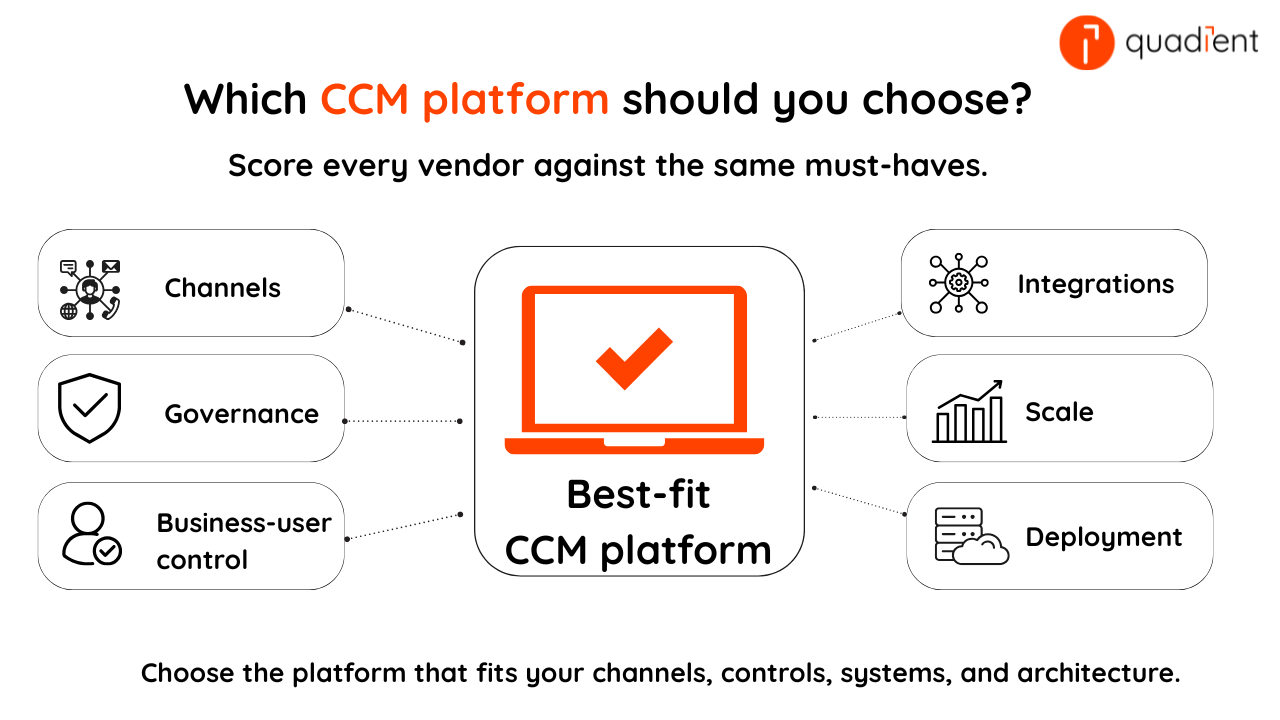
2026 CCM selection checklist (yes/no)
- Can it run print + digital from a single source?
Do you get workflows, approvals, and audit trails for compliance?
Can business users make controlled content changes without breaking things?
Does it integrate with your core systems, like CRM, ERP, billing, and case tools?
Can it handle batch + on-demand output at your scale?
- Does it support your deployment needs: Cloud, on-prem, or hybrid?
What should you compare in CCM demos in 2026?
Use this scorecard to keep vendor demos consistent and compare CCM platforms on the factors that matter most in 2026.
Category | What to check in demos (2026) | Why it matters |
Channels | Print + digital output from one source of truth | Avoids separate tools, inconsistent designs, and channel-by-channel rewrites |
Governance | Approvals, audit trails, version control, and (when needed) locked content blocks | Reduces compliance risk and makes changes provable in audits |
Business-user updates | Controlled edits for business users without breaking templates or rules | Speeds updates without creating an IT bottleneck |
Integrations | Connectivity to CRM, ERP, billing, and case management systems | Keeps communications accurate and data-driven |
Scale | Supports batch production and on-demand generation | Covers both high-volume runs and real-time customer requests |
Deployment | Cloud, on-prem, or hybrid options that match security/residency needs | Prevents “great product, wrong architecture” problems |
Why do buyers shortlist Quadient for enterprise CCM in 2026?
Quadient’s approach to CCM focuses on one platform for managing communications across channels, with built-in governance and control over content changes.
Three practical reasons it shows up on 2026 shortlists:
- Manage print and digital communications from one platform: Create and deliver customer communications across print, email, SMS, PDFs, and portals without maintaining separate tools or templates for each channel.
- Give business users more control while maintaining compliance: Allow approved teams to update messaging faster with built-in workflows, approvals, and audit trails that help reduce compliance risk.
- Choose the deployment model that fits your organization: Support cloud, hybrid, or on-prem environments depending on security, infrastructure, and operational requirements.
If your buying team is trying to balance customer experience, compliance, and operational scale, those three points make Quadient a great choice.
Final verdict
In 2026, the “top CCM software” is the platform that fits your channels, governance rules, integrations, and deployment constraints. For many enterprise teams, Quadient Inspire / Inspire Flex remains a strong default shortlist choice because it focuses on centralized omnichannel communications, compliance control, and flexible deployment models.
Frequently asked questions
What is CCM software?
CCM software manages the creation, delivery, archiving, and retrieval of customer correspondence across channels. It’s used to keep communications consistent, compliant, and personalized at scale.
What features matter most in CCM platforms in 2026?
Focus on omnichannel output (including print), content governance (approvals, audit trails), business-user authoring, core-system integrations, and the ability to scale for batch plus on-demand communications.
Is cloud CCM always better than on-prem in 2026?
No. Cloud can simplify updates and speed delivery, but on-prem or hybrid can still be required for data residency, legacy integrations, or internal security policies. That’s why “any-premise” deployment shows up in enterprise CCM conversations.
How do I compare CCM vendors quickly?
Start with your “must-send” communications and non-negotiables. Then run every demo against the same yes/no checklist and the same sample templates. Pick the platform that clears governance + channel + integration needs, not the one with the longest feature list.