


















Introduction
Debt can fund growth, but it also creates payments that must be made regardless of how quickly customers pay. By adding short-term and long-term borrowings, finance teams can see how much the business owes, how heavily it relies on debt, and whether its cash flow can comfortably support those obligations.
This guide explains how to calculate total debt, analyze its implications, and improve cash flow through stronger collections and accounts receivable automation.
Quick answer: To calculate total debt, add a company’s short-term debt and long-term debt.
Total debt = Short-term debt + Long-term debt
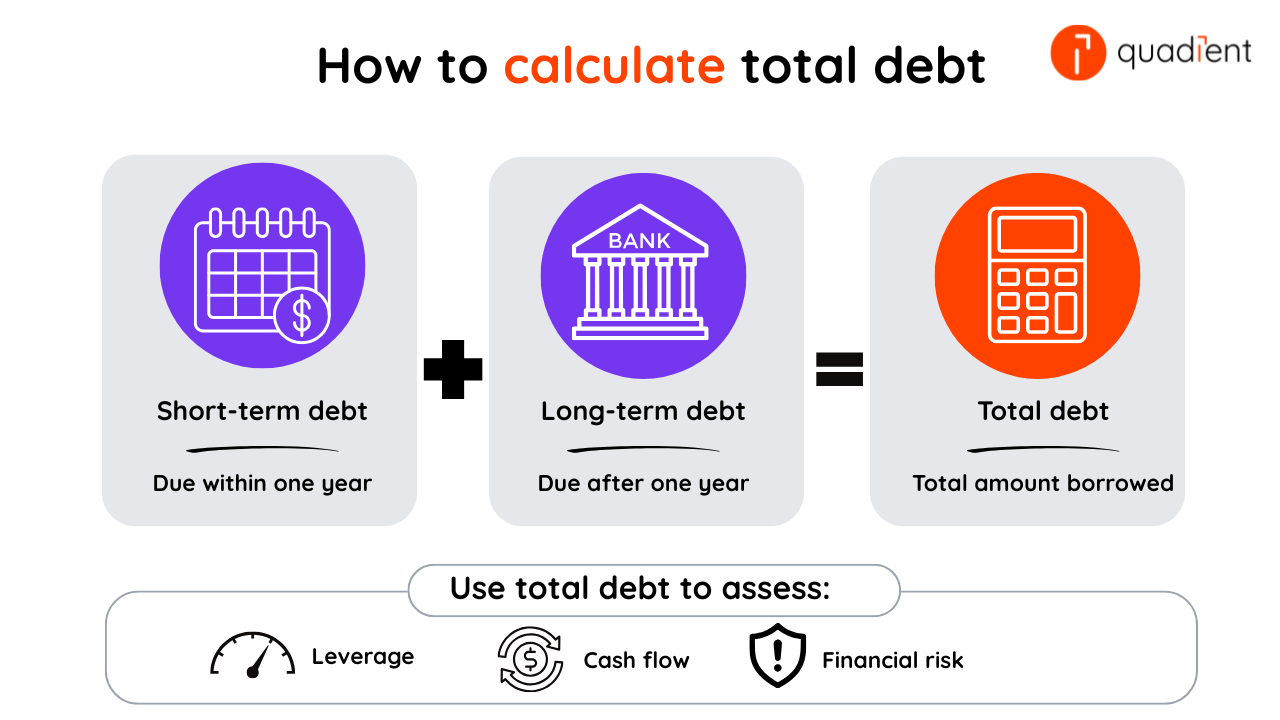
What is total debt?
Total debt is the money a company has borrowed and still needs to repay. It includes short-term debt due within one year and long-term debt due later. Common examples include bank loans, bonds issued to investors, and formal loan agreements known as notes payable.
These amounts appear on the liabilities side of the balance sheet, although they may be spread across several line items and supporting notes.
Total debt is different from total liabilities. Total liabilities include all obligations, such as accounts payable, accrued expenses, and taxes payable, while total debt focuses on loans and other financing obligations.
What is short-term debt?
Short-term debt includes borrowings that must be repaid within one year and is usually reported under current liabilities.
Common examples include:
Short-term loans and bank overdrafts
Revolving credit, which allows a business to borrow, repay, and borrow again up to an approved limit
Business credit card balances
Notes payable due within one year
The current portion of long-term debt, meaning the amount due within the next 12 months
The current portion of finance lease liabilities
Short-term debt can place immediate pressure on cash flow because payments are due soon. A profitable company may still face liquidity problems if it does not have enough cash or other liquid assets to cover these obligations.
Accounts payable is also a current liability, but it is not usually included in total debt because it represents unpaid operating expenses rather than borrowed money.
What is long-term debt?
Long-term debt includes borrowings due more than one year after the balance sheet date. Examples include bank loans, bonds payable, mortgages, long-term notes payable, and finance lease liabilities.
Acquisitions, equipment, technology, and real estate are often funded through long-term debt. This can support growth, provided the company can manage the repayments and interest costs.
Why does understanding total debt matter?
Understanding total debt supports cash planning and borrowing decisions while helping identify financial risk. It also shows how much the company relies on borrowed money to fund its operations and growth.
The figure is most useful when viewed alongside company size, earnings, cash flow, and repayment schedules. A company with $5 million in debt may be financially stable if it generates strong earnings and has enough cash to meet its payments. Another company with $1 million in debt may face greater risk if sales are falling, cash flow is weak, or a large portion of the debt is due soon.
Financial health
Reviewing debt over time shows whether the company is borrowing more, paying balances down, or maintaining a steady level. Rising debt may be reasonable during a period of expansion, but it can be a warning sign when borrowing is used to cover routine expenses or cash shortages.
Total debt should also be considered alongside assets, available cash, retained earnings, shareholders’ equity, and operating performance. Retained earnings are profits kept in the business, while shareholders’ equity represents the owners’ remaining interest after liabilities are deducted. Together, these measures provide a fuller view of the company’s financial stability.
Cash flow planning
Knowing how much debt is due, and when, helps businesses forecast cash needs and prepare for upcoming payments. These payments may include principal and interest due monthly, quarterly, or at maturity.
It also shows how much cash the business may need to keep available for operations and unexpected expenses. It is especially important for companies with seasonal revenue, slow-paying customers, or operating costs that vary over time. Strong sales don’t lead to healthy cash flow if customers take months to pay their invoices.
Financial risk
Knowing a company’s total debt can help identify potential financial strain before it becomes a serious problem.
Warning signs may include:
A large portion of debt is due within the next year
Interest rates on variable-rate loans are increasing
Cash flow is becoming less predictable
Customer payments are slowing
The company is relying heavily on revolving credit
Interest expense is rising faster than earnings
Identifying these risks early gives the company time to improve collections, cut costs, refinance debt, renegotiate payment terms, or seek additional funding.
Creditworthiness
Lenders typically review a company’s debt, cash flow, earnings, and ability to repay before approving new financing. Companies with high debt may face higher interest rates, stricter loan terms, or fewer borrowing options.
Strategic planning
Expansion and investment plans often depend on how much debt the company already carries. Manageable debt and steady cash flow can leave room for growth, while high borrowing costs or large upcoming payments may make repayment the priority.
How is total debt calculated?
The total debt formula is:
Total debt = Short-term debt + Long-term debt
Use the balance sheet to find short-term and long-term debt. Review the notes to the financial statements if the full amounts are not listed separately.
Exclude operating liabilities such as accounts payable, deferred revenue, and taxes payable.
What is an example of how to calculate total debt?
Suppose ABC Corp has:
$50,000 in short-term debt
$300,000 in long-term debt
Its total debt is:
$50,000 + $300,000 = $350,000
Total debt quick-reference table
Debt category | ABC Corp example |
Short-term debt | $50,000 |
Long-term debt | $300,000 |
Total debt | $350,000 |
How do you analze total debt?
Analyze total debt by comparing it with the company’s assets, equity, cash flow, earnings, and interest costs. Financial ratios can help show whether the debt is manageable.
What is the total debt ratio?
The total debt ratio shows how much of a company’s assets are financed by debt:
Total debt ratio = Total debt ÷ Total assets
If ABC Corp has $350,000 in total debt and $1 million in assets, its total debt ratio is 35%.
Some companies calculate the debt ratio using total liabilities instead of total debt, so it's best to check the definition before comparing results.
What is the debt-to-equity ratio?
The debt-to-equity ratio compares total debt with shareholders’ equity:
Debt-to-equity ratio = Total debt ÷ Shareholders’ equity
The higher the ratio, the more the company relies on debt. Acceptable levels vary by industry.
What is net debt?
Net debt shows how much debt remains after subtracting cash and cash equivalents:
Net debt = Total debt − Cash and cash equivalents
Because it accounts for available cash, net debt can give a clearer picture of leverage. However, some of that cash may be needed for payroll, supplier payments, and daily operations.
What is the net debt-to-EBITDA ratio?
The net debt-to-EBITDA ratio compares net debt with EBITDA, or earnings before interest, taxes, depreciation, and amortization. EBITDA is commonly used as a measure of a company’s operating earnings.
Net debt-to-EBITDA ratio = Net debt ÷ EBITDA
The result shows how manageable the company’s debt may be in relation to earnings. It is most useful when compared with past performance and industry benchmarks.
What is the interest coverage ratio?
The interest coverage ratio shows how easily earnings can cover interest costs:
Interest coverage ratio = EBIT ÷ Interest expense
EBIT, or earnings before interest and taxes, is commonly used to measure operating profit. A falling ratio may signal financial pressure, even if total debt has not increased.
How can accounts receivable affect total debt?
Accounts receivable is not included in total debt. However, slow customer payments can create cash shortages, increasing the need for short-term borrowing. Faster collections make more cash available to repay debt and reduce reliance on credit.
Improve cash flow: Faster payments turn accounts receivable into cash sooner, helping the business cover expenses and upcoming debt payments.
Improve cash flow forecasting: Expected payment dates give the business a better idea of when cash will be available, making it easier to plan debt payments and spot potential shortages.
Reduce uncollectible receivables: Clear credit policies, accurate invoices, and timely follow-up can lower the risk of invoices going unpaid. Resolving disputes quickly can also prevent payment delays from becoming long-term collection problems.
Lower interest costs: Additional cash can be used to repay credit cards, revolving credit, or short-term loans sooner.
Support debt repayment planning: A clearer view of overdue invoices and expected collections helps businesses decide when to repay debt and which balances to address first. For example, they may choose to pay down borrowing with the highest interest rate when sufficient cash becomes available.
For example, if ABC Corp collects $50,000 in overdue invoices and uses the cash to repay short-term debt, its total debt would fall from $350,000 to $300,000.
Conclusion
The total debt formula is simple, but the number only becomes meaningful when viewed alongside cash flow, assets, equity, earnings, and industry benchmarks. Together, these measures show whether the company’s debt remains manageable.
Stronger collections can provide more cash for debt payments and reduce reliance on short-term borrowing. Quadient Accounts Receivable automation helps businesses reduce overdue invoices, automate collections, resolve disputes, and improve cash flow visibility, giving finance teams better information for debt and liquidity planning.
