


















Introduction
Certified Mail® is a United States Postal Service® (USPS) service that helps businesses and individuals send important mail with proof of mailing, tracking, and delivery verification.
Whether you're sending legal notices, contracts, tax documents, medical records, or other business communications, Certified Mail creates a documented mailing trail. This guide explains how Certified Mail works, when to use it, how to send it, what it costs, and how businesses can simplify the process with an online digital service.
Quick answer: What is USPS Certified Mail?
USPS Certified Mail® is an optional service that provides proof of mailing, USPS Tracking®, and verification that delivery was completed or attempted. A signature is required at delivery, and senders can add a Return Receipt to receive a copy of the signature, showing who accepted the mailpiece and when it was delivered.
Key takeaways
Certified Mail provides proof that USPS accepted your mailpiece and verification that delivery was completed or attempted.
Every Certified Mail item includes USPS Tracking® and a unique tracking number.
A signature from the recipient or an authorized agent is required at delivery.
Return Receipt provides a copy of the signature, showing who accepted the mailpiece and when it was delivered.
Certified Mail is commonly used for legal notices, contracts, tax documents, healthcare records, compliance communications, and other important business correspondence.
Businesses that send Certified Mail regularly can simplify preparation, tracking, and recordkeeping using an online digital service instead of manually filling out physical green cards.
1. What is USPS Certified Mail?
Certified Mail is an optional USPS service that adds proof of mailing, tracking, and delivery verification to eligible mail classes, including First-Class Mail® and Priority Mail®.
When USPS accepts the mailpiece, the sender receives a mailing receipt and tracking number. During transit, USPS Tracking provides delivery updates. At delivery, the recipient or an authorized agent signs for the mailpiece, creating a documented record of delivery.
If additional documentation is needed, senders can purchase optional services such as Return Receipt or Restricted Delivery. Return Receipt provides a copy of the signature and delivery information. Restricted Delivery limits delivery to the named recipient or the recipient's authorized agent, rather than anyone authorized to accept mail at the delivery address.
What are the benefits of Certified Mail?
Benefit | What you get | Why it matters |
Proof of mailing | You receive a USPS mailing receipt when the mailpiece is accepted. | Documents that the item was mailed on a specific date. |
USPS Tracking | You receive a tracking number to monitor delivery status online. | Lets you follow the mailpiece while it is in transit. |
Signature required | The recipient or another authorized person signs for the mailpiece at delivery. | Confirms that the mailpiece was delivered. |
Return Receipt (optional) | You receive a copy of the signature and delivery information. | Provides additional proof of who accepted the mailpiece. |
Delivery verification | USPS verifies that delivery was completed or attempted. | Creates a documented mailing trail for audits, disputes, or compliance. |
When should you use Certified Mail?
Certified Mail is a good choice whenever you need proof that an important document was mailed and confirmation that delivery was completed or attempted.
Businesses commonly use Certified Mail for:
Legal notices and legal documents
Contracts and agreements
Tax documents
Collection letters and default notices
Government communications
Healthcare records
Compliance and regulatory documents
Financial records
Business correspondence that requires proof of mailing or delivery
Although businesses are among the most frequent users, anyone can send Certified Mail by visiting a USPS Post Office or using an approved online digital service.
What's the difference between Certified Mail and Return Receipt?
Certified Mail and Return Receipt are often used together, but they serve different purposes. Certified Mail provides proof of mailing, tracking, and delivery verification, while Return Receipt provides a copy of the signature and delivery information.
Feature | Certified Mail | Return Receipt |
Primary purpose | Provides proof of mailing, USPS Tracking, and delivery or attempted-delivery verification | Provides a copy of the signature and delivery information |
What's included | Mailing receipt and tracking number | Physical green card (PS Form 3811) or Electronic Return Receipt |
Signature | A signature is collected at delivery | The sender receives a copy of the signature |
Tracking | Included | Uses the Certified Mail tracking record |
Best for | Important mail that requires proof of mailing and delivery | Situations where proof of who signed for the mailpiece is required |
What is Return Receipt?
Return Receipt provides a copy of the signature and delivery information for a Certified Mail item.
There are two Return Receipt options:
Physical Return Receipt (Green Card): The green card (PS Form 3811) is attached to the mailpiece before mailing, signed at delivery, and returned to the sender.
Electronic Return Receipt: Electronic Return Receipt (ERR) provides the same information digitally, making it easier to store, retrieve, and manage. ERR is also less expensive. As of July 12 2026, you can save $1.74 on every Certified mailpiece when you choose Electronic Return Receipt over the regular physical Return Receipt.
How much does Certified Mail cost?
Certified Mail is an additional USPS service purchased in addition to the postage for your mailpiece. The total cost depends on:
The mail class you choose
The current USPS Certified Mail service fee
Any optional services you add, such as Return Receipt or Restricted Delivery
Important letters are typically sent using First-Class Mail with Certified Mail and Return Receipt. The chart below compares the traditional green card process at the Post Office with sending the letter using a postage meter and a digital service such as Quadient e-Certify with ERR.
Mailing cost | Traditional green card | Quadient e-Certify with ERR | Savings |
First-class Mail postage | $ 0.82 | $0.78 | $0.04 |
Certified Mail | $5.55 | $5.55 | $0.00 |
Return Receipt | $4.65 | $2.91 | $1.74 |
Total | $11.02 | $9.24 | $1.78 |
Because USPS mailing rates change periodically, it's a good idea to check the latest pricing before sending your mail.
Does Certified Mail require a USPS account?
No. Anyone can send Certified Mail at a USPS Post Office without creating a USPS account.
Businesses that send Certified Mail frequently may prefer an online digital service that allows them to prepare, send, track, and archive Certified Mail from a computer while maintaining USPS proof of mailing and delivery records.
What payment methods are accepted?
USPS Post Offices accept several forms of payment for Certified Mail, including major credit cards, debit cards, cash, and other payment methods accepted at retail locations.
If you're using an online Certified Mail solution, payment options depend on the service provider.
2. How to send Certified Mail
You can send Certified Mail at any USPS Post Office or by using an approved online digital service.
How do you send Certified Mail at the Post Office?
Prepare your mailpiece. Address your mailpiece, apply the required postage, and complete PS Form 3800.
Add optional services. Select Return Receipt, Electronic Return Receipt, or Restricted Delivery if needed.
Mail your item. Pay for postage and Certified Mail at the Post Office and keep your mailing receipt.
Track delivery. Use the tracking number on your mailing receipt to monitor delivery through USPS Tracking®.
Can you send Certified Mail online?
Yes. Businesses can prepare, send, track, and manage Certified Mail using an approved online digital service. Instead of completing paper forms and visiting the Post Office, users can prepare mail, select mailing options, verify addresses, and track delivery from a secure online portal.
Good to know: Online Certified Mail is designed for letters and documents. If you're mailing packages, you'll typically use USPS shipping services such as Priority Mail or USPS Ground Advantage® instead.
3. What happens when you receive Certified Mail?
When Certified Mail reaches the recipient's address, USPS attempts delivery and requires a signature before the mailpiece can be delivered.
How will the recipient know Certified Mail has arrived?
If no one is available to sign, USPS leaves a delivery notice with instructions for redelivery or pickup at the local Post Office.
Who can sign for Certified Mail?
With standard Certified Mail, the recipient or another person authorized to accept mail at the delivery address may sign for the mailpiece. To limit delivery to the intended recipient or the recipient's authorized agent, add Restricted Delivery.
Can Certified Mail be delivered without a signature?
No. A signature is required to complete delivery of Certified Mail. If no one is available to sign, USPS records a delivery attempt and follows its standard procedures for redelivery, pickup, or return to the sender.
What happens if Certified Mail isn't signed for?
If no one signs for the mailpiece, USPS holds it at the local Post Office for a limited time. If it isn't claimed during that period, it is typically returned to the sender as unclaimed.
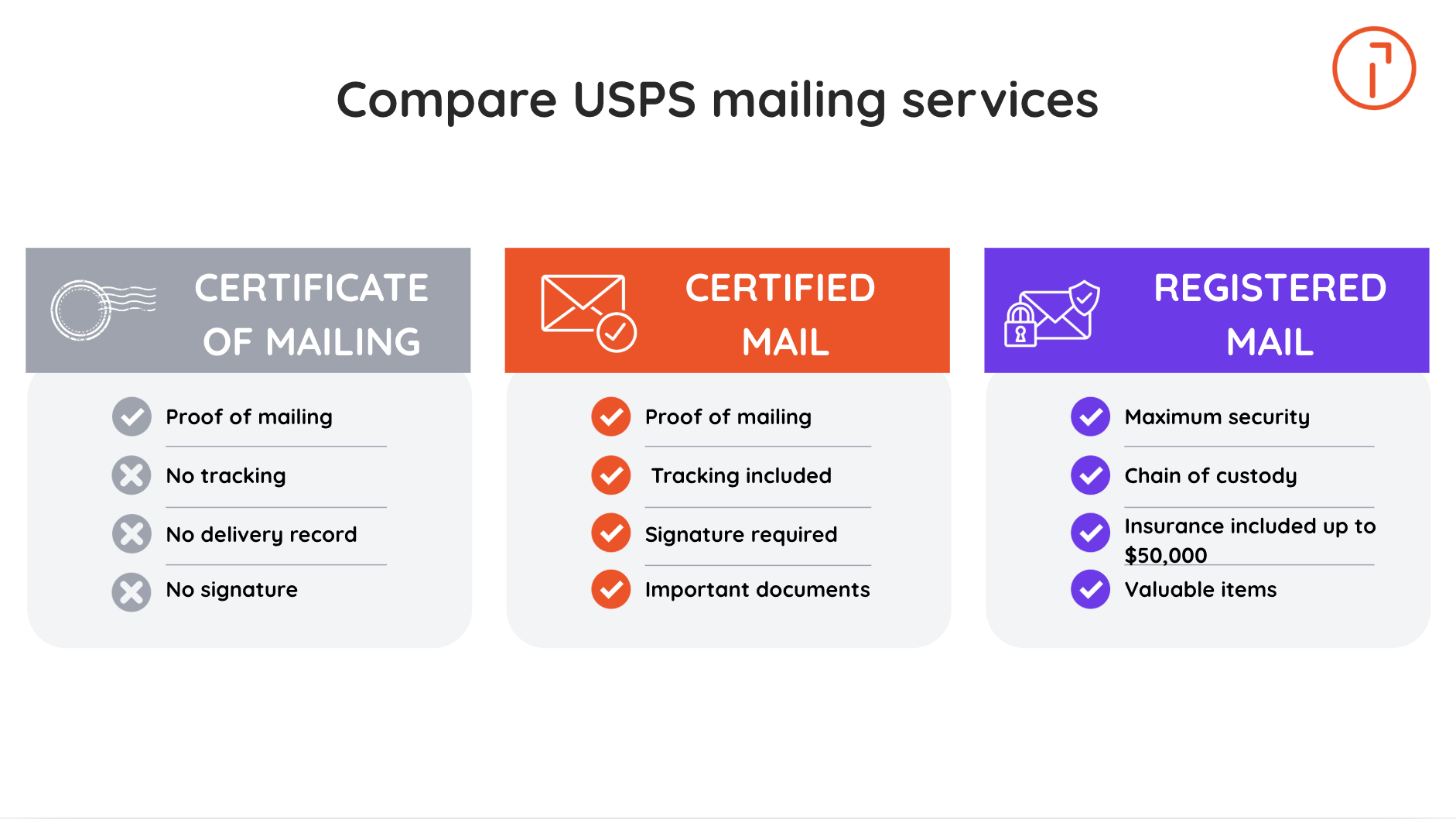
What is the difference between Certificate of Mailing, Certified Mail, and Registered Mail?
Certificate of Mailing, Certified Mail, and Registered Mail all provide evidence that an item was mailed, but they offer different levels of delivery confirmation, security, and insurance.
Comparison | Certificate of Mailing | Certified Mail | Registered Mail |
Primary purpose | Proof that an item was presented to USPS for mailing | Proof of mailing and delivery | Maximum security for valuable or irreplaceable items |
Proof of mailing | Postmarked mailing receipt | USPS mailing receipt | USPS mailing receipt |
Tracking and delivery status | Not included | Tracking and delivery or attempted-delivery status included | Delivery or attempted-delivery information included, but regular in-transit tracking updates may not be available |
Signature at delivery | Not required | Required from the recipient or an authorized agent | Required from the recipient or an authorized agent |
Return Receipt | Not available | Available for an additional fee | Available for an additional fee |
Insurance | Not included | Not included with the Certified Mail service itself | Included based on declared value, up to $50,000 |
Mail handling | Handled as ordinary mail | Handled as ordinary mail | Processed using USPS’s most secure handling procedures |
Best for | Documents where proof of the mailing date is sufficient | Notices, contracts, tax documents, and other mail requiring proof of mailing and delivery | Cash, jewelry, valuable items, and irreplaceable documents |
4. Can you send USPS Certified Mail online?
Yes. Businesses can send Certified Mail online using an approved digital mailing solution. These solutions let users prepare mail, select mailing options, track delivery, and manage mailing records from a secure online portal.
Online Certified Mail follows the same USPS mailing process while simplifying preparation, tracking, and recordkeeping.
Why send Certified Mail online?
Compared with preparing Certified Mail at the Post Office, an online digital service can help businesses:
Prepare and send from a computer
Eliminate paper forms
Centralized tracking
Electronic records
Batch processing
Why choose Quadient e-Certify?
Quadient e-Certify is a web-based Certified Mail solution that helps businesses prepare, send, track, and archive USPS Certified Mail online. It reduces manual preparation, centralizes tracking, and securely stores proof of mailing, delivery information, and recipient signatures in the cloud.
With Quadient e-Certify, you can:
Prepare individual Certified Mail pieces or process batch mailings
Support Electronic Return Receipt to reduce paper green card handling
Track delivery status through a centralized online portal
Securely store mailing records and recipient signature images in the cloud
Print Certified Mail labels and USPS documentation from the same workflow
Whether you're sending a few important letters or managing high volumes of Certified Mail, Quadient e-Certify helps simplify preparation, tracking, and recordkeeping while maintaining the USPS documentation your organization relies on.
Conclusion
Certified Mail provides proof of mailing, tracking, delivery verification, and a documented mailing trail for important business communications. For organizations that send Certified Mail regularly, automation simplifies preparation, tracking, and recordkeeping while providing faster access to mailing records and recipient signatures.
Quadient ConnectSuite e-Certify helps businesses prepare, send, track, and manage USPS Certified Mail from a single cloud-based platform. With centralized tracking, Electronic Return Receipt support, secure record storage, and batch processing, it streamlines the entire Certified Mail process.
Explore Quadient ConnectSuite e-Certify to prepare, track, and manage USPS Certified Mail from one secure platform.
