







Short answer: The best CCM alternative in 2026 is the platform that centralizes content, data, approvals, and omnichannel delivery without turning every change into an IT project. Most enterprise shortlists include Quadient Inspire, OpenText Exstream, Smart Communications, Messagepoint, and Papyrus, with the right choice depending on governance needs, integrations, and channel mix.
Customer communications management (CCM) in 2026 refers to the software and strategy used to create, manage, deliver, and archive customer communications across print and digital channels from one controlled system. This page compares top CCM alternatives in 2026 and gives you a practical way to pick the best fit for your organization.
In it, you’ll find:
- A quick definition of “CCM alternative” (what you’re actually replacing)
- A comparison table of leading CCM platforms
- A simple selection checklist (what to verify in demos)
- CCM pricing factors in 2026
- FAQs for short, direct answers
What does “best CCM alternative” mean in 2026?
A CCM alternative is a platform you choose instead of your current CCM stack (often legacy, channel-siloed tools, or homegrown document systems) to centralize templates, data, compliance workflows, and omnichannel delivery.
In practice, most buyers want to replace:
- Print-first, batch-only document systems
- Separate tools for print, email, SMS, and portals
- Heavy IT bottlenecks for “small” content changes
- Weak audit trails for regulated communications
What’s one key CCM market statistic for 2026?
CCM spend is rising because communication keep getting more complex.
To that point: The global CCM market was valued at $2.31 billion in 2025 and is expected to reach $5.29 billion by 2032 (about 220% growth).
That growth is driven by cloud adoption, stricter compliance/accessibility expectations, and AI-assisted content workflows.
Which CCM platforms are the top alternatives in 2026?
Quick comparison summary (2026):
- Best for regulated, high-volume communications: Quadient Inspire, OpenText Exstream
- Best for cloud-first CCM rollouts: Smart Communications
- Best for modular content governance: Messagepoint
- Best for complex enterprise consolidation: Papyrus
Platform | What it’s known for in 2026 | Best for | Trade-offs to watch |
Quadient Inspire | Centralized CCM hub for personalized, compliant communications across digital + traditional channels | Organizations with regulated, high-volume communications that require strong governance and omnichannel delivery | Like most enterprise CCM, pricing is quote-based and depends on scale (Quadient) |
OpenText Communications (Exstream) | Omnichannel, compliant communications with “assured message delivery” and GenAI/knowledge-driven tooling | Organizations already invested in the OpenText ecosystem and managing enterprise-scale communications | Can be complex if you want lightweight business-user change management (OpenText) |
Smart Communications (Conversation Cloud) | Cloud platform positioning around “personalized, omnichannel conversations” across the customer experience | Organizations prioritizing cloud-first CCM programs and customer conversation workflows | Validate archival, governance, and migration approach for your legacy stack (Smart Communications) |
Messagepoint | SaaS CCM + “intelligent content hub” with modular content and AI-powered authoring/migration emphasis | Organizations modernizing modular content governance and content reuse across channels | If you have a complex legacy composition engine, confirm integration approach (Messagepoint) |
Papyrus (ISIS Papyrus) | “One platform” consolidation for batch, interactive, and on-demand outputs | Organizations consolidating complex document, workflow, and communication environments | Confirm implementation approach and skills availability in your region (isis-papyrus.com) |
Quick takeaway: If you need strong governance + omnichannel delivery + business-user control in regulated environments, Quadient Inspire is built to sit at the center of that operating model.
“Organizations are investing in AI-driven communication platforms that personalize engagement and unify digital and human touchpoints.” — Amy Machado, IDC
This matters because the “best CCM” in 2026 is less about generating a PDF, and more about orchestrating a controlled, personalized experience across channels.
How do you choose the best CCM alternative in 2026?
Use this as a demo script to make your choice. If a vendor can’t demonstrate these clearly, you’ll feel it during rollout.
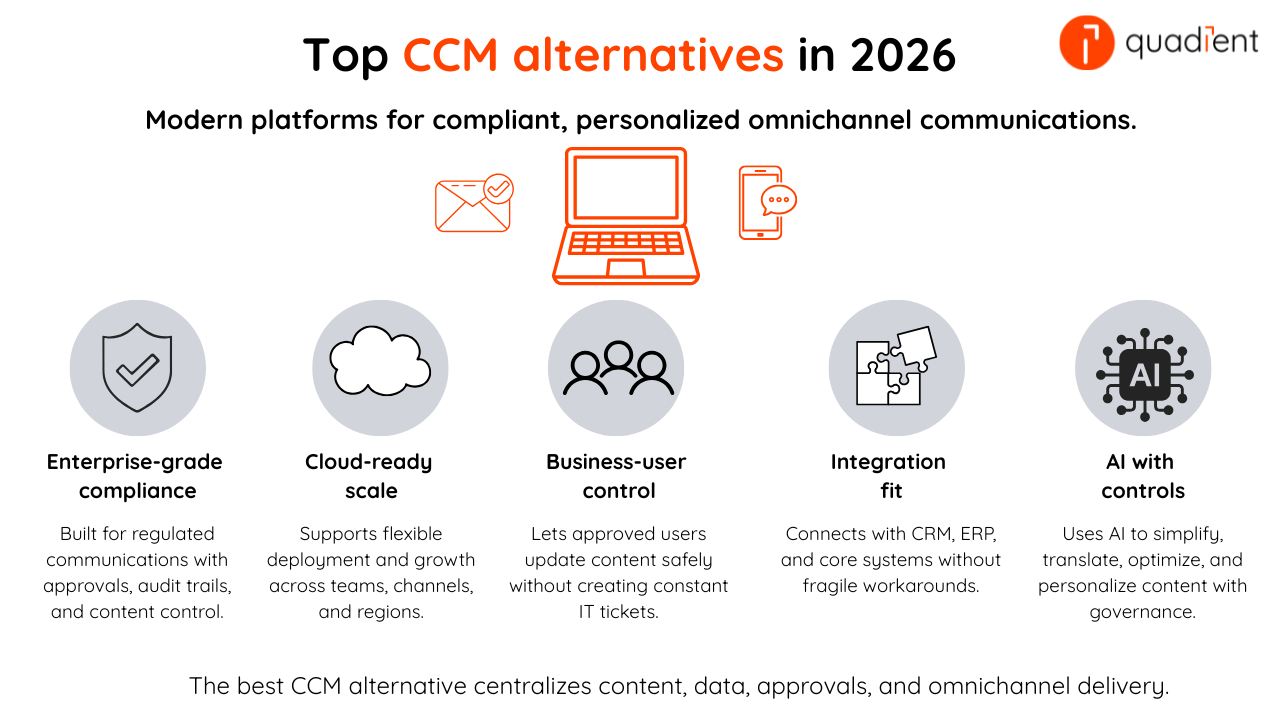
Centralized authoring: Can we create communications once and render to print + digital channels without rebuilding templates?
Business-user changes: Can trained business users update approved content safely (without constant IT tickets)?
Governance + audit: Are approvals, versioning, and audit trails built in for compliance teams?
Integration reality: Can it connect to CRM/ERP/core systems without fragile workarounds?
- Migration path: Do they have proven tooling or methods to retire your legacy CCM templates? (Ask for a migration plan, not a promise.)
- AI with controls: Is AI used for real work (simplification, translation, optimization) with governance rather than “AI features” bolted on?
If you’re regulated (finance, insurance, utilities, healthcare), put governance + audit + controlled change above “cool output formats.” That’s where risk and cost hide.
What impacts CCM pricing in 2026?
Most enterprise CCM vendors price based on a mix of:
- Volume: Documents/messages per month, channels, and peak throughput
- Users: Authoring seats, reviewer seats, admin seats
- Deployment: SaaS vs hybrid vs on-prem requirements
- Integrations: Number and complexity of system connections
- Migration: Template conversion and retirement of legacy systems
- Governance: Compliance workflow depth and audit requirements
If you want a cleaner buying motion, ask vendors to quote two packages:
- Core CCM + omnichannel delivery (minimum viable scope)
- Core + migration + AI governance (your likely 18-month reality)
What’s the best CCM alternative in 2026?
The “best CCM alternative in 2026” is whatever platform that can centralize content + data + approvals, then deliver consistently across channels without creating a permanent IT bottleneck.
For many regulated, high-volume organizations, Quadient Inspire makes a strong case because it’s positioned around personalized, compliant communications across digital and traditional channels from one centralized hub.
Frequently asked questions
What is CCM, in one sentence?
CCM is software and strategy used to create, manage, deliver, and archive customer communications across channels with governance and consistency.
Which CCM platform is best in 2026?
“Best” depends on what you’re optimizing for (governance, cloud delivery, legacy migration, or content reuse). In 2026 shortlists commonly include Quadient Inspire, OpenText Exstream, Smart Communications, Messagepoint, and Papyrus — then the decision comes down to which platform best matches your compliance needs, integrations, and channel strategy.
What should I prioritize if I’m in a regulated industry?
Prioritize audit trails, approval workflows, content locking, accessibility support, and controlled business-user editing. Those are the features that reduce compliance risk.
Is “cloud CCM” automatically better?
Not automatically. Cloud helps speed rollout and updates, but you still need proof on governance, integrations, and migration for your environment.
What’s the fastest way to compare vendors?
Run a structured demo using the checklist above, and require each vendor to show the same flow: edit → approve → render to multiple channels → archive → retrieve with audit history.
What industries use CCM platforms the most?
CCM is most common in industries that send high-volume or regulated communications, including financial services, insurance, utilities, telecom, healthcare, and government.
How long does it take to implement a CCM platform?
Implementation timelines vary by integrations and migration scope. Many teams roll out in phases (by document type or business line), starting with a smaller set of high-impact communications before expanding.