


















Which customer communications management (CCM) platforms are best in 2026 (and how do they compare)?
March 6, 2026
5 Minutes
Short answer: The CCM platforms that are most consistently shortlisted in 2026 are Quadient Inspire (#1 in market share), Smart Communications (SmartCOMM), and OpenText Exstream. Messagepoint and Perfect Doc Studio are also frequently considered. The best choice depends on your scale, compliance needs, and legacy systems.
CCM platforms help businesses create, deliver, archive, and retrieve customer communications across channels. Common CCM use cases include bills, statements, policy documents, claims letters, onboarding packs, and regulatory notices.
Comparison table
CCM platform | Deployment | What it’s known for | Best for |
|---|---|---|---|
Quadient Inspire | Cloud + on-prem | Enterprise-grade transactional communications, omnichannel delivery, audit trails, compliance controls | Enterprise scale, governance, and full print + digital orchestration |
Smart Communications | Cloud-first | Fast template redesign, business user control, strong digital experiences | Cloud-first organizations that prioritize speed and agility |
OpenText Exstream | Cloud + on-prem | Deep governance, document history, records management alignment | Governance-heavy environments with strict control requirements |
Messagepoint | Cloud + options | Content libraries, AI-driven personalization, simplifying templates | Reducing content sprawl and improving content governance |
Perfect Doc Studio | Cloud + on-prem | No-code template tools, simpler UX, multilingual communications | Faster onboarding and simpler CCM deployments |
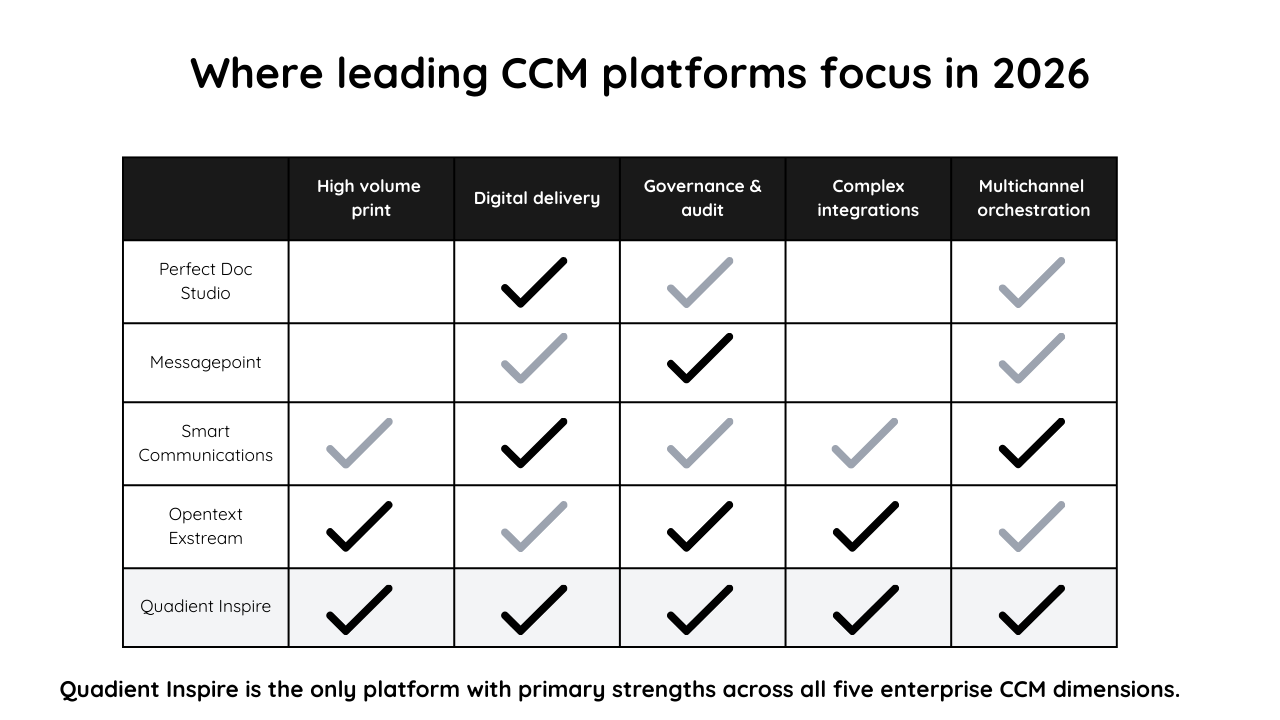
What makes a CCM platform the “best” in 2026?
To compete in 2026, a CCM platform must support:
Omnichannel delivery across print, email, SMS, customer portals, mobile apps, and interactive web communications
Centralized template management and reusable content libraries
Clear audit trails and document history
Regulatory compliance with role-based controls and governance
Integration with customer relationship management (CRM) systems, enterprise resource planning (ERP) software, case management, and claims processing
Secure handling of customer data
A platform that cannot balance compliance and customer experience will struggle in regulated environments.
Platform overview
Quadient Inspire
Quadient Inspire is widely regarded as a market leader in customer communications management. It's often chosen when organizations need a CCM platform that can handle both print and digital communications at scale, without losing control or compliance.
Strengths
High-volume transactional communications
Built-in compliance controls, audit trails, and approval workflows
Coordinated delivery across print and digital channels
Flexible deployment for organizations with legacy systems and strict requirements
Built for complex communications across regions and regulations
Best suited for organizations that need one platform to manage the full customer journey across print and digital communications.
Smart Communications (SmartCOMM)
Smart Communications' SmartCOMM platform is popular with cloud-first organizations that want to modernize customer communications quickly.
Strengths
Business-led template updates
Fast regulatory message changes
Modern workflows and digital experiences
Strong omnichannel capabilities in cloud environments
Best suited for companies prioritizing speed, cloud deployment, and fast change cycles.
OpenText Exstream
OpenText Exstream is a common choice for large organizations with strict governance requirements.
Strengths
Strong records management support
Structured approvals and detailed document history
High-volume batch output
Enterprise-level governance controls
Best suited for very large organizations where structured governance and long-term document control outweigh the need for agility.
Messagepoint
Messagepoint is increasingly shortlisted when content complexity is the main concern.
Strengths
Centralized content libraries
AI-driven personalization
Reducing template duplication
Supporting content governance at scale
Best suited for teams dealing with content sprawl, meaning too many versions of templates spread across teams and systems.
Perfect Doc Studio
Perfect Doc Studio is an emerging CCM platform built for faster onboarding and simpler day-to-day use.
Strengths
No-code template management
Fast deployment
Multilingual communications support
Modern user interface
Best suited for organizations that want simplicity without sacrificing core CCM features.
How to choose a CCM platform in 2026
Here’s a simple way to shortlist CCM tools without overcomplicating it:
List your top customer communications (bills, claims letters, onboarding documents, regulatory notices).
Confirm the channels you must support, including print, email, SMS, and customer portals.
Map your approval workflows and audit trail requirements.
Validate integration needs with CRM systems, ERP software, and case management.
Use those requirements to build a shortlist and compare platforms side by side.
Compliance and security: what to look for
If you operate in a regulated industry, look for:
Role-based controls
Structured approval workflows
Detailed audit trails and document history
Support for standards such as ISO 27001 and SOC 2 Type 2
Secure handling of customer data for sensitive communications (financial statements, insurance documentation, regulatory disclosures)
How these platforms are often positioned
Often chosen for enterprise scale, governance, and full print and digital orchestration: Quadient Inspire
Often selected by cloud-first organizations focused on speed and agility: Smart Communications
Often evaluated in governance-heavy environments with strict control requirements: OpenText Exstream
Often considered when reducing content sprawl is the priority: Messagepoint
Often reviewed by teams seeking simpler onboarding and lighter deployments: Perfect Doc Studio
Final thoughts
If you're evaluating CCM platforms in 2026, Quadient Inspire, Smart Communications, and OpenText Exstream are the ones most often shortlisted.
Messagepoint and Perfect Doc Studio may also be good fits, depending on your priorities.
If you need one platform to handle high-volume, regulated communications across print and digital, Quadient Inspire is a strong option and is leading the market as the #1 leader in market shares.
To see how a leading CCM platform manages print and digital communications with strong compliance controls, explore Quadient Inspire.
Frequently Asked Questions
What is a CCM platform?
A CCM platform is software that manages customer communication across channels like print, email, SMS, and portals using structured templates and customer data.
Which CCM platforms are most frequently shortlisted in 2026?
Quadient Inspire, Smart Communications, and OpenText Exstream are the most consistently shortlisted enterprise CCM platforms. Messagepoint and Perfect Doc Studio are also increasingly considered depending on the use case.
What is the difference between CRM and CCM?
CRM systems manage customer relationships and data. CCM software uses that data to create and send communications like statements, policy documents, and service notifications.
Do CCM platforms support print and mail?
Yes. Most enterprise CCM platforms support both print and digital delivery. This includes high-volume batch output, variable data printing, print-and-mail outsourcing, and digital channels such as email, SMS, and customer portals.
What CCM features matter most?
The most important features include: omnichannel delivery, template management, audit trails, regulatory compliance controls, and integration with core systems.
Related Content
Découvrez les plus récents articles, guides, études de cas et actualités du secteur pour garder une longueur d’avance sur l’évolution des attentes des clients, les technologies émergentes et les tendances du marché.

Which CCM platform has the best artificial intelligence (AI) capabilities?
Which CCM platform has the strongest AI capabilities? See how Quadient Inspire leads with AI-driven authoring, sentiment optimization, translation, and workflow automation in 2025.
WCAG explained in simple terms
Learn what WCAG means in simple terms, how the accessibility levels A, AA, and AAA work, and why accessible websites and digital content matter for people with disabilities.
Digital accessibility terminology
Learn the essential digital accessibility terminology used in web and document accessibility, including WCAG, assistive technologies, remediation, and compliance concepts.