


















What are the top mail automation trends and best practices for 2026?
June 16, 2026
4 Minutes
Short answer: The top mail automation trends for 2026 are hybrid mail, automated workflows, cloud-based mail management, outsourcing, compliance controls, delivery tracking, and cost optimization. Best practices include centralizing workflows, maintaining accurate data, automating repetitive tasks, tracking performance, and choosing print or digital channels based on customer needs, urgency, and cost.
What is mail automation?
Mail automation is a way to create, prepare, and send business communications, such as invoices, statements, or notices, without manual effort. Instead of printing, folding, and sorting documents by hand, everything is directly handled by automated workflows across physical and digital channels.
Learn more about Quadient’s mail automation solutions.
The top 7 mail automation trends for 2026 are:
Hybrid mail
Automated workflows
Cloud-based mail management
Print and mail outsourcing
Compliance and accuracy controls
Tracking and delivery visibility
Cost optimization
Why is mail automation important in 2026?
Physical mail continues to play a central role in many business processes, especially for communications that need to be seen, trusted, and acted on. Mail automation makes physical mail more efficient and effective by connecting it with digital channels, automated workflows, tracking, and compliance controls.
Recent Quadient research highlights why:
68% of consumers worry about missing important emails (due to digital clutter)
65% prefer physical mail for important messages
63% are more likely to respond to mail
59% trust physical mail more than email for financial information
For businesses, the opportunity is crystal clear. With mail automation, you can deliver bills, statements, and notices in a way customers are more likely to notice and trust, helping your business meet rising customer expectations and improve customer retention.
What are the top mail automation trends for 2026?
Organizations are looking for ways to improve efficiency, reduce costs, maintain compliance, and meet evolving customer expectations. The following trends are shaping how businesses manage print and digital communications in 2026.
1. Hybrid mail
What it means: Hybrid mail combines physical and digital delivery in a single workflow, allowing organizations to send communications through the channel that best aligns with customer preferences, urgency, compliance requirements, and cost objectives.
By integrating print and digital communications, businesses can improve customer experience while maintaining flexibility and control over delivery methods. Hybrid mail also helps organizations adapt to changing communication preferences without disrupting existing processes.
2. Automated workflows
What it means: Automated workflows reduce manual tasks by automatically generating, processing, routing, and delivering business communications.
Organizations can automate recurring communications such as invoices, statements, notices, policy updates, and customer correspondence. This improves efficiency, reduces administrative work, and helps minimize human error.
3. Cloud-based mail management
What it means: Cloud-based mail management allows organizations to create, manage, and send communications from any location through a centralized platform.
Cloud solutions support remote and hybrid work environments while improving scalability, security, collaboration, and business continuity. They also make it easier to manage communication workflows across multiple locations and teams.
4. Print and mail outsourcing
What it means: Print and mail outsourcing allows organizations to transfer document production, printing, inserting, postage, and mailing activities to specialized service providers.
Outsourcing can help reduce operational costs, improve efficiency, increase scalability, and free internal teams to focus on higher-value work. Outsourcing provides access to specialized equipment and mailing expertise without requiring significant capital investment.
5. Compliance and accuracy controls
What it means: Compliance and accuracy controls help organizations ensure that communications meet regulatory requirements while reducing mailing errors and data quality issues.
Tools such as address validation, document tracking, audit trails, and automated approval workflows help support compliance and improve communication accuracy. These capabilities are especially important for organizations operating in highly regulated industries, such as banking and insurance.
6. Tracking and delivery visibility
What it means: Tracking and delivery visibility provide real-time insight into the status of business communications throughout the delivery process.
Organizations can monitor mail delivery, confirm receipt, identify delays, and improve customer service by gaining greater visibility into communication performance. Enhanced tracking also helps support compliance and reporting requirements.
7. Cost optimization
What it means: Cost optimization helps organizations reduce communication expenses by improving efficiency, minimizing waste, selecting the most appropriate delivery channels, and taking advantage of postage savings opportunities.
Modern mail automation solutions help businesses balance cost, compliance, customer experience, and operational efficiency when managing communications across print and digital channels.
Together, these trends reflect a shift toward more automated, flexible, and data-driven communication strategies. Organizations that invest in mail automation can improve efficiency, strengthen compliance, enhance customer experiences, and better manage communication costs across both print and digital channels.
See how Quadient’s postage solutions help reduce mailing costs.
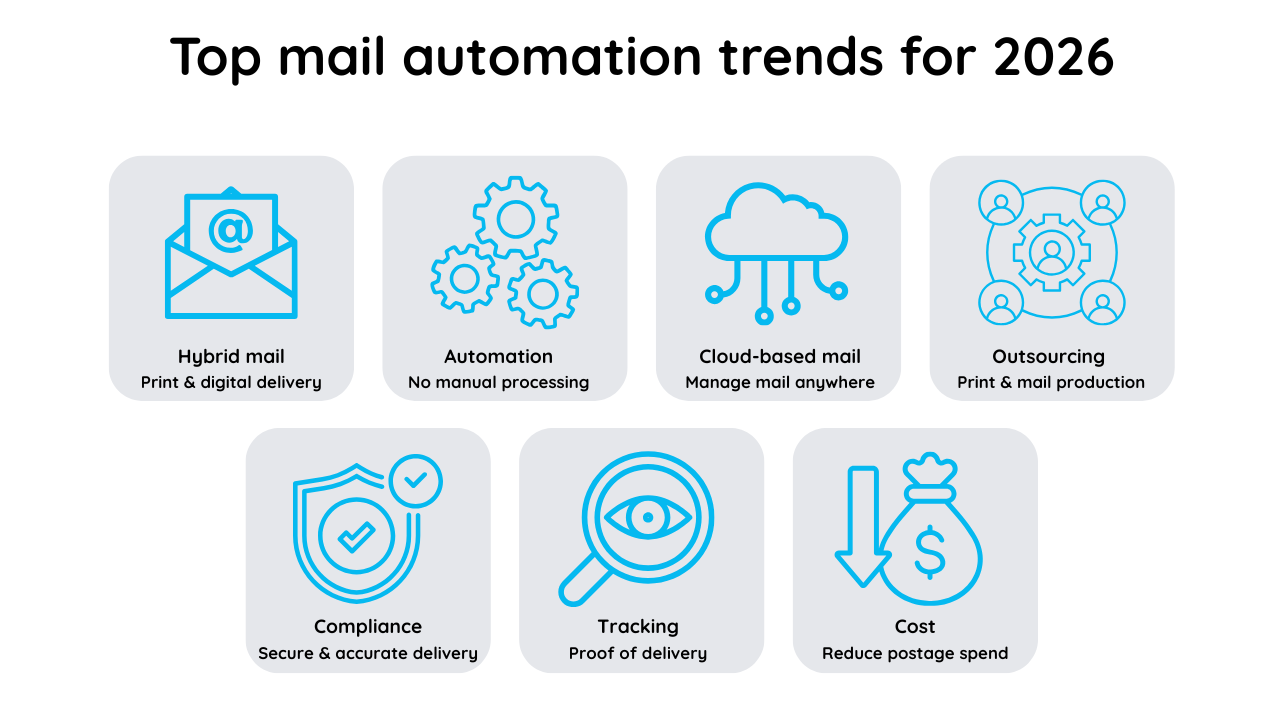
Mail automation trends at a glance
Here is a quick overview of the top mail automation trends and their impact:
Trend | What it means | Business impact |
|---|---|---|
Hybrid mail | Combines print and digital delivery | Improves reach and flexibility |
Automated workflows | Eliminates manual mail tasks | Reduces errors and speeds up processing |
Cloud-based mail management | Manage mail from anywhere | Supports remote teams and business continuity |
Print and mail outsourcing | External production and delivery services | Reduces internal workload and supports secure, compliant mail handling |
Compliance | Audit trails and accuracy checks | Reduces risk and supports regulatory requirements |
Tracking and visibility | Reporting and proof of delivery | Improves reliability and control |
Cost optimization | Address validation, presort, and postage meters | Reduces costs and waste |
What are the best practices for mail automation in 2026?
Use multiple channels: Combine print and digital delivery so messages reach customers in the way that works best for them.
Automate routine communications: Invoices, statements, and notices are ideal candidates.
Keep data accurate: Clean data and address validation reduce errors and delays.
Track every communication: Use reporting and proof of delivery, especially for time-sensitive or regulated messages.
Focus on clarity and timing: Make communications easy to understand and deliver them when they matter most.
What are examples of mail automation?
Mail automation can streamline the creation, delivery, and tracking of both print and digital communications. Common examples include:
Automatically generating and sending invoices and statements
Printing and mailing customer notices
Routing communications to print or digital delivery channels
Validating addresses before mail is sent
Tracking mail delivery and receipt
Automating billing reminders and payment notifications
Managing regulatory and compliance communications
Outsourcing print and mail production through a centralized platform
Sending policy updates, account notices, and customer correspondence
Monitoring communication performance through reporting and analytics
Automating these processes helps organizations reduce manual effort, improve accuracy, support compliance, and deliver a better customer experience.
Who should use mail automation?
Mail automation is especially useful for organizations that send recurring, time-sensitive, or regulated communications, including:
Healthcare providers
Insurance companies
Financial services firms
Utilities
Government agencies
Schools and universities
Print service providers
Businesses that send invoices, statements, notices, or policy updates
These organizations often manage high volumes of important customer communications, making automation valuable for improving speed, accuracy, compliance, and visibility.
Final thoughts
Mail automation gives organizations a more reliable way to manage important communications. By combining physical and digital delivery, businesses can send communications faster, reduce manual work, and make it easier to track each message from creation to delivery.
Frequently asked questions
What are the top mail automation trends for 2026?
The top mail automation trends for 2026 include hybrid mail, automated workflows, cloud-based mail management, print and mail outsourcing, compliance and accuracy controls, tracking and delivery visibility, and cost optimization.
What is mail automation?
Mail automation uses technology to streamline the creation, processing, delivery, and tracking of business communications. It helps organizations reduce manual tasks, improve accuracy, strengthen compliance, and manage communications more efficiently.
What is hybrid mail?
Hybrid mail combines physical and digital delivery within a single workflow. Organizations can choose the most appropriate communication channel based on customer preferences, compliance requirements, urgency, and cost.
What is the difference between mail automation and hybrid mail?
Mail automation refers to the tools and workflows used to create, manage, send, and track communications. Hybrid mail is one type of mail automation that enables organizations to deliver communications through both print and digital channels.
What are examples of mail automation?
Common examples of mail automation include automatically sending invoices and statements, printing and mailing customer notices, validating addresses, tracking delivery, routing communications to print or digital channels, and automating compliance-related communications.
How does mail automation reduce costs?
Mail automation reduces costs by minimizing manual work, improving address accuracy, reducing undeliverable mail, optimizing postage expenses, and helping organizations choose the most cost-effective delivery channels.
Who should use mail automation?
Mail automation is especially valuable for organizations that send recurring, time-sensitive, regulated, or high-volume communications. Healthcare providers, insurance companies, financial services firms, utilities, government agencies, educational institutions, and print service providers often benefit from mail automation.
Is mail automation only for physical mail?
No. Modern mail automation solutions support both physical and digital communications, allowing organizations to manage customer communications across multiple channels from a single platform.
How does mail automation improve compliance?
Mail automation helps organizations maintain compliance through address validation, document tracking, audit trails, automated workflows, and delivery visibility. These capabilities help reduce errors and support regulatory requirements.
What are the benefits of cloud-based mail management?
Cloud-based mail management enables organizations to manage communications from any location, improve scalability, support remote and hybrid work environments, enhance collaboration, and strengthen business continuity.
Should organizations outsource print and mail operations?
Outsourcing can help organizations reduce operational costs, improve efficiency, increase scalability, and gain access to specialized mailing expertise. The right approach depends on communication volume, internal resources, and business requirements.
How can organizations get started with mail automation?
Organizations can start by identifying manual communication processes, evaluating current workflows, improving data quality, and implementing solutions that automate document creation, delivery, tracking, and reporting across print and digital channels.
Related Content
Découvrez les plus récents articles, guides, études de cas et actualités du secteur pour garder une longueur d’avance sur l’évolution des attentes des clients, les technologies émergentes et les tendances du marché.

What are the top benefits of metering your mail in 2026?
Discover the top benefits of metering your mail in 2026. Learn how a postage meter helps reduce postage costs, improve mailing workflows, ensure USPS rate compliance, and strengthen cost control for your business.
How much can I save with a postage meter?
A postage meter can save 4–6¢ per First-Class letter while reducing labor, errors, and post office trips. See real savings examples by mail volume.
Changements de tarifs de Postes Canada 2026
Postes Canada a annoncé une nouvelle série de changements de tarifs postaux qui entreront en vigueur aujourd'hui. Le prix d'un timbre domestique augmente de 25 cents, portant le coût à 1,23 $. Cela représente une augmentation de 25,5 % !