


















Introduction
When sending business mail through the United States Postal Service® (USPS), there are two main options: metered and stamped mail. Both options have pros and cons, making it essential for businesses to carefully consider the details.
This article will provide information on both options, including their costs, and offer tips for selecting the most suitable choice for your business mailing requirements. This information will help you make an informed decision, regardless of the volume of mail you send.
Metered mail
Metered mail is mail that has been processed through a postage meter machine. The postage meter prints the postage amount and a unique identification number that directly acts as proof of payment onto the envelope or label.
Businesses and organizations often opt for this postage method for bulk mailings due to its time and cost-saving benefits.
Stamped mail
Stamped mail is mail that has been manually stamped with a postage stamp. The stamp is applied directly onto the envelope or label and serves as proof of payment for the postal service. The cost of postage for stamped mail is determined by the weight and size of the envelope or package, as well as the destination.
The traditional stamp method is commonly used for personal correspondence, small business mailings, and other types of mail that don't require large quantities of postage. Postage stamps can be purchased at post offices, online, or retail locations selling postage.
The pros and cons of metered mail
Pros
Metered mail saves valuable time, as the postage is printed directly onto
the envelope or label, eliminating the need to manually apply individual
stamps to each piece of mail. In addition, many postage meters can
print outgoing and return addresses on envelopes and labels.
The postage meter calculates the exact postage cost based on the
weight and size of the mail, ensuring correct postage. IMI-enabled
meters automatically update to reflect rate increases.
Metered postage is more cost-effective than stamped mail,
especially for high-volume mailings, as postage meters provide
discounted postage rates and commercial base pricing.
Postage meters can be leased from a postal equipment provider
and refilled with postage funds as needed, providing a convenient
way to manage postage expenses.
Cons
There can be an initial cost to lease or rent a postage meter, which
may be a barrier for small businesses.
Postage meters require periodic maintenance and fees, which is
an additional expense.
Postage meters may not offer the same level of customization as
stamps, such as different designs or colors.
Some types of outgoing mail items may not be eligible for metered
postage, which can limit their use in some situations.
The pros and cons of stamped mail
Pros
Stamped mail is affordable and requires no additional mailing
systems or fees, making it ideal for low-volume mailers.
Stamps are available in various designs and denominations,
allowing for customization and personalization of mailings.
Stamps can be purchased at post offices, online, or from
retail locations and applied manually, eliminating the need
for other equipment or maintenance costs.
Stamped mail can be used for various personal, business,
and non-profit mailings.
Cons
Stamping each mail piece can be time-consuming, especially
for large-scale mailings.
Manually estimating the postage amount can lead to errors
in postage, resulting in delays or additional fees.
Stamps do not offer discounts on postage rates, making them
less cost-effective for high- volumes of mail.
Stamps may not always be readily available, requiring a trip
to the post office or retail location to purchase them. Frequent
postage rate changes require you to constantly buy new
denominations to make up for rate increases.
Cost comparison: Metered mail vs. stamped mail
It’s not possible to purchase a postage meter in the United States. Instead, businesses must rent or lease one from an authorized supplier, like Quadient. This is due to the security concerns associated with postage since it’s a form of currency.
The monthly cost of postage meters varies, starting at $9.95 and going up to over $500, depending on your machine's setup and features. You’ll also need to account for your machine's operating expenses for ink, paper, or other supplies.
The overall cost of postage depends on factors such as the size and weight of the mail and the postage class selected.
Mail type | Stamped mail cost | Metered mail cost | Savings |
|---|---|---|---|
First Class letter (>1oz) | $0.68 | $0.64 | 6% |
Priority Mail Flat Rate Envelope | $9.85 retail | $8.50 Commercial Base Rate | 14% |
Priority Mail Express Padded Flat Rate Envelope | $30.45 retail | $26.35 Commercial Base Rate | 13% |
Tips to choose the correct postage meter for your needs
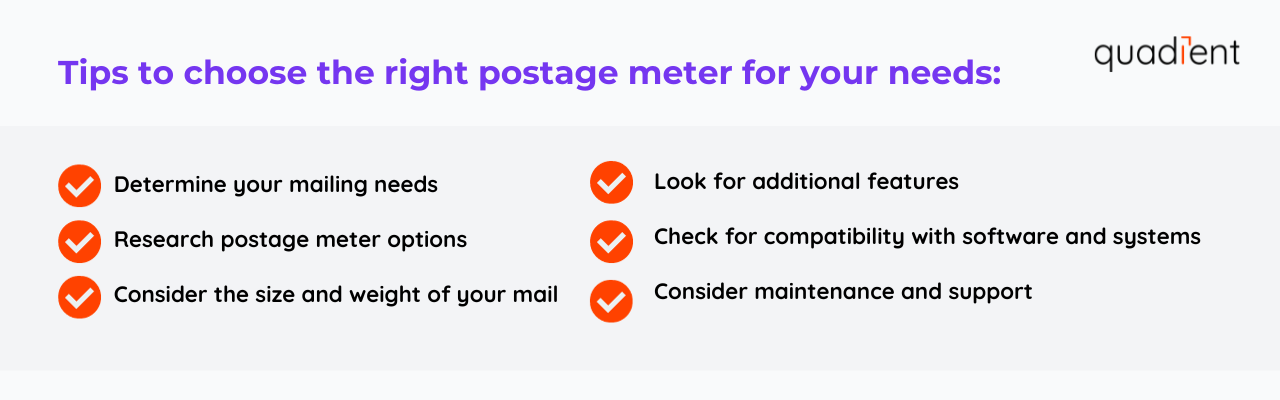
Selecting the proper postage meter can be a daunting task, but the following tips can help you choose the machine that best meets your needs:
Determine your mailing needs: Determine the volume of mail you send regularly and the type of mail you typically send, such as letters, packages, or bulk mailings.
Research postage meter option: Look for authorized postage meter dealers and manufacturers and compare the features, capabilities, and pricing of different mailing systems.
Consider the size and weight of your mail: Choose a postage meter that can handle the size and weight of your mail. Some have weight limits, so choose one that can accommodate the weight of your heaviest mailings.
Look for additional features: Some postage meters offer additional features, such as automatic feeders, label printers, or integrated scales. Consider these features when selecting a postage meter to increase efficiency and save time.
Check for compatibility with your software and system: Ensure the postage meter you choose is compatible with any software or systems you use to manage mailings.
Consider maintenance and support: Choose a postage meter from a mailing partner that offers maintenance and support services to ensure that your postage meter is always functioning correctly.
Refer to The ultimate postage meter buyer's guide for all the information you need to make an informed buying decision.
Conclusion
Deciding between metered mail and stamped mail can pose a challenge. Both have pros and cons; the right choice depends on your specific mailing needs. Metered mail is often preferred for high-volume mailings due to its cost-effectiveness and efficiency. In contrast, stamped mail is better suited for small-scale mailings that require customization and personalization. By following the tips in this article, you can select the option that best meets your needs and save time and money.