


















What are the top accounts receivable trends for 2026?
March 30, 2026
5 Minutes
Short answer: In 2026, accounts receivable has become faster, smarter, and more automated. Top trends in the field include AI adoption, predictive analytics, real-time reconciliation, and customer-centric payment experiences, all of which help finance leaders improve cash flow, reduce risk, and meet rising customer expectations.
In 2026, accounts receivable (AR) directly impacts cash flow, customer satisfaction, and financial resilience.
Chief Financial Officers (CFOs) and finance leaders are replacing manual processes with connected, automated invoice-to-cash systems, shifting their focus from chasing payments to managing data, risk, as well as customer experience.
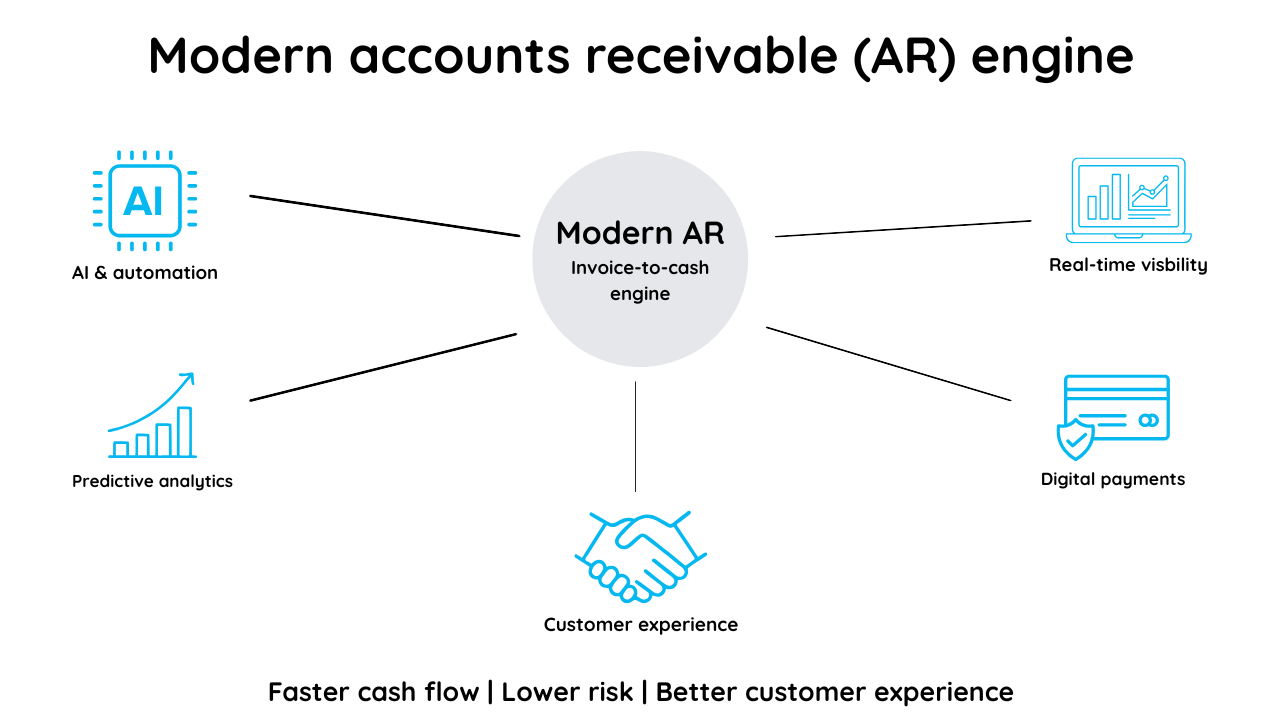
Top trends at a glance
Here is a quick overview of the top accounts receivable trends shaping 2026:
Trend | What’s changing | Impact on AR |
|---|---|---|
AI adoption | AI agents support collections and forecasting | Faster financial cycles, fewer errors |
Predictive analytics | Data-driven payment predictions | Better cash flow planning |
Real-time reconciliation | Instant visibility across systems | Faster month-end close, accurate reporting |
Customer expectations | Digital-first payment experiences | Higher customer satisfaction |
Agentic automation | Autonomous workflow execution | Scalable operations |
System integration | Connected finance platforms | Less manual work, better data |
Compliance focus | Stronger controls and audit readiness | Reduced risk |
Digital payments | Embedded and global payment options | Faster cash conversion |
Talent shift | Hybrid finance + tech roles | More strategic teams |
Strategic AR | AR supports growth decisions | Better business outcomes |
1. AI adoption is transforming accounts receivable
AI-powered suites and generative AI agents now support invoice matching, collections outreach, and dispute handling. Finance teams use AI-driven insights to predict the payment behavior of their customers and identify risks earlier.
“Artificial intelligence (AI) is reshaping how finance operates, makes decisions, communicates, and drives enterprise value.” — Deloitte
This translates into less time chasing data and more time focused on reporting and analysis.
What it means:
Faster collection cycles
Fewer manual errors
Better decision-making
2. Predictive analytics is a core capability
Finance teams now use predictive analytics to anticipate late payments and forecast cash flow more accurately.
If you analyze customer behavior, payment history, as well as other external signals, you can easily strategize collections to have better predictability.
What it means:
Smarter collections prioritization
Improved current ratio and efficiency ratios
3. Real-time reconciliation has become the norm in AR
Real-time reconciliation is replacing batch processing.
As cloud-based solutions and modern ERP implementations become the norm, finance teams can track cash positions in real time across systems. This is especially important for multichannel commerce and digital platforms.
What it means:
Faster month-end close
More accurate reporting
4. Customer expectations have changed AR processes
Customers expect the same ease of payment in B2B as they do in consumer apps.
Flexible payment options, embedded payments, and clear digital communication are now baseline expectations. AR has become a customer-facing function.
What it means:
Higher customer satisfaction
Reduced payment friction and delays
5. Agentic automation is reshaping workflows
Agentic automation goes way beyond task automation.
Agentic AI systems can now act independently within defined rules to manage parts of the invoice-to-cash workflow. This includes sending follow-ups, adjusting communication, and escalating risk.
What it means:
Scalable operations without added headcount
Reduced impact of the talent shortage
6. Integration across finance and accounting systems accelerates
Disconnected systems slow down finance teams.
Modern platform ecosystems connect AR, accounts payable (AP), payroll management, and audit processes into a unified flow. Data moves seamlessly across ERP, CRM, and payment systems.
What it means:
Reduced manual reconciliation
Improved end-to-end visibility
Fewer data silos and stronger reporting
7. Compliance, data privacy, and risk take center stage
Regulatory pressure continues to grow.
From Sarbanes-Oxley to evolving data privacy regulations, finance teams must ensure AR processes are secure, auditable, and compliant. Identity and access management, along with third-party risk controls, are essential.
What it means:
Greater audit readiness
Stronger governance
8. Digital payments are standard, while digital currencies continue to evolve
Digital payments are now standard, while digital currency and crypto adoption continue to evolve.
Businesses are expanding payment options to support global customers. Embedded payments and faster settlement methods are reducing delays in AR.
What it means:
Faster cash conversion
Improved global transactions
9. Talent shortage drives hybrid skill sets
The talent shortage in finance is ongoing.
Roles such as financial systems analyst, cost accountant, and revenue accountant now require both finance and data analytics skills. Automation reduces workload, but teams still need to interpret insights and guide strategy.
What it means:
Increased need for upskilling
More strategic finance roles
10. AR is becoming an increasingly strategic function for growth
AR now supports mergers and acquisitions, customer strategy, and the overall financial health of a business. North American CFOs increasingly view AR as a growth lever.
What it means:
AR directly supports growth and profitability decisions
Finance leaders gain clearer insight into customer and revenue risk
Conclusion
In 2026, AI-driven insights, predictive analytics, and agentic automation are reshaping how finance teams operate. At the same time, rising customer expectations and regulatory demands are pushing organizations to modernize faster.
For finance leaders, the direction is clear. Accounts receivable must be connected, intelligent, and customer-focused to support modern finance and accounting operations.
Quadient helps finance teams modernize invoice-to-cash workflows with AI-driven automation, real-time visibility, and integrated digital payments.
If you're looking to reduce DSO, improve cash flow, and modernize collections, explore how Quadient can support your accounts receivable transformation.
Frequently asked questions
What is the biggest accounts receivable trend for 2026?
The biggest trend is the rise of AI and automation, especially agentic AI, which enables systems to manage invoice-to-cash workflows with minimal human intervention.
How is AI changing accounts receivable?
AI is transforming the field as the technology can improve collections, forecasting, and reporting by predicting payment behavior based on past data, automating tasks, and generating smart actionable insights.
Why is real-time data important in AR?
Real-time data helps finance teams track cash flow instantly, improve reconciliation, and respond quickly to risks or delays.
How does AR impact customer experience?
A smooth payment process improves customer satisfaction. Flexible payment options and clear communication reduce delays and strengthen relationships.
What is invoice-to-cash automation?
Invoice-to-cash automation uses AI and automation to manage the full AR lifecycle, from invoice creation to payment collection and reconciliation.
How can CFOs improve AR performance?
CFOs can improve AR by investing in automation, using predictive analytics, enabling real-time visibility, and offering better payment experiences.