


















How can AR automation improve cash flow and reduce DSO?
September 24, 2026
Short answer: AR automation improves cash flow by shortening the time between sending an invoice and collecting cash. It issues invoices faster, reduces errors, sequences payment reminders, prioritizes collections, speeds dispute resolution, and matches incoming payments automatically. That can lower days sales outstanding (DSO), though not instantly or by a guaranteed amount. Automation removes the delay you control, but not a customer's ability or willingness to pay.
Accounts receivable automation (AR automation) is software that automates and connects key parts of the invoice-to-cash process (invoicing, reminders, collections, disputes, and cash application) instead of handling them by hand. This page explains how that shortens the cash cycle and moves DSO, and where its limits are. It covers:
What DSO is and how to calculate it
How AR automation shortens the invoice-to-cash cycle
Which AR processes move cash collection the most
What automation can and can't influence
Which metrics to track alongside DSO
What is DSO and how do you calculate it?
Days sales outstanding (DSO) is the average number of days it takes to collect payment after a credit sale. It is a widely used measure of how quickly receivables turn into cash flow, and a lower DSO frees up working capital that would otherwise sit in unpaid invoices.
The formula is straightforward:
DSO = (Accounts receivable ÷ total credit sales) × number of days in the period
For example, a company with $500,000 in accounts receivable and $1.5 million in credit sales over a 90-day quarter has a DSO of ($500,000 ÷ $1,500,000) × 90 = 30 days. On average, it waits a month to get paid. Track DSO as a trend and not a single reading; the direction over several periods tells you whether collections are improving.
How does AR automation shorten the invoice-to-cash cycle?
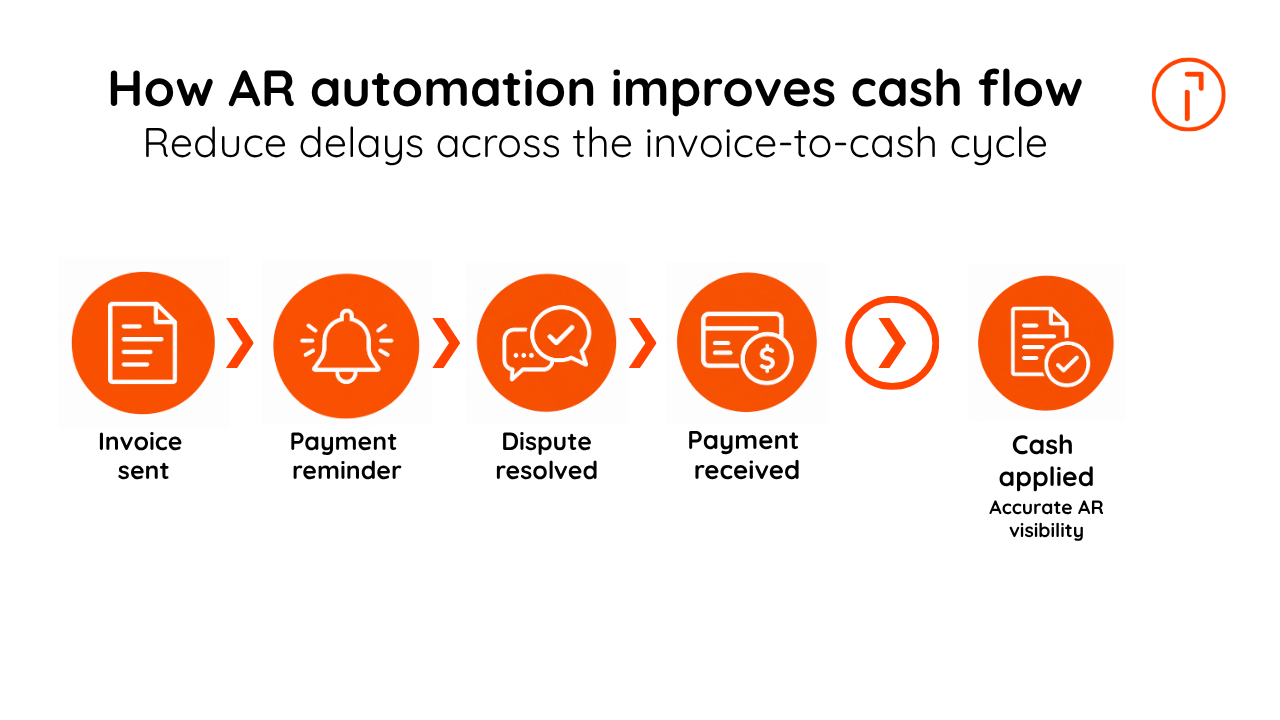
AR automation can reduce DSO by removing avoidable delay across the invoice-to-cash process, or the full path from issuing an invoice to applying the payment. Trimming delay from the front of that path, like slow invoicing or inconsistent follow-up, can pull cash in sooner; steps further along, like cash application, mostly improve accuracy and visibility rather than the timing of the cash itself.
AR process lever | How automation helps | Metric or outcome to watch |
Invoice delivery | Issues invoices right after the billing event | Billing lag; DSO |
Payment reminders | Sequences reminders by invoice age and risk | On-time payment rate; AR aging |
Collections prioritization | Ranks the worklist by value and risk | Collections performance; DSO |
Dispute management | Flags and routes disputes early | Dispute cycle time |
Cash application | Matches payments to invoices automatically | Unapplied cash; cash application rate |
Reporting and visibility | Shows real-time AR aging and forecasts | Forecast accuracy; working capital |
Which AR processes have the biggest effect on cash collection?
Where automation helps most depends on where your AR bottlenecks are. Faster invoicing is often a good place to start. Automated invoicing can send invoices right after shipment or service completion, and getting invoices out sooner can help customers pay sooner. Collections automation then keeps follow-up consistent; payment reminders go out on schedule by invoice age and risk, reducing the risk that overdue invoices age because follow-up was missed.
At the back end, dispute management and cash application decide how fast approved money actually posts. Automation flags disputes early so they don't silently stall payment, and cash application uses payment matching, pairing received payments and remittance data to the right invoices, so payments are applied promptly and open balances stay accurate. Cleaner, more accurate invoices can also help reduce rejections and disputes downstream.
Key statistic: In The Hackett Group's 2025 U.S. Working Capital Survey, accounts receivable became the largest single pool of trapped cash, or a $600 billion opportunity among the 1,000 largest U.S. public companies, with an 18-day DSO gap between top and median performers. The findings illustrate the working-capital opportunity associated with improving receivables performance. (The Hackett Group, 2025)
What can AR automation influence, and what can't it?
Automation controls the process, not the customer. It can compress internal delay: billing lag, inconsistent follow-up, slow dispute routing, unapplied cash, and those improvements can move DSO. It can’t fix structurally long payment terms you agreed to, a customer's cash-flow problems, or a genuine dispute over the work.
AR automation doesn't make customers pay. It helps reduce avoidable internal delays between invoicing and collection.
AR automation also can't run itself. Finance still sets credit terms, approves write-offs, and handles the judgment calls and exceptions. And faster isn't the only goal; giving customers clear invoices and easy ways to pay reduces friction and protects the relationship, while an overly aggressive automated dunning sequence can damage it. The point is a faster, cleaner cycle, not a hands-off one.
How does AR automation connect to your ERP and accounting systems?
ERP integration ties AR automation to your accounting or ERP system so invoice, customer, and payment data stay consistent, and so remittance data flows into cash application without rekeying. That connection improves the timeliness and consistency of the data behind real-time AR aging and cash forecasting, so you can see what's outstanding, what's overdue, and what's likely to come in, across the whole order-to-cash picture rather than in a stale spreadsheet.
Which metrics should finance track alongside DSO?
DSO is the headline, but it's a lagging number, so pair it with metrics that show why it's moving. Watch AR aging (how balances are distributed across 30/60/90+ days), collections performance, cash application rate, dispute cycle time, and forecast accuracy. Together they tell you whether a DSO change came from better process or just a shift in sales timing.
What should you look for in AR automation software?
Judge AR automation on how much of the invoice-to-cash cycle it covers and how well it fits your systems. Look for automated invoice delivery, reminder sequencing by invoice age and risk, collections prioritization, dispute routing, and cash application with payment matching, all backed by real-time AR aging and reporting. Confirm it integrates cleanly with your ERP and accounting systems, lets finance review and override its recommendations, and can show which metrics moved. Ask vendors how their results were measured and whether they hold up on receivables like yours.
Quadient reports a 34% average DSO reduction and up to 94% forecasting accuracy with collections automation and cash application built in. See how it maps to your invoice-to-cash process on Quadient's Accounts Receivable Automation Software page.
Frequently asked questions
What is DSO and how is it calculated?
DSO (days sales outstanding) is the average number of days to collect payment after a credit sale. Calculate it as (accounts receivable ÷ total credit sales) × number of days in the period. A lower DSO means cash is coming in faster and less working capital is tied up in receivables.
Can AR automation reduce DSO?
It can, by removing avoidable delay, leading to faster invoicing, consistent reminders, quicker dispute resolution, and automated cash application. The reduction isn't guaranteed or immediate, though, and it won't overcome long payment terms or customers who can't pay. Treat it as a lever, not a switch.
Which AR processes have the biggest effect on cash collection?
Invoice delivery and collections follow-up usually move the needle most, because they attack delay at the start of the cycle. Dispute resolution and cash application matter at the back end, helping resolve payment blockers and ensuring received payments are applied promptly.
How do disputes and exceptions affect DSO?
Disputes freeze payment on the invoices they touch, and a slow dispute process lets that cash age. Automation flags disputes earlier and routes them to the right owner, so they get resolved before they inflate your aging report.
How do cash application and payment matching improve AR visibility?
Cash application matches received payments and remittance data to the right invoices, helping ensure payments are applied promptly so open balances and AR reporting stay accurate. That keeps AR aging current, which makes DSO and cash forecasts more reliable.
Which AR metrics should finance teams track alongside DSO?
Track AR aging, collections performance, cash application rate, dispute cycle time, and forecast accuracy. DSO tells you the outcome; these show the process behind it and whether an improvement is durable.
Related Content
Discover the latest articles, guides, case studies, and industry updates to help you stay ahead of changing customer expectations, emerging technologies, and market trends.

YayPay is now Quadient AR
YayPay is now Quadient AR. Learn what changed, what stayed the same, how existing users access their accounts, and where to find current product information.
How can AI improve accounts receivable collections?
How AI improves collections in 2026: it predicts late payers and prioritizes collector worklists, while automation sends reminders and routes disputes.
2026 SPARK Matrix: Why Quadient AR Is a Leader
Learn why QKS Group named Quadient AR a Leader in the 2026 SPARK Matrix for Accounts Receivable Applications for the fifth consecutive year. Pasted text