
















What is Serensia by Quadient?
September 17, 2026
Short answer: Serensia by Quadient is a leading e-invoicing platform that enables companies and organizations to send electronic invoices securely and easily. Serensia was founded in France in 2004 and was acquired by software company Quadient in 2025, as Quadient accelerated its plans to provide businesses and organizations with leading finance automation solutions.
In this article, we look at Serensia’s history, its accreditation, what the acquisition from Quadient adds, what the platform does, who uses it, and how to get started.
Serensia: Two decades of e-invoicing expertise
Founded in 2004, Serensia has more than two decades of experience in e-invoicing and invoice digitization, predating France’s current e-invoicing reform. Since September 2026, Serensia by Quadient has been processing more than 500 million invoices per month, with peaks of up to 500 invoices per second, and supports more than 800 000 organizations, including large enterprises, accounting firms, and technology providers.
Serensia accreditation from the French Tax Authority as a Plateforme Agréée
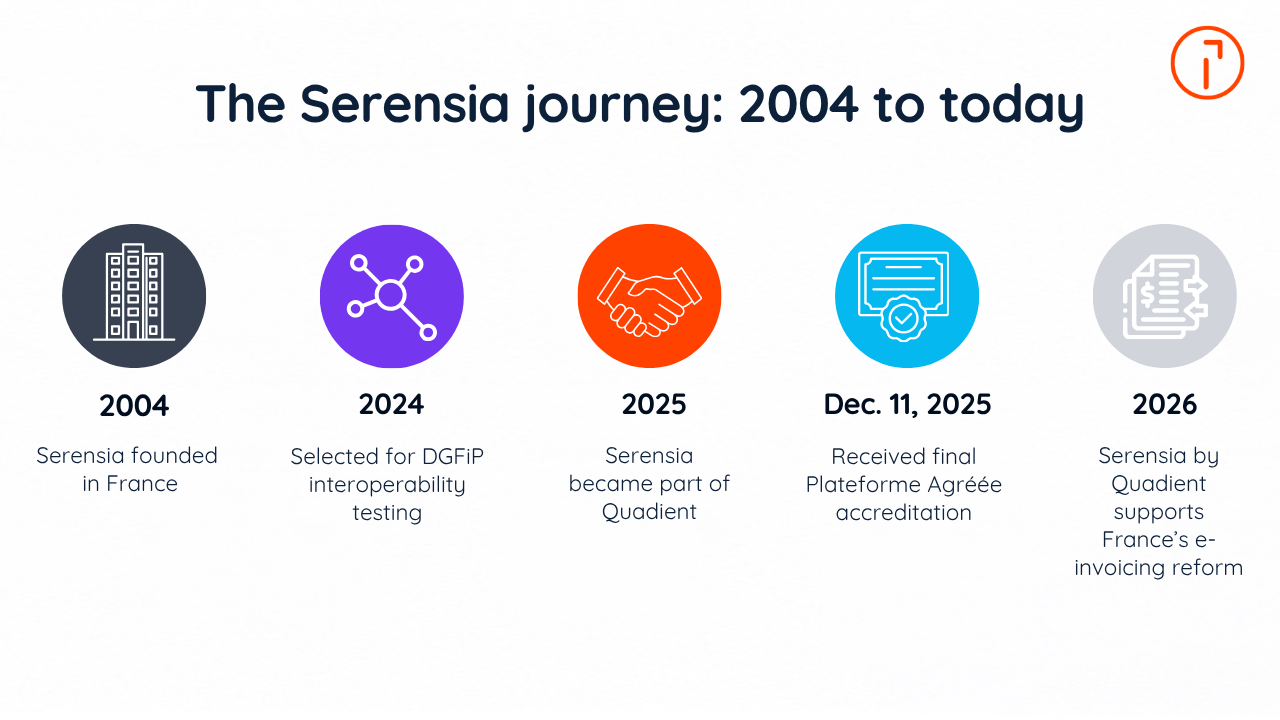
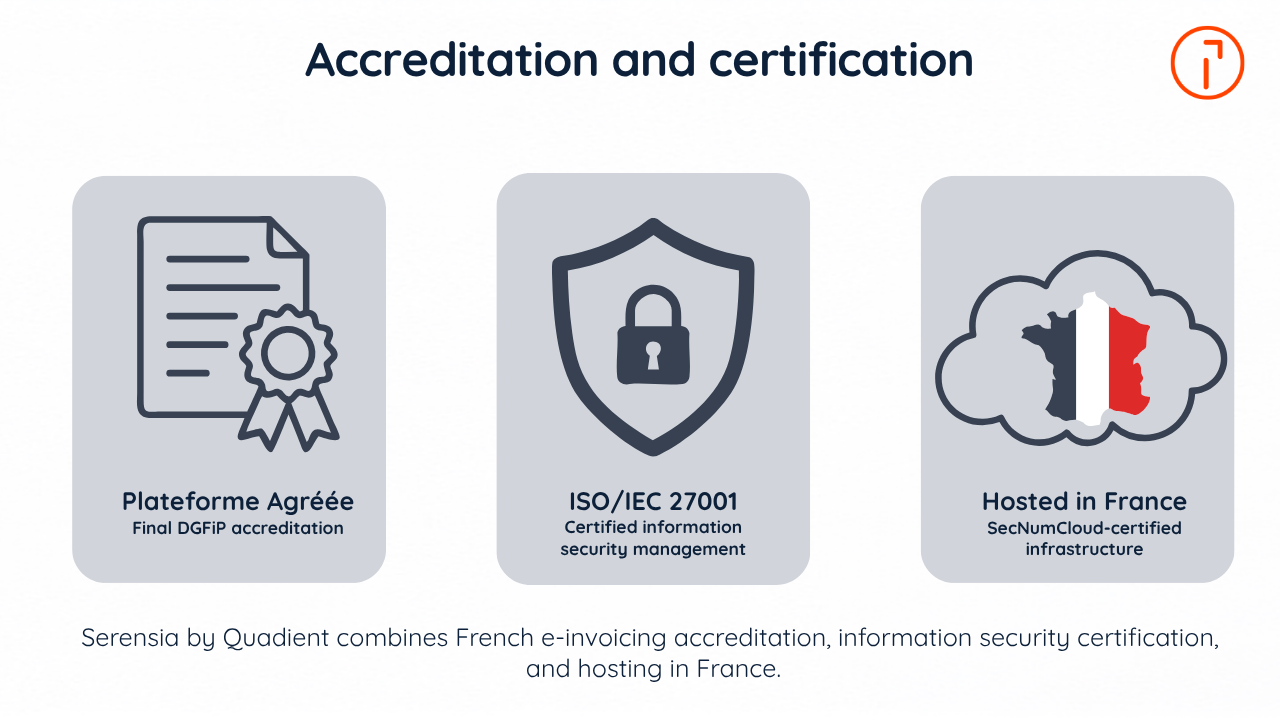
The French tax administration, the Direction générale des Finances publiques (DGFiP), granted Serensia by Quadient final accreditation as a Plateforme Agréée on December 11, 2025, making it one of the leading einvoicing solutions in France.
This accreditation confirmed that Serensia by Quadient is authorized to operate within France’s e-invoicing system. This is a basic requirement for participating in the regulated exchange of electronic invoices in the country.
Serensia was one of the first three platforms selected in 2024 for French Tax Authority interoperability testing. The testing examined how platforms exchange invoice information and connect with the national directory and data hub.
That accreditation allows it to participate in the regulated exchange of electronic invoices. Its platform capabilities connect those exchanges with the finance systems businesses already use.
Serensia by Quadient is ISO 27001 certified and hosted in France on SecNumCloud-certified infrastructure, meeting sovereign hosting requirements.
How Quadient's backing strengthens Serensia
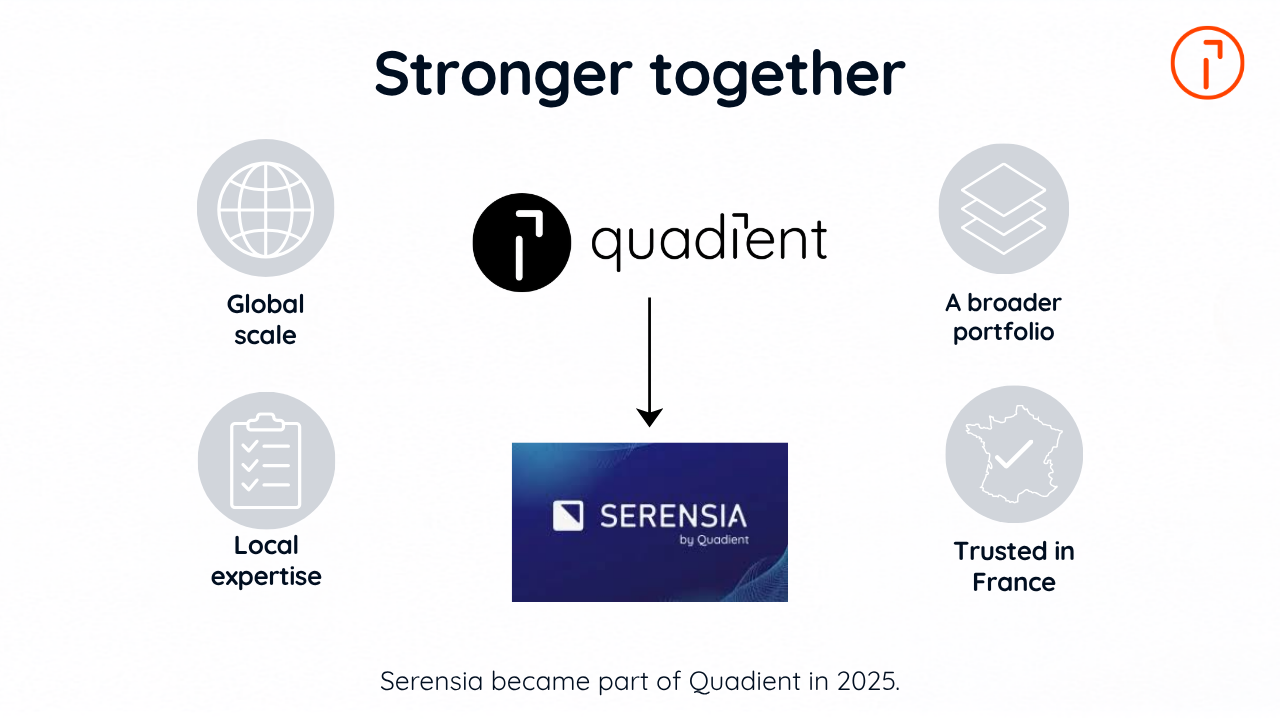
Serensia became part of Quadient in 2025 and is now known as Serensia by Quadient.
As part of Quadient, Serensia has access to the resources of a larger international technology company. As e-invoicing requirements evolve, this can support continued investment in the platform, regulatory updates, interoperability, and customer support as the platform is positioned as a leading European player in e-invoicing.
What does the Serensia platform do?
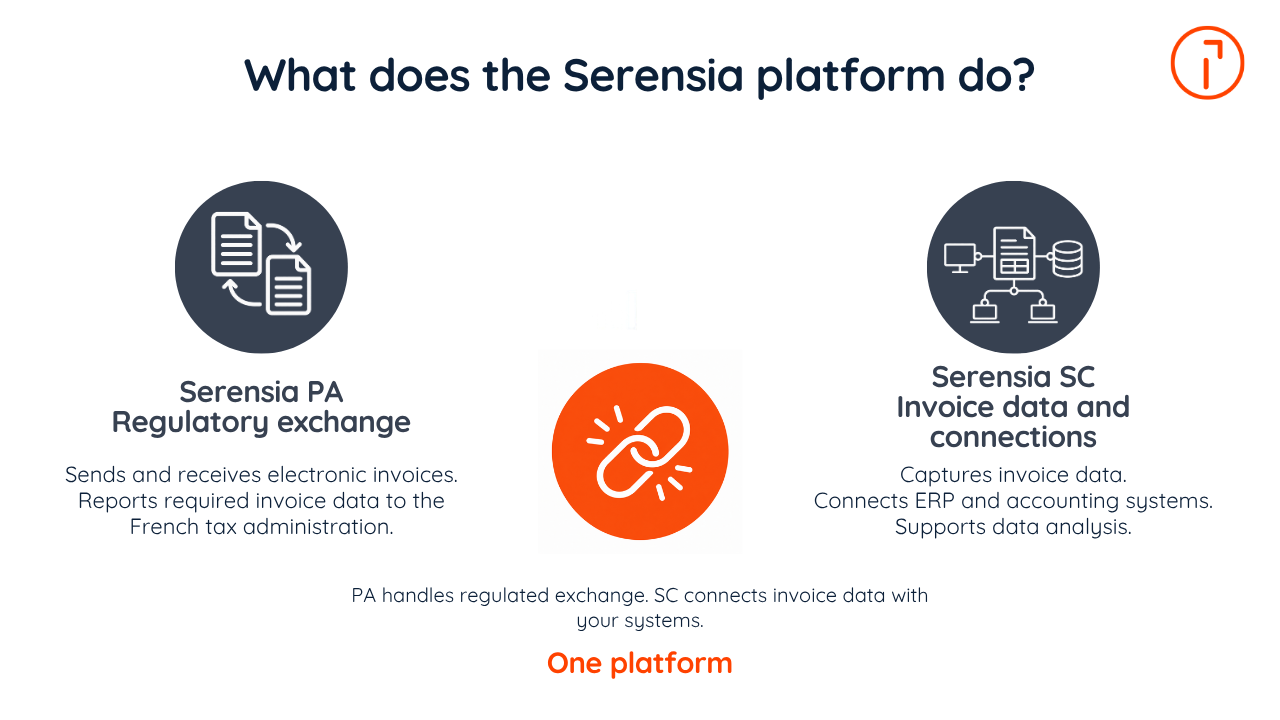
The Serensia by Quadient platform combines Plateforme Agréée (PA) and Solution Compatible (SC) functions. Each plays a different role in the electronic invoicing process.
Function | Main role | What it supports |
Serensia PA | Meets French e-invoicing requirements | Sends and receives electronic invoices and reports required data to the French tax administration |
Serensia SC | Manages invoice data and system connections | Captures invoice data, connects with ERP and accounting systems, and analyzes invoice information |
In practice, the PA and SC functions cover different parts of the same invoicing process. The PA side focuses on the regulated exchange of invoice data, while the SC side helps organizations connect that data with their existing finance systems.
For example, an incoming invoice can be captured and processed through Serensia SC, while Serensia PA handles the regulated exchange and reporting required under the French system. Bringing both functions together can reduce the need to manage separate platforms for compliance and invoice processing.
This combination can be useful for organizations that want to connect compliance requirements with their existing finance processes. Rather than treating regulatory invoice exchange and internal invoice processing as completely separate activities, the platform brings both into the same environment.
Serensia by Quadient is compatible with the Peppol network, which helps businesses exchange electronic invoices across different platforms and countries.
The platform also offers a white-label option that allows software vendors and accounting firms to use Serensia by Quadient to power their own customer-facing e-invoicing portals.
Who uses Serensia by Quadient?
Serensia by Quadient helps organizations prepare for mandatory electronic invoicing and integrate with ERP systems. Customers highlight its availability, reliability, responsiveness, and the ability to bring several areas of e-invoicing expertise together in one platform.
For organizations with existing finance systems, integration is an important part of the transition to e-invoicing. Rather than replacing their ERP or accounting software, the platform can connect with those systems and support the exchange and processing of invoice data.
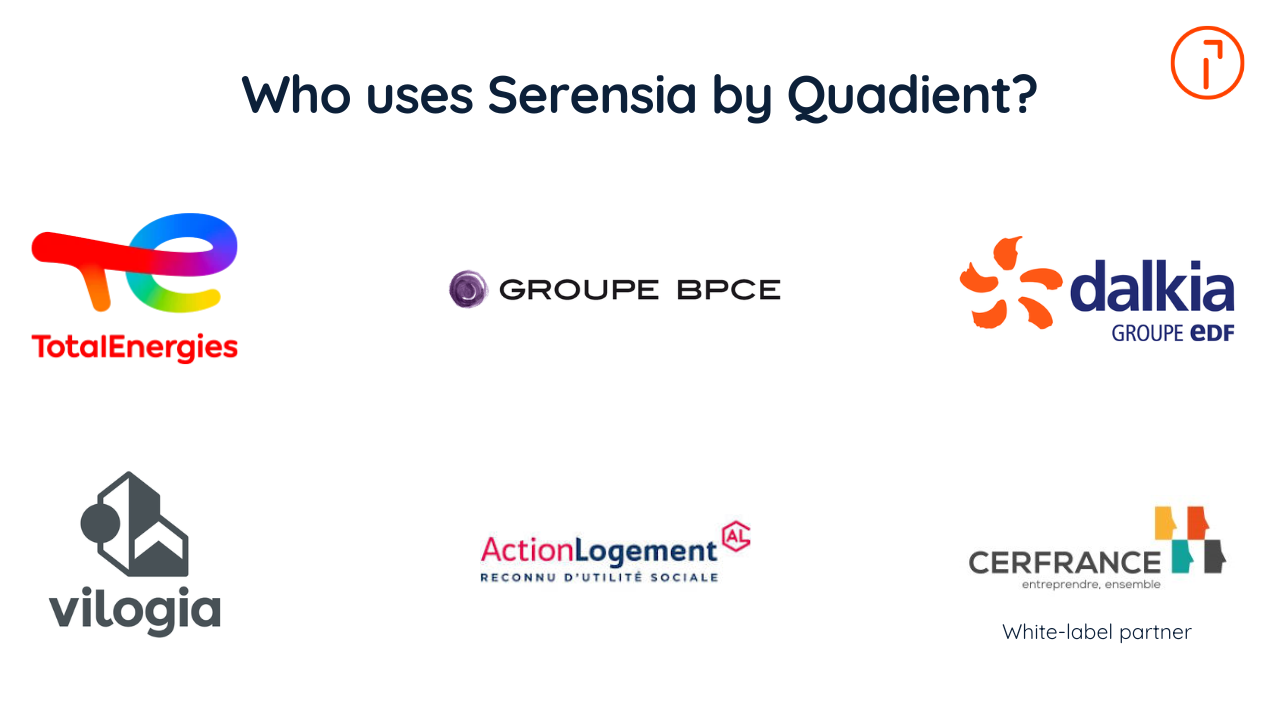
French organizations such as TotalEnergies, BPCE, Dalkia, VILOGIA, and Action Logement use Serensia by Quadient.
Cerfrance, an accounting network representing approximately 320,000 small and mid-sized businesses, uses Serensia by Quadient through a white-label agreement.
From the French e-invoicing specialist to a leading European platform
The platform's development is increasingly focused on a market that extends beyond France.
European countries are introducing e-invoicing mandates at different speeds and with different requirements. At the same time, common standards and networks are making it easier for businesses to exchange structured invoices across borders.
Serensia by Quadient operates a certified Peppol Access Point, giving organizations a secure gateway to exchange electronic documents with other participants on the Peppol network. This provides connectivity to organizations across more than 42 countries.
Instead of creating and maintaining individual connections between every supplier, customer, and e-invoicing platform, an organization can connect to an Access Point and use the Peppol network to communicate with other participants.
The platform supports several commonly used invoice formats, including UBL 2.1, CII, Factur-X/ZUGFeRD, and EDIFACT, and can normalize invoices to Peppol BIS Billing 3.0 for exchange over the network.
Peppol BIS Billing 3.0 is based on the European EN 16931 electronic invoicing standard, helping create a common semantic framework for exchanging invoice information between organizations and systems.
Preparing for the future of European e-invoicing
The European e-invoicing environment will continue to change over the coming years.
The European Union adopted its VAT in the Digital Age, or ViDA, package in March 2025. Among other changes, ViDA introduces digital reporting requirements for cross-border B2B transactions from July 1, 2030, based on mandatory electronic invoicing. Existing national digital reporting systems will progressively need to align with the European framework by 2035.
When Quadient acquired Serensia, it specifically identified the platform’s Peppol infrastructure and its ability to support upcoming requirements in markets including France, Belgium and Germany, as well as the future ViDA framework, as strategic capabilities.
Choosing Serensia among accredited platforms
As of mid-2026, France had more than 100 accredited e-invoicing platforms, which can make it difficult to choose the right one. Organizations should start by understanding their own needs and priorities before comparing providers.
Serensia by Quadient combines PA and SC functions with high-volume invoice processing and white-label options. Serensia by Quadient processes more than 250 million invoices per year, with peaks of up to 100 invoices per second. For organizations handling significant invoice volumes, that level of processing capacity can be an important factor when comparing accredited platforms.
Scalability may be especially important for larger organizations, while interoperability matters for businesses that need to exchange invoices across different platforms or systems. Accounting networks and software providers may place more weight on white-label capabilities because they need to provide e-invoicing services to their own customers.
These capabilities may suit large enterprises, accounting networks, and software providers that need scalability, reliability, interoperability, or the ability to offer e-invoicing services under their own brand.
The right platform will depend on the organization’s invoicing requirements, systems, and operating model.
Getting started with Serensia
Serensia by Quadient is an established e-invoicing platform with more than two decades of experience, accreditation as a Plateforme Agréée, and Quadient’s scale behind it.
Organizations evaluating Serensia by Quadient can start by reviewing their current invoice processes, ERP and accounting systems, invoice volumes, and integration requirements.
Learn more about Quadient e-invoicing solutions and request a demo to see how Serensia by Quadient works with your invoicing processes and systems.
Frequently asked questions
What is Serensia by Quadient?
Serensia by Quadient is an electronic invoicing platform owned by Quadient. It combines Plateforme Agréée functions with Solution Compatible capabilities for invoice processing, ERP integration, and invoice data management.
Is Serensia an accredited Plateforme Agréée?
Yes. Serensia by Quadient has received final accreditation from the DGFiP, the French Tax Authority, as a Plateforme Agréée. Plateforme Agréée is the current designation for platforms previously known as PDPs.
Is Serensia ready for ViDA?
ViDA is being introduced progressively across the European Union, with important cross-border B2B digital reporting requirements taking effect from July 2030. Quadient has identified Serensia’s Peppol infrastructure and international architecture as part of its strategy for supporting businesses as ViDA and national e-invoicing requirements develop.
What is the difference between Serensia PA and Serensia SC?
Serensia PA handles regulated electronic invoice exchange and reporting. Serensia SC supports invoice capture, ERP integration, and invoice data analysis. Both sets of capabilities are available on the Serensia by Quadient platform.
Who owns Serensia?
Quadient owns Serensia. Serensia became part of Quadient in 2025 and is now known as Serensia by Quadient.
Related Content
Discover the latest articles, guides, case studies, and industry updates to help you stay ahead of changing customer expectations, emerging technologies, and market trends.

Which electronic invoicing platforms are approved or compliant in 2026?
A 2026-ready guide to approved vs compliant e-invoicing platforms. Includes verification steps for France PDP and Peppol access points, a comparison table, selection drivers, “worth it?” test, and FAQs.

How do you choose a certified e-invoicing platform in 2026?
Learn how to choose a certified e-invoicing platform in 2026, including what “certified” really means, what to verify by country, and key decision drivers.