


















Introduction
Businesses often need proof that they sent legal notices, contracts, financial documents, tax forms, and compliance communications. They also need confirmation that delivery was made or attempted.
That's where Certified Mail® comes in. It provides proof that your mailpiece was sent, along with tracking and delivery verification.
In this article, we'll explain what Certified Mail is, how it works, when to use it, and how to send it online.
What is Certified Mail?
Certified Mail is a United States Postal Service (USPS) service that provides proof that a mailpiece was sent and electronic verification that it was delivered or that delivery was attempted. It includes a mailing receipt, a USPS Tracking® number, and the option to add Return Receipt® for proof of the recipient’s signature.
It is not a mail class or delivery speed. It is an added service available for eligible USPS mail classes, such as First-Class Mail® and Priority Mail®, when senders need documented proof that important mail was sent and delivered.
Key takeaways
USPS Certified Mail provides proof that a mailpiece was sent and electronic verification that it was delivered or that delivery was attempted.
This service requires a recipient signature, but senders need Return Receipt if they want proof of the signature.
Certified Mail is an add-on to eligible USPS mail classes such as First-Class Mail and Priority Mail.
Certified Mail is not a faster mail class. It travels at the speed of the selected mail class.
Online Certified Mail tools can help businesses reduce manual work, centralize tracking, store signatures, and manage proof of delivery.
How does Certified Mail work?
When you send Certified Mail, USPS assigns the mailpiece a unique, trackable number and gives you a mailing receipt. You can use that tracking number to check delivery status on the USPS Tracking page.
Someone at the delivery address must sign for the mailpiece when it is delivered. If delivery cannot be completed, USPS records the delivery attempt. If you add Return Receipt, you will receive a copy of the signature.
The service follows the delivery timeline of the mail class you choose, such as First-Class Mail or Priority Mail. It does not make mail move faster, but it adds proof, tracking, and delivery records to the mailing process.
What proof does Certified Mail provide?
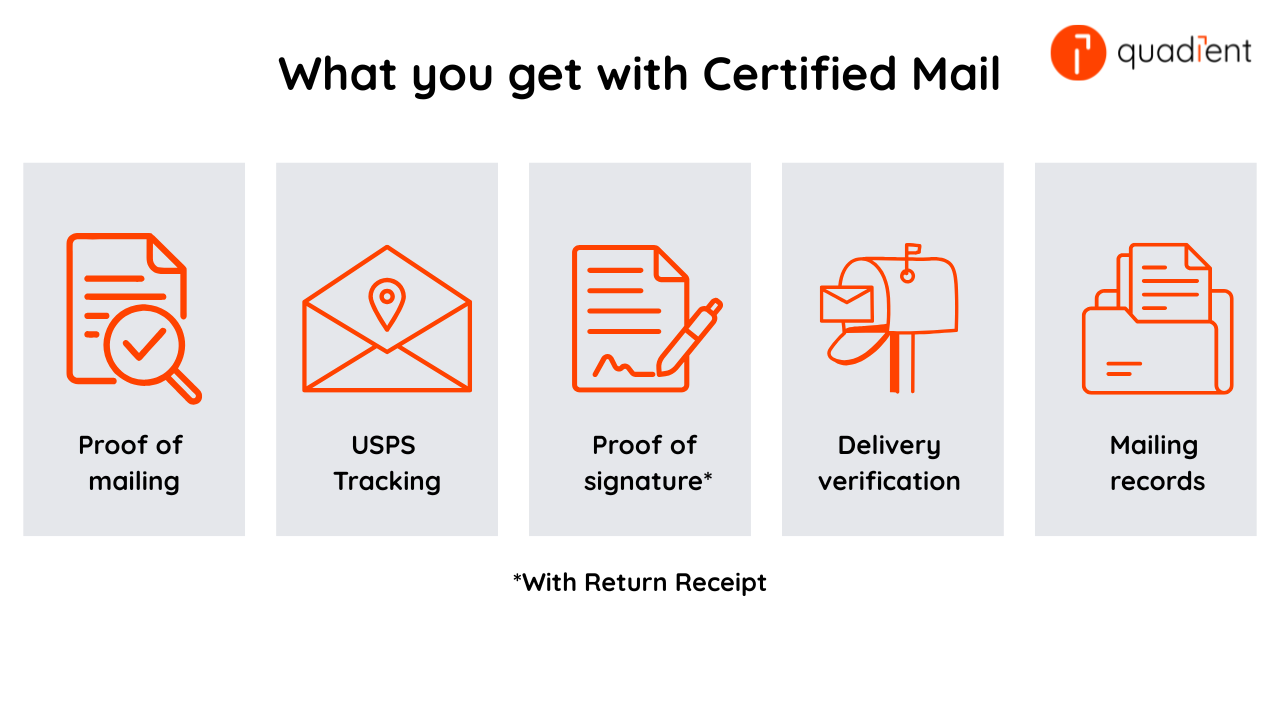
The service provides proof of mailing and electronic verification of delivery or attempted delivery. If you add Return Receipt, it can also provide a record of the recipient’s signature.
Does Certified Mail require a signature?
Yes, this service requires a signature at delivery. If the sender needs proof of who signed, they should add Return Receipt, which can be provided by mail or electronically.
What is Certified Mail used for?
It is commonly used for important communications that require proof of mailing, delivery verification, or signature records, including:
Legal documents: Contracts, subpoenas, notices, and other legal mail that requires a clear delivery record.
Business communications: Invoices, official notices, collections letters, and critical customer correspondence.
Official notifications: Tax documents, permits, licenses, and other government or organizational notices.
Financial documents: Loan notices, mortgage documents, insurance communications, and payment-related correspondence.
Contractual agreements: Contracts, agreements, and documents that confirm obligations or responsibilities.
Compliance communications: Regulated communications that may require proof of mailing, proof of delivery, signature records, or delivery evidence for audits and recordkeeping.
What are the benefits of Certified Mail?
Certified Mail offers several benefits for businesses and individuals who need proof that important mail was sent and delivered:
Proof of mailing: Receive an official USPS receipt confirming the item was accepted for mailing.
Delivery verification: Confirm that the mailpiece was delivered or that delivery was attempted.
Proof of signature: Add Return Receipt to receive the recipient's signature.
Mailing records: Keep documentation for legal, financial, or compliance purposes.
Cost savings: Get documented delivery without paying for courier services.
How to send Certified Mail at the Post Office
To send Certified Mail at the Post Office, follow these steps:
Bring your letter or package to your local Post Office.
Ask for Certified Mail or Certified Mail with Return Receipt.
Complete PS Form 3800 with the recipient’s name and address, then attach the Certified Mail barcode label to your mailpiece.
Pay the required postage and Certified Mail fee.
Keep your mailing receipt and tracking number so you can monitor delivery using USPS Tracking. If you purchased Return Receipt, you will receive proof of the recipient's signature after delivery.
How to send Certified Mail online
To send Certified Mail online, follow these steps:
Upload the document you want to send.
Enter and verify the recipient's mailing address.
Select Certified Mail and any additional services, such as Return Receipt or Restricted Delivery, if only a specific recipient is authorized to sign.
Review and submit the mailing.
Track delivery status online and access proof of mailing, delivery records, and signature records from a centralized dashboard.
Online Certified Mail can be used for letters and documents, but not packages.
Certified Mail vs. other USPS services
Certified Mail is often compared with Return Receipt, Registered Mail®, and Priority Mail tracking. Each service serves a different purpose.
Certified Mail vs. Return Receipt
These two services are different, but they are often used together. Return Receipt is an add-on that gives the sender proof of the recipient’s signature.
Feature | Certified Mail | Certified Mail with Return Receipt |
Main purpose | Proof of mailing and delivery or attempted delivery | Adds proof of who signed for the mailpiece and when it was delivered |
Mailing receipt | Yes | Yes |
Tracking number | Yes | Yes |
Signature required | Yes | Yes |
Sender receives signature proof | Not automatically | Yes, by mail or electronically |
Best for | Important mail where proof of mailing and delivery activity is needed | Legal, compliance, financial, or business mail that requires signature evidence |
Certified Mail vs. Registered Mail
Both services provide tracking and proof of mailing, but they serve different needs. Certified Mail is used for delivery records. Registered Mail is used for valuable or sensitive items that need added security.
Feature | Certified Mail | Registered Mail |
Main purpose | Proof of mailing and delivery activity | Added security for valuable or sensitive items |
Tracking | Yes | Yes |
Signature required | Yes | Yes |
Security handling | Standard USPS handling | Enhanced USPS security handling |
Insurance | Not included | Available |
Typical use | Legal notices, contracts, compliance documents, financial communications | Valuable items, high-value documents, collectibles, sensitive shipments |
Cost | Lower | Higher |
Certified Mail is usually the better choice when businesses need delivery evidence, a mailing receipt, tracking, and optional signature proof. Registered Mail is better suited for items that require added security and insurance.
Certified Mail vs. Priority Mail tracking
These services serve different purposes. Certified Mail adds proof and delivery records, while Priority Mail focuses on delivery speed.
Feature | Certified Mail | Priority Mail |
Mail class | No | Yes |
Tracking | Yes | Yes |
Proof of mailing | Yes | No |
Delivery verification | Yes | Standard tracking only |
Signature requirement | Yes | Optional |
Compliance documentation | Yes | Limited |
Delivery speed | Depends on the mail class selected | Typically faster than First-Class Mail |
Businesses may choose to send Certified Mail with Priority Mail when they need both faster delivery and a documented record of mailing and delivery activity.
Six Certified Mail myths debunked
Myth 1: Certified Mail is only for legal documents. The service can be used for any important mail where the sender needs proof of mailing and delivery activity.
Myth 2: Certified Mail is too expensive. It can be a cost-effective way to add proof and visibility without using a courier service.
Myth 3: Certified Mail records must be stored manually. Electronic Return Receipts can be archived in a secured online portal making it easier to store and retrieve signature records.
Myth 4: Certified Mail always takes longer. The service matches the delivery speed of the selected mail class, such as First-Class Mail or Priority Mail.
Myth 5: Certified Mail must be completed at the Post Office. Businesses can use online Certified Mail tools to prepare, track, and manage mailings digitally. Some digital services require you to drop the letter off at the Post Office, while others will induct the letter into the mailstream for you.
Myth 6: Certified Mail is the same as Registered Mail. The service provides proof of mailing and delivery activity. Registered Mail provides added security for valuable or sensitive items.
Manual Certified Mail vs. online Certified Mail
Businesses that send Certified Mail regularly may find manual processes time-consuming. Online Certified Mail tools can help reduce administrative work and improve recordkeeping.
Feature | Manual Certified Mail | Online Certified Mail |
Form preparation | Completed manually | Generated digitally |
Tracking | Checked one item at a time | Managed from a centralized dashboard |
Return Receipt storage | Physical or manual filing | Cloud-based storage |
Notifications | Manual monitoring | Automated alerts |
Proof of delivery | Stored manually | Stored electronically |
Signature records | Physical or electronic depending on service | Centralized and searchable |
Best for | Occasional Certified Mail users | Businesses sending higher volumes of important mail |
Online Certified Mail can help organizations centralize mailing activity, reduce paper handling, and keep delivery records easier to find.
What is online Certified Mail?
Online Certified Mail allows businesses to prepare, send, track, and manage Certified Mail using a digital platform.
With a solution like Quadient Connectsuite e-Certify, users can upload documents, enter recipient details, select the required mailing services, track USPS delivery activity, and store proof of mailing and delivery records electronically.
Online Certified Mail is especially useful for businesses that need to send important mail regularly and maintain records for customer service, legal, financial, or compliance purposes.
What are the benefits of online Certified Mail?
The online service makes mailing and recordkeeping easier with:
Centralized record storage: Store and manage proof of mailing, proof of delivery, and signature records in one place.
Compliance support: Maintain digital records that support audits, legal documentation, internal policies, and recordkeeping requirements.
Time savings: Reduce manual tasks such as completing forms, filing paper receipts, and searching for delivery records.
Improved visibility: Monitor Certified Mail activity from a centralized dashboard instead of tracking mailpieces individually.
Automatic notifications: Receive alerts when mail is delivered, delivery is attempted, or signature records become available.
Secure digital storage: Protect sensitive mailing records with secure electronic storage and easy access when needed.
Quadient e-Certify for Certified Mail
Quadient e-Certify helps businesses manage Certified Mail from one platform. It centralizes preparation, tracking, notifications, and record storage.
e-Certify replaces paper forms, manual tracking, and physical filing with a single digital platform for preparing, sending, and tracking mailings.
Quadient e-Certify can help businesses:
Prepare mailings online.
Track USPS delivery activity.
Manage electronic Return Receipts.
Store proof of mailing and digital proof of delivery.
Keep signature records organized.
Receive delivery notifications.
Support document retention and compliance workflows.
e-Certify helps reduce manual effort while keeping important mailing records organized and easy to retrieve. This is especially helpful for organizations that send legal notices, billing communications, healthcare correspondence, collections notices, government documents, or financial communications.
Conclusion
When you need proof that an important document was mailed and confirmation of delivery or attempted delivery, Certified Mail provides a reliable USPS service for documenting the mailing process. Whether you're sending legal notices, financial documents, tax forms, or other important correspondence, it gives you a documented record that standard mail does not.
Digital mailing platforms such as Quadient e-Certify make it easier to prepare, send, track, and manage Certified Mail while keeping mailing and signature records organized.
