


















Introduction
The price of postage is based on several factors, including an item's weight, size, and shape. Shipping zone, packaging, and extra services can also affect the price. This makes it easy for businesses to overpay or underpay for postage. Incorrect postage can result in returned mail, delays, and higher overall shipping costs.
In this article, we explain how to correctly weigh and measure mail, compare USPS services, and account for dimensional weight. We also cover how postage meters and shipping software can help you calculate the right amount.
Key takeaways
Weight, size, shape, destination, and mail class can all affect postage.
Weigh letters with every insert and packages with all their packing materials.
Compare USPS services.
Use accurate measurements and current rates to calculate postage.
What are the factors that determine postage costs?
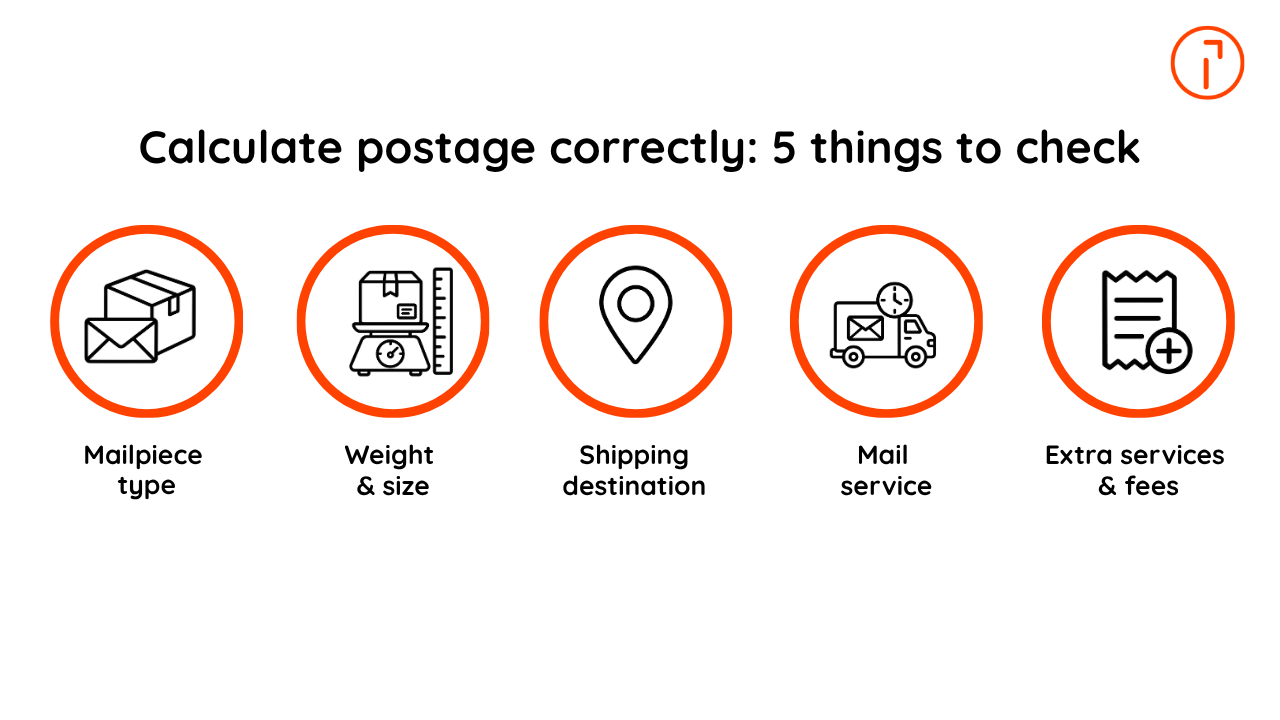
Type: Large or unevenly thick envelopes may be priced as a package.
Weight and dimensions: Going over a weight or size threshold can increase the price.
Origin and destination: Distance affects some domestic package prices. International prices also depend on the destination country.
Mail class and extra services: Delivery speed, additional insurance, and signature services can affect the cost.
Postage method: Your account or mailing tool may allow you to access to commercial rates.
Envelope shape matters, too. A square envelope may cost extra because it cannot go through standard USPS sorting equipment.
How do you weigh and measure business mail?
Weigh the item once it is ready to send. Include the envelope and every insert, or the box and all packaging materials. A product weight from your order system may exclude packaging, so check the finished package weight before buying postage.
Use a postal scale and measure the outside of the package, including any bulges. Follow the measurement and rounding rules for the service you choose. For example, a USPS Ground Advantage package weighing 4.1 ounces is charged at the 8-ounce price tier.
When does dimensional weight apply?
Dimensional weight accounts for the space a package occupies. For commercial packages sent using USPS Ground Advantage®, dimensional-weight pricing applies when a package exceeds one cubic foot. USPS compares dimensional weight with actual weight and uses the greater of the two.
For rectangular USPS Ground Advantage commercial packages, the rules effective July 12, 2026, require you to:
Round the length, width, and height up to whole inches.
Multiply those measurements together.
If the result exceeds 1,728 cubic inches, divide it by 139.
Round the result up to a whole pound.
For a 5 lb box measuring 16 x 12 x 10 inches, the volume is 1,920 cu in. This value divided by 139 and rounded to the nearest whole number equals 14 lb. In this scenario, the charge will be made on 14 pounds, destination zone, and additional costs.
Using a smaller box may reduce dimensional weight and lower your postage costs.
How do you choose the right USPS service?
Select a service that will accept your item and meet your deadline. Finally, compare the price and benefits.
Service | When to consider it | What affects the price |
First-Class Mail® | Sending eligible letters, postcards, and large envelopes | Weight, size, and shape. Domestic prices do not vary by distance. |
USPS Ground Advantage | Sending domestic packages without an urgent deadline | Weight and zone, with cost based on size where applicable. |
Priority Mail® | Sending documents or packages that need faster delivery than standard ground service | Weight and zone, or a set price with Flat Rate packaging. |
Priority Mail Express® | Sending documents or packages with an urgent deadline | Weight and destination, with Flat Rate envelope options available. |
Media Mail® | Sending qualifying books or other eligible media | Weight, plus any optional extra-service fees. |
How do shipping zones affect postage?
USPS shipping zones group destinations by distance from the mailing origin, so identical packages can cost different amounts to send to different locations.
Use the ZIP Code where the package will actually enter the mailstream. If you ship from several offices, make sure your shipping software uses the correct origin.
Is flat-rate shipping cheaper?
Flat-rate shipping can be cheaper, but it depends on the item’s weight, packaging, and destination.
You can send packages that weigh up to 70 pounds at USPS Flat Rate prices with Priority Mail Flat Rate. You'll have to pick a Flat Rate box or envelope, and then your shipment must fit in that box or envelope. The box must close normally.
Compare that price with using your own packaging. Flat Rate may be cheaper if you are sending a heavy item a longer distance. Your own packaging may be cheaper if you are sending a lightweight item a shorter distance
Which extra services and fees should you include?
Total postage = base postage + selected extra services + applicable postal fees.
Check what the service already includes. USPS Ground Advantage includes tracking and $100 of insurance, subject to coverage conditions. More valuable items may need additional shipping insurance.
If the mail piece qualifies for First-Class Mail and Priority Mail services, Certified Mail® service offers a mailing receipt and proof of delivery or attempted delivery of the mailing. Additional charges will apply to get a Return Receipt that comes with the actual delivery confirmation signed by the recipient.
Some parcels that are long or oddly shaped may require the payment of additional charges apart from dimensional weight charges.
For international shipments, consider destination restrictions and any custom requirements. Duties or taxes may be charged separately from the cost of postage, so you need to determine who pays these charges.
Which tools can help you calculate postage?
Choose a tool that fits the mail you send:
The USPS postage price calculator helps with occasional mailings and estimates.
Online postage services can calculate postage and let you print shipping labels.
Shipping software can compare shipping rates across carriers. It can also manage labels and tracking.
A postage meter with a scale combines weighing, rate selection, and postage printing for letters and mixed office mail.
If you're a small business, you should also check available discounts.
USPS may adjust your postage charge if the package’s weight or dimensions differ from the details used to create the shipping label.
How does postage differ from total shipping costs?
Postage covers the services you select as well as the cost of delivery through the postal system. Total shipping costs also include packaging materials, the time your staff spends preparing the mail, and any equipment, software, or processing and handling costs.
Conclusion
Using a consistent process helps your team calculate postage correctly the first time. Be sure to weigh and measure the item with inserts and packing and select the lowest-priced service that fits your delivery deadline.
Quadient postage meters help teams manage everyday mail with integrated or connected weighing, guided rate selection, and postage printing. Explore our postage meters and mailing systems to find an option that fits the mail you send.