


















Introduction
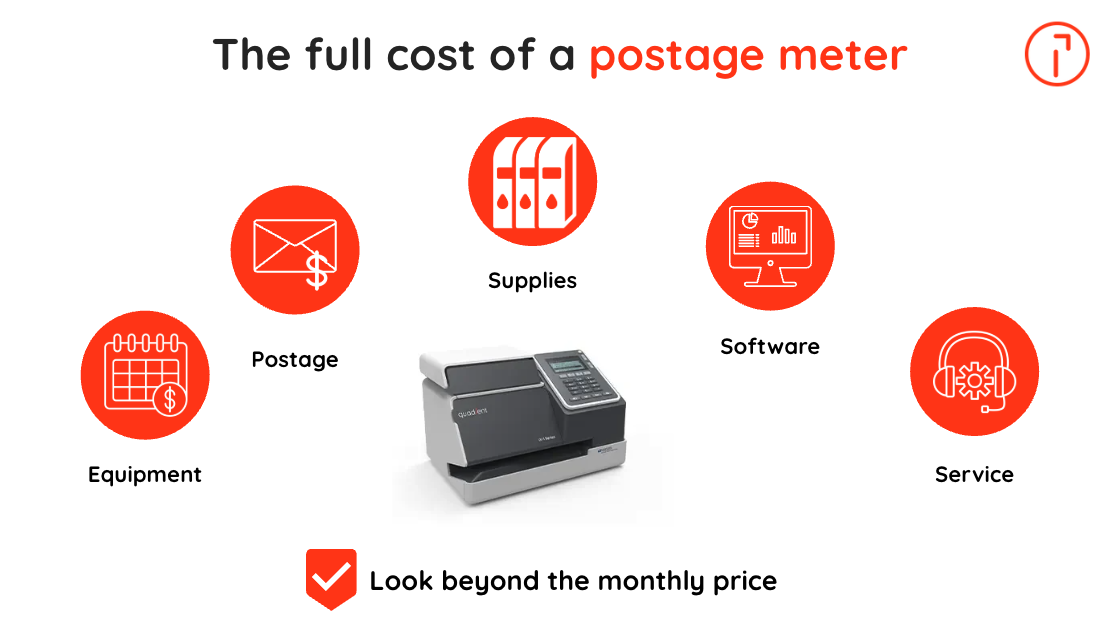
The monthly cost of a postage meter doesn’t tell the whole story. You also need to account for postage, supplies, software, maintenance, and other services included in your agreement.
In this article, we discuss postage meter costs, potential savings, USPS® requirements, and what to review before choosing a provider.
Key takeaways
In the US, you can’t buy a postage meter. You’ll need to lease or rent one.
In addition to the cost of the equipment, businesses may also pay for postage, supplies, software, service, and other charges included in the agreement.
As of January 1, 2025, businesses are required to use an IMI-compliant meter.
First-Class Mail® letters sent with a postage meter cost less than those sent with stamps.
Review the total cost, included services, contract length, and cancellation terms, not just the advertised monthly price.
What is a postage meter?
A postage meter is a device that weighs mail, calculates the required postage, and prints a USPS-approved postage indicium on an envelope or label. The indicium proves that the postage has been paid.
Some models include automatic rate updates, expense reporting, and online postage funding. Some also include mailing software and envelope feeding and sealing.
Postage meters range from compact models for small businesses to automated systems designed for high-volume mailrooms.
Why can’t you buy a postage meter?
Businesses in the US cannot buy a postage meter, as these machines are able to store and print postage, and as such, are at risk of being hacked or exploited with malicious intent. To prevent these risks, the only way to get a postage meter is to lease one from a USPS-approved vendor, such as Quadient, one of the leading providers of postage meters in the world.
The provider usually takes care of registering and activating the meter when you rent or lease it.
What is IMI compliance?
Intelligent Mail Indicia, or IMI, is the current USPS standard for postage meter security and data. Non-IMI meters had to be withdrawn from service after December 31, 2024, so businesses must now use an IMI-compliant meter.
How much does a postage meter cost?
Costs vary, but the following table covers the related costs you should consider.
Cost | What it covers |
Equipment rental or lease | Use of the postage meter and related mailing equipment |
Postage funds | The actual USPS postage applied to each mailpiece |
Ink and supplies | Meter ink, postage labels, sealing solution, and cleaning supplies |
Software and connectivity | Rate updates, reporting, shipping tools, and online services |
Maintenance and support | Repairs, replacement parts, technical support, or equipment replacement |
Contract-related fees | Possible charges for delivery, installation, upgrades, cancellation, and equipment return |
Commercial mailing fees, if applicable | USPS permit and annual fees that may apply to qualifying presorted mailings |
How much are postage meter lease fees?
Lease costs depend on the equipment, services, and agreement terms. Compact hand-fed meters generally cost less than automated systems that weigh, feed, seal, and meter large batches of mail.
Monthly pricing may vary based on:
Mail volume and processing speed
Scale capacity and feeding options
Reporting, software, and connectivity
Maintenance coverage
Agreement length
We recommend checking what the quoted price includes, as supplies, software, installation, postage funding, and service may cost extra.
How do postage funds work?
Postage is paid separately from the equipment rental fee through a postage funding account. Depending on the provider and account, businesses may prepay postage or use a credit option that is billed later.
What postage meter supplies do you need?
Supply needs vary by meter model and mail volume.
Common postage meter supplies include:
Meter-specific ink cartridges
Postage labels or meter tape
Envelope sealing solution
Cleaning cards or cleaning envelopes
Envelopes and other mailing supplies
Supply prices vary by model, cartridge yield, package size, and supplier. Businesses should estimate how often ink and labels will need to be replaced based on their monthly mail volume.
Using ink and supplies designed for the specific mailing system helps maintain print quality and reduce the risk of equipment issues. Providers typically offer model-specific ink, labels, cleaning products, and sealing supplies for their machines.
Are maintenance and repairs included?
It depends on the provider and agreement. Some plans include technical support, parts, preventive maintenance, and replacement equipment. Others charge extra for certain repairs or service calls.
It's best to confirm what is covered, whether parts and labor are included, and how quickly service requests are handled before signing.
How much can you save with a postage meter?
A postage meter provides a four-cent discount on eligible one-ounce First-Class Mail letters.
As of July 12, 2026:
Postage method | Price per one-ounce letter |
Stamped First-Class Mail letter | $0.82 |
Metered First-Class Mail letter | $0.78 |
Saving per letter | $0.04 |
At these rates, a business would save $20 on 500 letters or $40 on 1,000 letters.
These savings should be weighed against equipment, supply, software, and service costs. Because USPS prices change, businesses should check current rates when estimating annual savings.
What other savings can a postage meter provide?
Savings can also come from reduced handling time and fewer manual mailing steps.
Accurate postage: An integrated scale helps calculate the correct amount and reduces overpayment or underpayment.
Less time preparing mail: Staff can weigh, rate, and apply postage without handling individual stamps.
Fewer trips to the Post Office: Prepare everyday letters and packages in the office instead of buying postage at the counter.
Better expense visibility: Reporting tools can track postage by department, account, project, or cost center.
Users still need to select the correct mail class, dimensions, and additional services.
Is a postage meter worth the cost?
A postage meter may be worth the cost for businesses that send mail regularly, want to reduce Post Office visits, and need better control over postage spending.
Businesses with very low mail volumes may find stamps or online postage more economical. Compare the estimated annual cost with current spending on postage, supplies, employee time, and Post Office visits.
How do you choose the right postage meter?
Match the meter to your mail volume, the items you send, the features you need, and the space available.
Consider | Questions to ask |
Mail volume | How many mailpieces do you send each week, and when are your busiest periods? |
Mail types | What sizes of envelopes and packages do you process, and which USPS services do you use? |
Equipment features | Do you need a scale, automatic feeding, envelope sealing, or faster processing? |
Reporting | Do you need to track postage by employee, department, or account? |
Space and growth | How much workspace is available, and is your mail volume likely to increase? |
Small businesses may only need a compact meter with an integrated scale. Growing organizations may benefit from faster processing, automatic feeding, detailed reporting, and mailing and shipping software.
What should you review before signing a postage meter agreement?
Ask the provider for a complete breakdown of the equipment, services, fees, and contract terms.
Monthly equipment cost: Confirm the regular price and whether an introductory rate will change.
Agreement length and renewal: Check how long the agreement lasts and whether it renews automatically.
Postage funding: Review the payment options and any refill, advance, credit, or late-payment fees.
Rate updates: Confirm how USPS rate changes are delivered and whether updates are included.
Supplies: Estimate the cost and replacement frequency of ink, labels, sealing solution, and cleaning products.
Maintenance and support: Review service coverage, repair procedures, response times, and replacement equipment policies.
Cancellation and return terms: Check for early termination charges, return instructions, and end-of-agreement fees.
Conclusion
A postage meter can make everyday mail faster to prepare and easier to manage. Before choosing a system, review the full cost, postage funding options, service coverage, and contract terms.
Quadient’s IMI-compliant iX Series includes compact office meters and automated systems for higher-volume mailrooms. Explore Quadient postage meters to find a model suited to your mailing needs.