















Introduction
Exploring your options for direct mail for small businesses? Launching a campaign to target a specific location gives you two paths to choose between:
Every Door Direct Mail (EDDM) and targeted direct mail
Both have advantages, but choosing the wrong path can waste a precious, limited marketing budget. That’s why understanding the two and selecting the most appropriate route is key to a successful campaign.
Before we compare EDDM vs. targeted direct mail, read our comprehensive guide to EDDM and our direct mail marketing page to get up to speed.
In this guide, we’ll cover which direct mail strategy small businesses should choose based on your audience, budget, and response-rate goals, and how Quadient’s mail automation tools can comprehensively support either route.
What's the difference between EDDM and targeted direct mail?
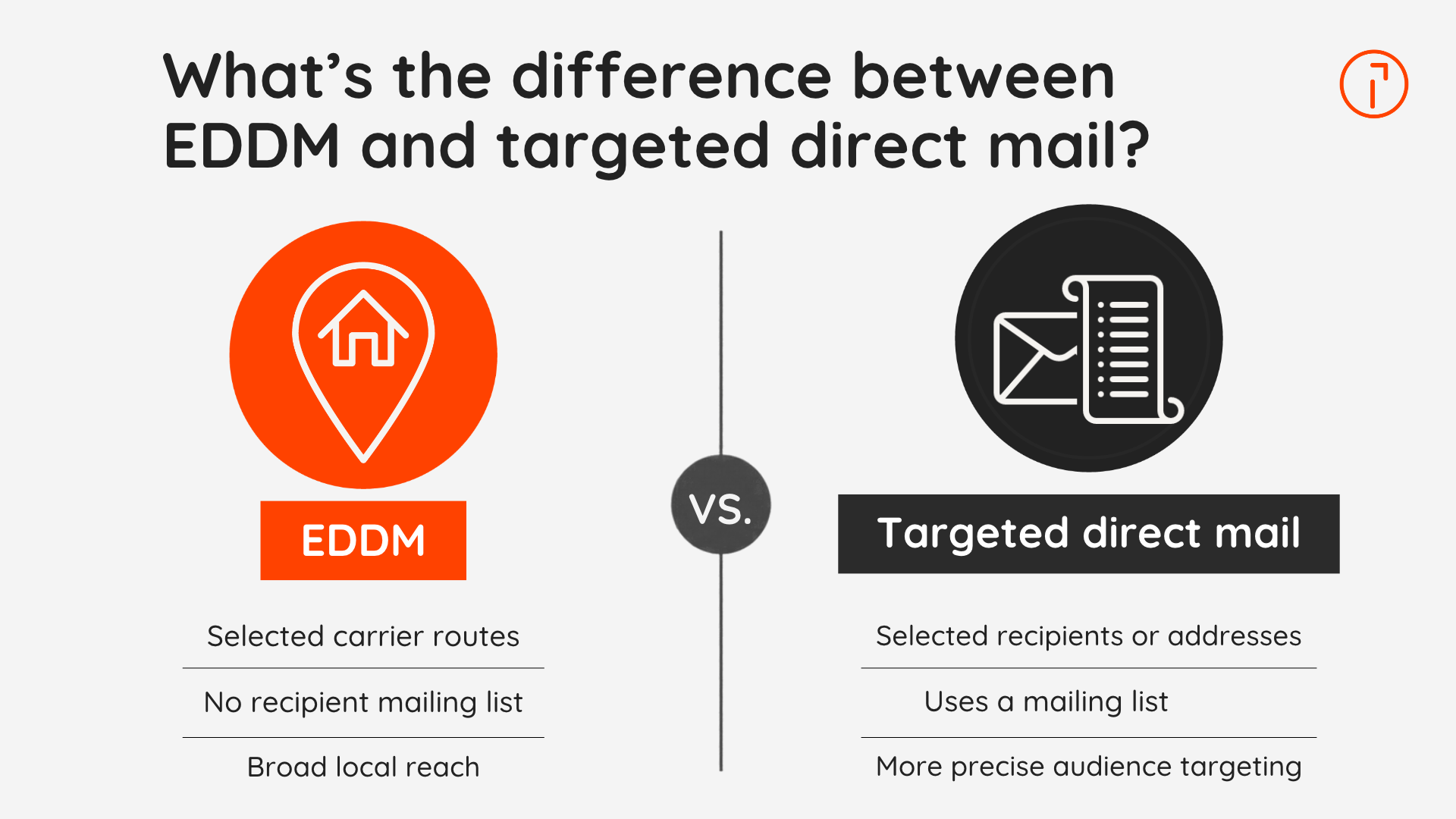
EDDM delivers to eligible addresses on selected carrier routes without a recipient list, while targeted direct mail uses a list of people or addresses selected to match a customer profile.
One of the most important things to note about EDDM is that this route requires no mailing list, recipient names, or individual addresses (source: USPS PostalPro, postalpro.usps.com), while targeted direct mail relies on a mailing list to reach specific addresses or recipients. For those choosing EDDM, this can be a big advantage when considering production time and list maintenance, saving both valuable time and money.
In comparison, targeted direct mail segments your campaign to reach specific addresses that match your ideal customer type, based on your campaign goals. This can be especially useful if your product is tailored to a niche market, rather than something almost everyone can relate to or have context around.
Here’s an overall breakdown of the differences between the two:
Feature | EDDM | Targeted direct mail |
|---|---|---|
How it works | Delivers to eligible addresses on selected carrier routes | Delivers to selected addresses from a mailing list |
Target audience | Broad - eligible addresses on selected carrier routes; routes can be filtered using demographic data | Defined, specific customers or prospects |
Mailing list? | No | Yes |
Personalization? | No recipient-level personalization | Yes - can include names, tailored offers and personalized messaging |
Cost | Lower postage costs | Higher postage costs (plus potential data/list costs) |
Quantities | USPS EDDM Retail requires at least 200 pieces, with a limit of 5,000 per day per ZIP Code | Depends on mailing service, postal class and supplier |
Best for? | Broad reach in a neighborhood | Specific customer acquisition or retention |
The rest of this article compares these two direct mail routes for small businesses, helping you move forward with your next campaign and start seeing results.
How do EDDM and targeted direct mail costs compare?
While we’re starting to get a sense of when targeted direct mail or EDDM works best in campaigns, cost is a major factor in how and when they’re used.
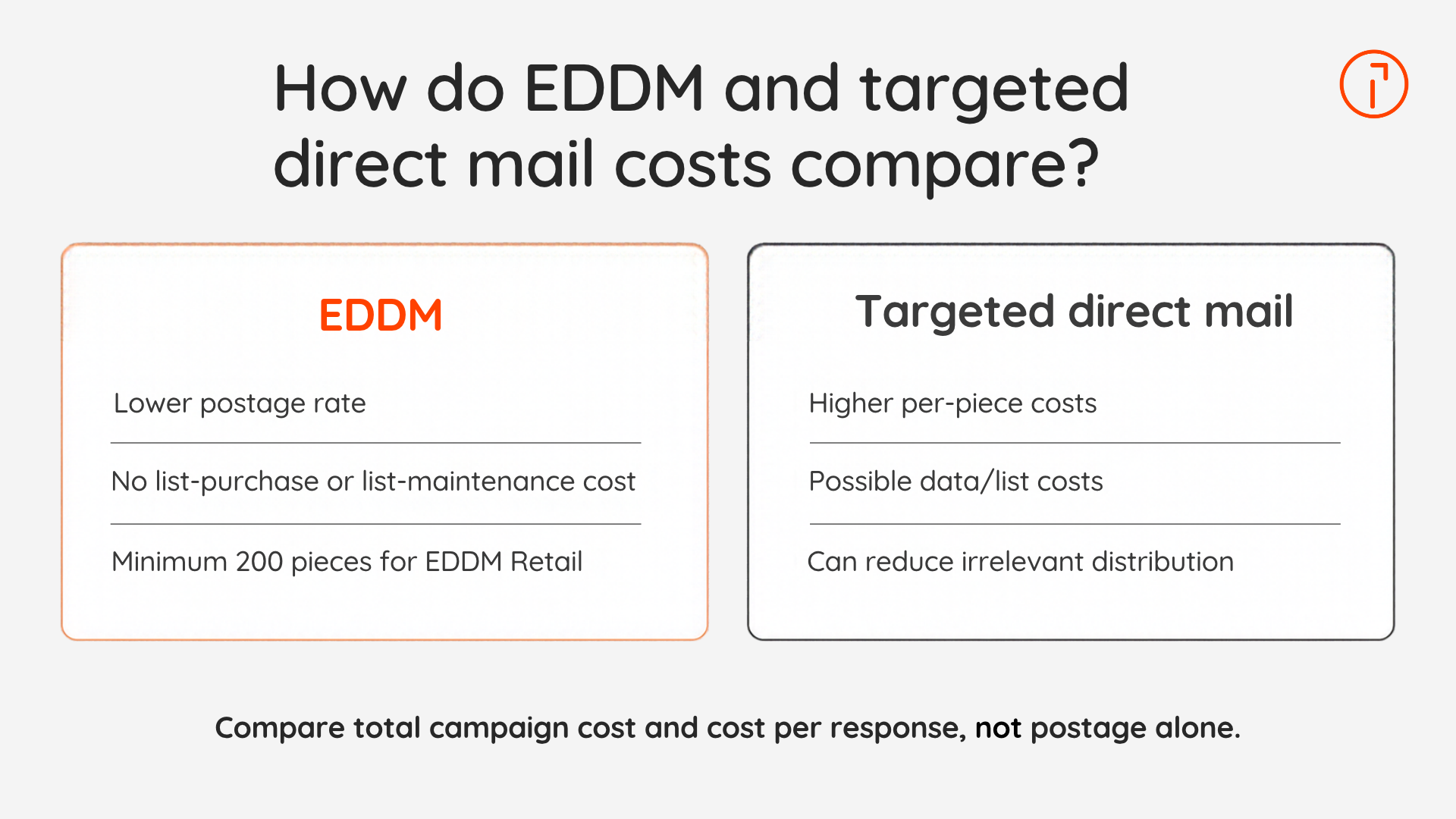
In short, EDDM generally costs less to send than targeted direct mail, but the cost comparison doesn’t end with postage alone. It’s more important to look at cost per result than production cost alone.
EDDM vs. targeted direct mail: Costs
EDDM
The current EDDM Retail postage rate is $0.260 per piece for flats up to 3.3 oz (Source: USPS Notice 123, effective October 4, 2026, pe.usps.com).
USPS handles EDDM Retail and EDDM BMEU (Every Door Direct Mail through a Business Mail Entry Unit) differently, including volume and permit requirements.
EDDM Retail requires at least 200 pieces and allows up to 5,000 pieces per day per ZIP Code (source: USPS PostalPro, postalpro.usps.com). For larger mailings, use EDDM BMEU, which requires a USPS Marketing Mail permit.
Targeted lists
Targeted direct mail is generally more expensive than EDDM as it requires using a refined mailing list. EDDM also qualifies for a lower USPS saturation postage rate than a targeted list, making it more affordable.
Acquiring a high-quality, well-validated list costs more than a generic, cheap, and stale one, and the admin that’s required to maintain this list can also add additional expense to this strategy.
Which is more cost-effective?
But the comparisons don’t end with surface-level cost alone. To understand your ROI, cost per result is the most important metric for analyzing campaign success.
For instance, sending up to 5,000 promotional materials with only a small number of conversions is much more expensive overall than sending just 1,500 targeted mailers that produce a strong response - even if they are at a higher per-piece cost.
Wasted materials should also factor into your decision. Because EDDM reaches every eligible address on selected routes, more pieces may go to households outside your ideal customer profile.
Targeted lists can reduce that mismatch by focusing mail on addresses that fit a more specific customer profile.
The real cost comparison is how useful the direct mail campaign is for your small business, and whether tailoring your route next time could save you money.
How does not needing a mailing list reduce EDDM costs?
Much of the cost comparison comes down to that all-important mailing list, which is required for a targeted direct mail approach.
Without a mailing list, you can save on list purchases and list management. EDDM Retail also does not require a bulk mail permit, making this route more straightforward. EDDM BMEU does require a USPS Marketing Mail permit. (Source: USPS PostalPro, postalpro.usps.com).
This contrasts with targeted mail’s ongoing list validation and refresh costs, which don’t ease up after the first campaign. List maintenance is a huge part of the strategy, and one that shouldn’t be overlooked.
When should you choose reach over precision?
Next, consider the trade-off between reaching everyone in the area and reaching a specific customer base. This targeting can affect how relevant your campaign is, so analyze the right route carefully before setting up your campaign.
When everyone in the area is a possible customer, EDDM is a great choice, giving you full coverage of a geographical area and reaching many customers.
For example, if your small business is a new neighborhood restaurant just opening its doors, or a local retail store offering a discount, EDDM can be a great way to acquire new customers by putting your services or products in front of thousands of people.
However, if your customer base is defined by something other than location, targeted lists can be more effective. For example, if your small business offers a service with a narrow customer profile, like high-end home services, it is likely to be better suited to a targeted list approach.
Targeted direct mail strategies for small businesses can more easily include specific household income brackets, homeownership status, recent movers, and other defining qualities to tailor your reach more granularly.
Targeted mail can be more relevant because the message and offer can be tailored to the recipient. But actual performance depends on factors such as the list, offer, creative, and audience, so cost shouldn’t be the only variable in your decision.
What should you know about direct mail response rates?
Your campaign's performance will naturally depend on the response rate you receive from your reach. By that logic, including response rate as a crucial component in your choice analysis can help to get the best ROI from your campaigns.
Direct mail in general is often cited at around a 4.4% average response rate, which is a good industry benchmark to position your campaign results against.
It’s also important to note the difference between mailing a house list (a list of your own customers) and mailing a cold prospect list. A house list, for instance, is considered to consistently outperform a cold prospect list in industry benchmarking, even before any further targeting is applied.
That’s why, if your small business has any existing customers or an inquiry list, even if it’s a small one, sending your direct mail campaigns to these customers first can be a low-risk way of testing out a campaign. Based on how well that does, you can then determine your strategy when reaching out to cold prospects using an EDDM campaign.
Whatever approach you decide is best, using mail tracking and automation tools can make it easier to monitor delivery and compare campaign results. Automation can also help streamline mail preparation and personalized printing for targeted lists.
How do you choose between EDDM and targeted direct mail?
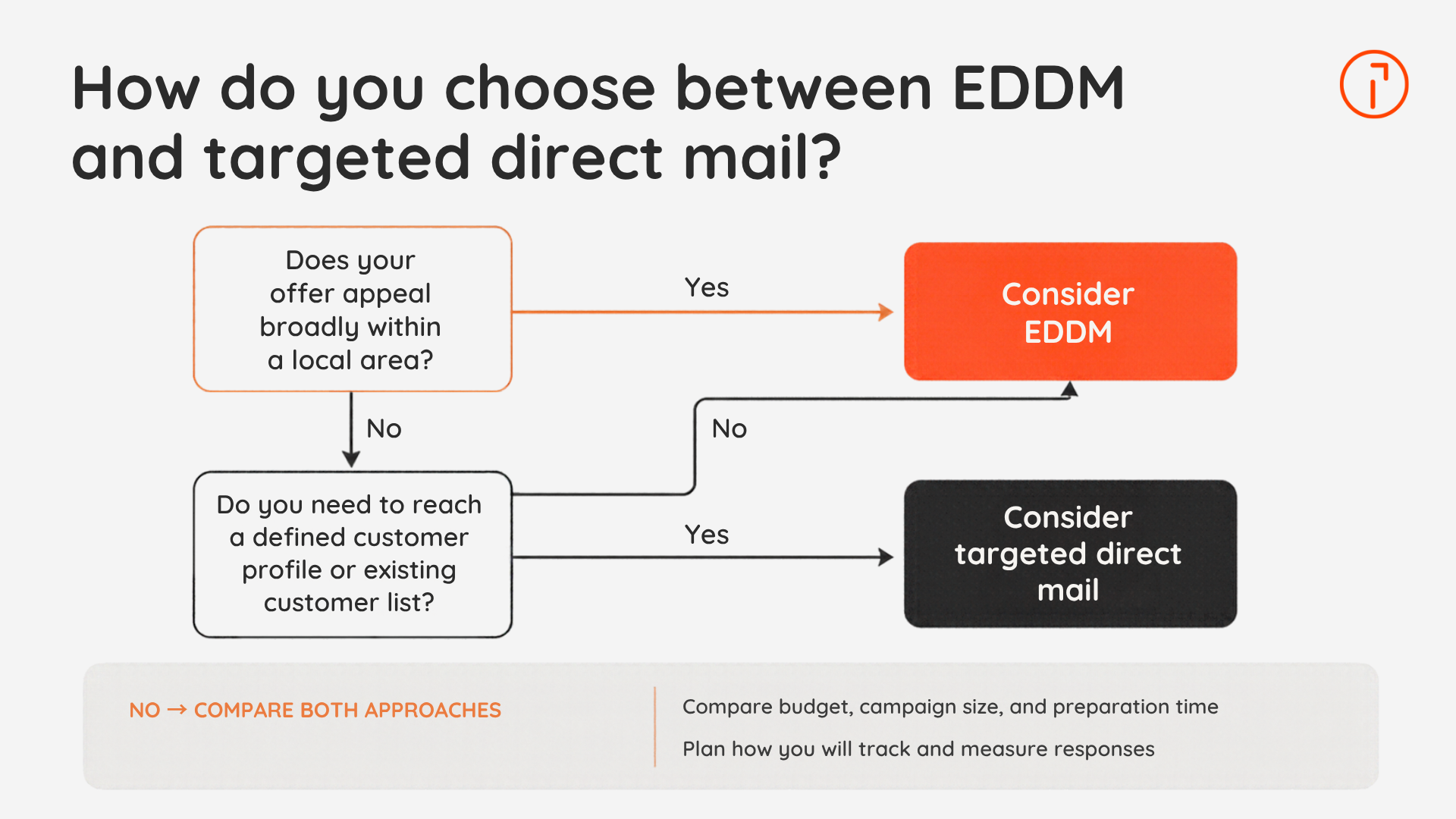
Now we’ve explored both sides of the direct mail coin - EDDM versus targeted direct mail - these simple questions can help you make a final decision.
Ask yourself these questions:
Does your product appeal to almost everyone? If so, EDDM may be the right choice.
Does your product only appeal to a specific group of people? If so, a targeted list may work more effectively.
Do you have a list of existing customers to mail first? This could be a good low-risk option to trial campaigns before sending out to a larger audience segment.
What’s your total budget? EDDM generally has lower per-piece postage, while targeted lists can focus spend on a more specific audience.
How long do you have to design and prepare mailings? Putting together a targeted list can take time, while EDDM can be a quicker, simpler route.
How will you track your campaign’s results? Use response mechanisms such as QR codes, PURLs, promo codes, or dedicated phone numbers to measure responses, and use mail tracking software to monitor delivery.
Can you test EDDM against targeted direct mail?
Another low-risk way to compare the approaches is to run two small campaigns at the same time.
You can run a small EDDM mailing campaign in one area and a small targeted direct mail campaign in another comparable area, then compare cost per response.
Based on these results, you’ll be able to see which campaign performed most effectively and how to further outreach to prospects and existing customers in the future.
Conclusion
While we’ve explored the details of both EDDM and direct mail marketing, there is no universally better option. Both of them have their place and purpose, and the choice depends on your audience, budget, and what you want to get out of your postal campaign.
To come to a final decision as quickly as possible, the questions above can help guide you. You could also run a comparison test to see how each approach performs for your audience.
At Quadient, our mail automation software can help streamline mail preparation, delivery tracking, and reporting in a connected workflow.
Looking for more information before you make your choice? Discover more about direct mail marketing or EDDM from our dedicated guides.
Transformation doesn’t have to be hard. Simplify your direct mail campaigns with help from Quadient.
