


















Introduction
The cost of preparing and sending mail can quickly add up. In addition to the cost of the postage itself, there's the cost of your employees' time, costs related to fixing errors, trips to the post office, and the cost of processing returned mail. Read on to learn several practical ways to reduce postage-related costs for your business.
Key takeaways
Weigh and measure your mailpieces accurately.
Choose the lowest-cost service that meets your delivery and tracking needs.
Use appropriately sized packaging to avoid unnecessary costs.
Keep addresses accurate to reduce returned mail and re-mailing.
Use automation and reporting to reduce manual work and identify hidden costs.
Where should you start when reducing business postage costs?
The first step in reducing business postage costs is to review your last 6 to 12 months of mailing activity. Look at what you send, how often you send it, which services you use, and where the most money is going. This will help you focus on the changes that will have the highest impact on your costs.
Audit area | What to review | What to look for |
Mail volume and mix | Review the volume of letters, flats, and packages you send | Changes in volume, duplicate mailings, or processes that no longer match mailing needs |
USPS services | Review the services and delivery speeds used most often | Frequent use of faster or higher-cost services than delivery requirements call for |
Weight and dimensions | Review whether mailpieces are weighed and measured accurately | Estimated weights, postage adjustments, or inconsistent measurements |
Packaging | Review package size and whether parcels use the correct packaging | Oversized boxes, too much empty space, or unnecessary packing materials |
Destinations and zones | Review where packages are being sent and the shipping zones involved | Destinations or zones that account for a disproportionate share of shipping costs |
Extra services | Review the use of insurance, signature services, Certified Mail, Return Receipt, or expedited delivery | Add-on services that are routinely used without a clear business need |
Postage method | Review whether you use stamps, online postage, postage meters, or other methods | Inconsistent methods, manual processes, or reliance on retail postage |
Address quality | Review returned and undeliverable mail for recurring address issues | Frequent returns, corrections, or re-mailings due to address data |
Department or location | Review postage spending by team, office, or business unit | Significant differences in costs or mailing practices between teams or locations |
What are the best ways to reduce business postage costs?
Most postage savings come from small, repeatable changes to how you prepare and send mail. The following strategies can help reduce postage charges and the internal cost of managing mail.
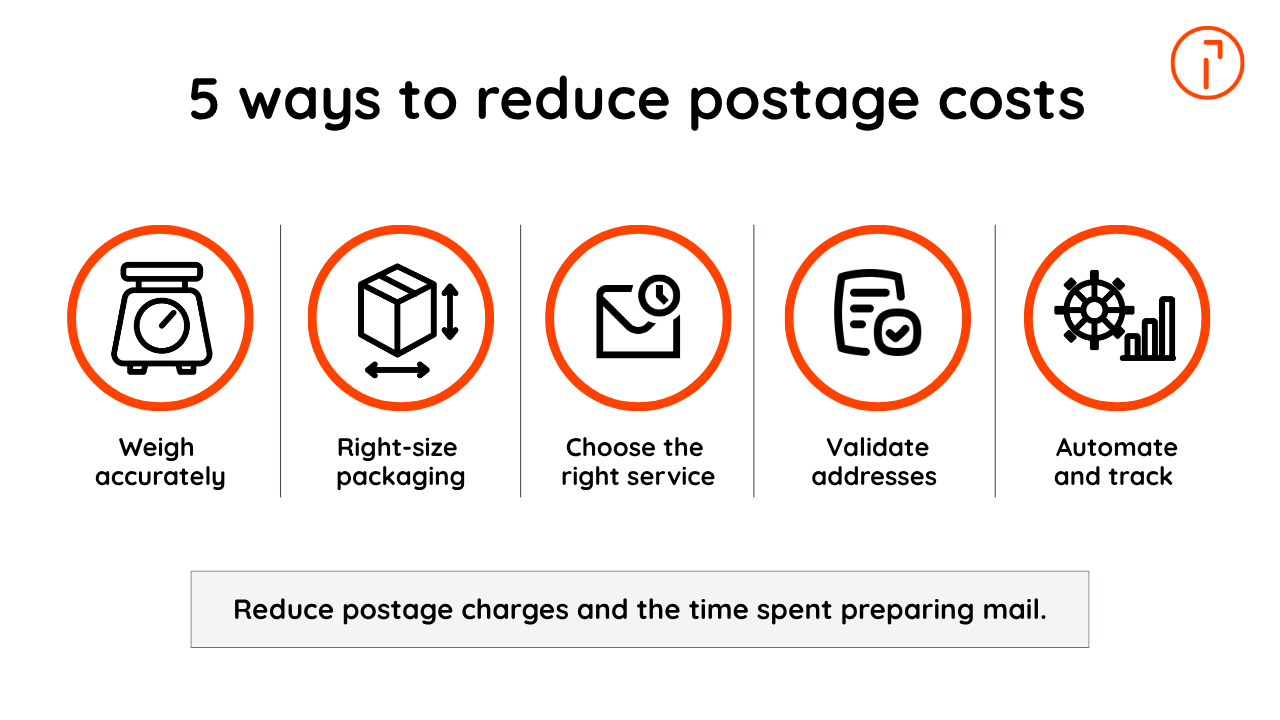
Weigh every mailpiece accurately
Weigh mailpieces precisely, including envelope, packaging, and contents. Estimating the weight can lead to overpaying or, when you apply too little postage, postage adjustments and delays.
Use the correct sizes for your envelopes and packaging
Always pick the smallest envelope or package possible, as oversized packaging may increase costs because some USPS prices and fees are based on package dimensions as well as weight.
Pick the correct USPS service
Compare shipping rates and shipping options based on the required mail delivery date, tracking, protection, and price. Avoid paying for expedited shipping when a lower-cost service perfectly meets your needs.
Access eligible commercial pricing
Depending on the USPS service and how the mail is prepared, postage meters, online postage platforms, and other mailing solutions may provide access to commercial pricing. Compare the commercial price with the retail price before choosing how to process the mailpiece.
Use a postage meter for regular mail
Postage meters are the single best way to send mail, they're easy to use, fast, and their features such as integrated weighing, rate calculation, postage printing, and account tracking, all improve accuracy and reduce manual work.
Validate addresses before mailing
Use address validation and regularly clean your mailing lists to identify incomplete, outdated, or incorrectly formatted addresses before mailing. This can reduce returned mail, re-mailing, delays, and wasted postage.
Consolidate mailings when possible
Combine documents for the same recipient, align recurring mailing schedules, process compatible mail in batches, and consider presort options where volume supports them.
Review extra services and add-ons
Use insurance, signatures, Certified Mail, Return Receipt, and expedited delivery only when the contents require them and make sure you have clear internal guidelines in place to optimize service usage.
Automate mailing and shipping workflows
Use shipping software and mailing technology to calculate postage, compare services, print labels, create mailing documentation, process batches, track items, and report on spending.
Regularly track your postage spending
Monitor your total spend regulargly but also track other key indicators such as your average cost per mailpiece, postage use per teams or department or cost centers, and returned-mail rates.
Which cost-saving opportunity should you prioritize?
Not sure where to begin? Use this table to identify the most relevant cost-saving opportunity based on your current mailing process.
If you frequently… | Focus on… |
Overpay or receive postage adjustments | Weighing and measuring mail more accurately |
Send parcels in partly empty boxes | Using right-sized packaging |
Use expedited services by default | Setting clear service-selection guidelines |
Deal with returned or undeliverable mail | Validating addresses and improving address data |
Prepare recurring mail manually | Automating mailing tasks |
Cannot explain changes in postage spending | Tracking costs by department, location, or account |
Buy stamps for regular office mail | Comparing stamps with online postage or a postage meter |
How do stamps, online postage, and postage meters compare?
The best option for your business will depend on your mail volume:
Stamps will be enough if you send only a small amount of mail. They come with a few hurdles. With stamps, you must manually check the best postage rates to select, you have to buy and store stamps, apply them, and then manually track the postage costs.
Online postage is useful for businesses that want to print postage or shipping labels from a computer. Costs and capabilities vary by platform, and businesses may need a printer, scale, labels, and a subscription to get the best out of the service.
Postage meters are the best option for businesses that send mail regularly. They can combine weighing, postage calculation, printing, rate updates, and expense reporting in one, unified and easy, workflow. They're by far the most efficient and simple way to send mail for a business.
The best choice for you will depend on how much mail you send, what you send, how long preparation takes, and whether you need to track spending by department or client.
Factor | Stamps | Online postage | Postage meter |
Postage calculation | Calculated manually | Calculated through the platform | Calculated through the meter and scale |
Rate updates | Monitored manually | Updated through the platform | Updated through the connected meter |
Equipment needed | None required | May require a computer, printer, and scale | Requires a meter and integrated or connected scale |
Supplies | Requires stamps and envelopes | Requires labels, paper, printer supplies, and envelopes or packaging | Requires meter ink, labels or tape, and envelopes or packaging |
Reporting | Provides limited reporting | Provides reporting that varies by platform | Can provide account- and department-level reporting |
Manual work | Requires manual purchasing, inventory management, application, and expense tracking | Requires some manual setup and processing | Requires fewer manual steps by combining weighing, postage calculation, and printing |
Ongoing costs | Includes postage and supplies | Often includes subscription or service fees | Typically includes rental or lease costs, plus supplies |
Best suited for | Businesses that send mail occasionally | Businesses that want to print postage or shipping labels from a computer | Businesses that send mail regularly |
How can packaging reduce parcel postage costs?
A large, lightweight parcel can cost more to send because USPS may apply dimensional-weight pricing or nonstandard fees based on size.
To keep costs under control:
Use the smallest possible packaging that protects the contents without excessive empty space
Standardize a practical range of boxes and mailers for common shipments
Use only as much bubble wrap and other packaging materials as needed to protect the contents and avoid unnecessary weight or empty space
Measure and weigh the final packaged item before calculating postage
Flat-rate shipping is not always the lowest-cost option and you sould compare with other available options based on the package’s weight, dimensions, destination, and any commercial pricing available to your business.
How can automation reduce letter-mail costs?
If employees prepare mail by hand every day, automation can reduce both processing time and avoidable postage errors.
Use a postage meter to automatically weigh mail, calculate postage, print postage, and apply current rates without relying on manual efforts or stamp inventory.
Track postage by department, location, client, or activity to identify unusual spending, budget overruns, and opportunities to improve cost allocation.
Use integrated or connected scales to improve postage accuracy.
Automate repetitive manual tasks such as folding, inserting, sealing, and applying postage for recurring mail like invoices, statements, and notices.
Use centralized reporting to simplify expense tracking and reduce the time spent reconciling mailing costs.
Automation does not lower the published USPS price, but it can reduce your total mailing cost by limiting manual work, preventing mistakes, and showing you where postage is being spent.
How should you calculate the total cost of business mail?
When comparing mailing methods, include postage and all the other costs involved in preparing and sending an item.
Cost category | What it includes |
Postage | USPS charges based on service, weight, dimensions, destination, and any extra services |
Labor | Employee time spent weighing, preparing, applying postage, reconciling costs, and making trips to the Post Office |
Supplies | Envelopes, packaging, labels, ink, tape, and other mailing materials |
Equipment or software | Costs associated with postage meters, mailing equipment, and online postage platforms |
Service fees | Subscription, rental, lease, and other recurring fees associated with the mailing method |
Re-mailing costs | Additional postage, supplies, and labor required when mail is returned or needs to be sent again |
Here's a simple formula you can use:
Total mailing cost = postage + labor + supplies + equipment or software + service fees + re-mailing costs
Conclusion
Reducing postage costs does not always require a major change. Start by reviewing what you send, how you prepare it, which services employees choose, and where you may be overspending. Accurate weighing, better packaging, cleaner address data, and regular reporting can all make business mail more cost-effective.
If manual preparation takes too much of your time or of your postage is hard to track, Quadient iX-Series mailing systems let you weigh mail, calculate postage, apply current rates, and monitor spending in the easiest possible way.
Explore Quadient postage meters to find the best solution for your mail volume, and budget.