


















Introduction
Are postage stamps still the easiest way to send business mail? They may be if you only send mail (really) occasionally. Once sending mail becomes a regular task, other options become much more enticing for several reasons, mostly convenience and time.
The top alternatives to stamps are: postage meters, automated mailing systems, mailing and shipping software, and print-and-mail services. All of these can directly reduce your reliance on stamps. Some just change how you pay for postage. Others take more of the preparation work off your team's plate. The right choice depends on the type and volume of mail you send, how often you send it, and the process that works best for you.
Below, we'll compare the top 10 alternatives and explain, for each of them, when each one may be a good fit, and for who.
Key takeaways
Postage meters are the best alternative to stamps for businesses that send mail regularly.
Mailing automation can reduce preparation time and improve postage accuracy.
Your mail type, volume, frequency, and workflow should guide your choice.
Mailing tools can give you a clearer view of postage use and costs.
Why move beyond stamps for business mail?
Think about how your team handles outgoing mail today. Do employees keep postage stamps on hand? Are they weighing envelopes? Checking postage rates? Preparing mail one piece at a time?
For occasional mail, that may be perfectly manageable. As mail volume grows, those small tasks can take up a big chunk of the working day.
Postage is only part of the cost of handling mail. Employee time, trips to the Post Office, supplies, and fixing postage errors all contribute to the cost of sending business mail.
Automating more of the mailing process can cut down on repetitive work and make everyday mail easier to handle.
10 alternatives to stamps for business mail
There is more than one way to move away from individual stamps. Some options let you calculate and print postage yourself. Others automate mail preparation or move the work to a service provider.
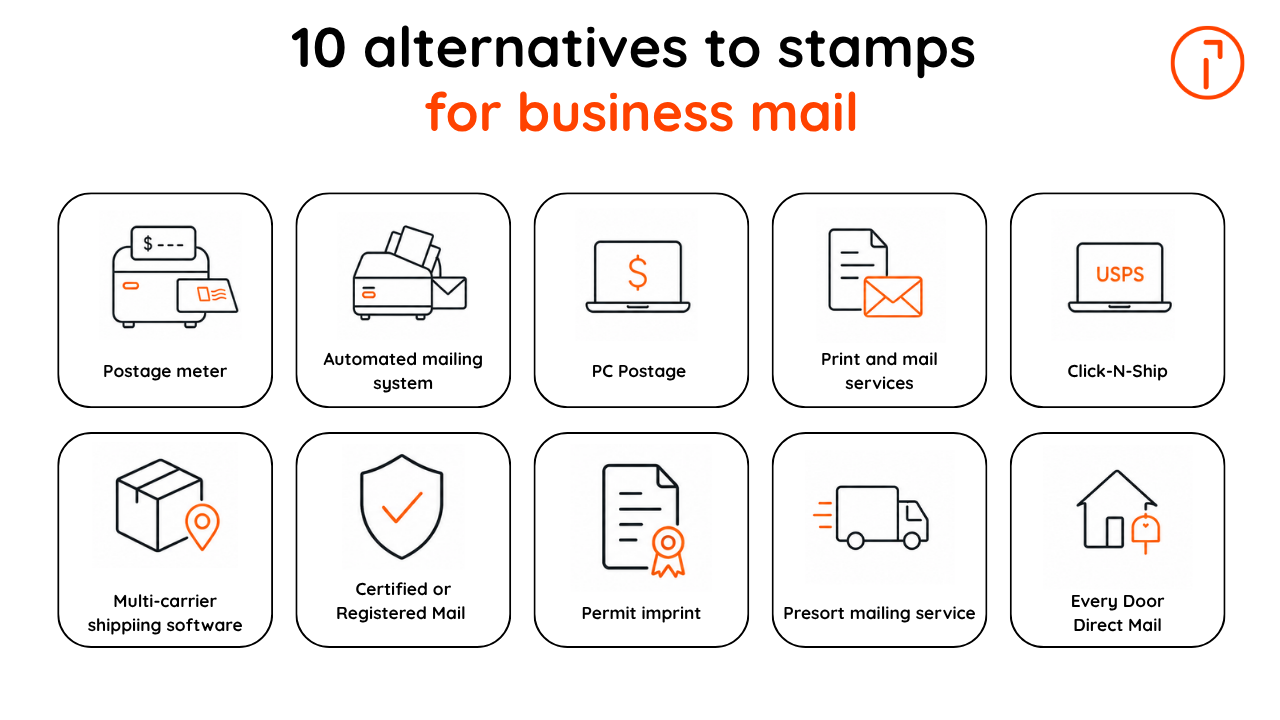
Use the table below to get a sense of which option might suit your business.
Alternative | A good fit if... | What it helps with | Keep in mind | Look at this first when... |
Postage meter | You send business mail throughout the week | Weighing mail and printing the right postage | You’ll need an agreement with an authorized provider | Stamps are becoming a regular part of your team’s workload |
Automated mailing system | Your team prepares a steady or growing volume of mail | Cutting down on weighing, postage printing, feeding, and sealing by hand | Choose equipment that matches the amount of mail you process | Mail preparation is taking up too much of your employees' time |
PC Postage | You send smaller volumes or mail from more than one location | Buying and printing postage from a computer | Your team may still need to weigh and prepare each item | You want to stop using stamps without adding dedicated equipment |
Print-and-mail services | You regularly send invoices, statements, notices, or customer letters | Letting a provider take care of printing and mailing | Consider security, turnaround time, cost, and how much visibility you need | You want employees to spend less time preparing mail |
USPS Click-N-Ship® | You want to buy USPS postage online | Purchasing postage and printing labels from a USPS account | Not every USPS mail service is available | You want an online USPS option without dedicated mailing equipment |
Multi-carrier shipping software | You regularly send packages with different carriers | Comparing carrier rates, creating labels, and tracking shipments | Each carrier account needs to be set up | Choosing between carriers is part of your shipping routine |
Certified Mail® or Registered Mail® online | You send documents that need proof of mailing, delivery, or extra security | Keeping mailing and delivery records, with added security (Registered Mail) | Preparation and acceptance depend on the USPS service | You send contracts, notices, or sensitive documents |
Permit imprint | You prepare qualifying commercial mail in larger batches | Printing an approved postage mark instead of adding individual stamps | USPS authorization and mailing preparation rules apply | You send planned commercial mailings |
Presort mailing service | You have a consistent volume of recurring mail | Moving sorting and postal preparation to a service provider | Minimum volumes, fees, and pickup arrangements may apply | You send enough mail to outsource preparation |
Every Door Direct Mail® | You want to reach households or businesses in select local areas | Sending qualifying local marketing mail without individual stamps | It is designed for direct-mail campaigns | Your goal is local marketing |
1. Postage meters
If your team sends letters throughout the week, a postage meter is a good place to start.
A postage meter weighs mail, calculates the required postage, and prints it onto an envelope or approved label.
Best for: Businesses that regularly send letters, invoices, checks, notices, or other office correspondence.
Not ideal for: Businesses that only mail occasionally and may not use dedicated equipment often enough to make it worthwhile.
Why it replaces stamps: Employees weigh the mailpiece and print the required postage as part of the same process.
Cost considerations: In the US, businesses lease postage meters rather than buy them. When comparing systems, look at the provider agreement, postage, supplies, software, service, and contract terms.
Why businesses use them: A meter can reduce stamp handling and trips to the Post Office while helping your team apply the right postage. Postage meters can also help businesses track postage costs.
Want to look more closely at the numbers? Read about postage meter savings or see how metered mail compares with stamped mail.
2. Automated mailing systems
What if applying postage is only one part of the problem?
As mail volume increases, employees may spend more time weighing envelopes, printing postage, and preparing each piece for mailing. An automated mailing system can take on more of that work.
Best for: Businesses with recurring mail volume that makes manual preparation time-consuming.
Why it replaces stamps: The system calculates and applies postage, so employees don't have to add stamps one envelope at a time.
What to consider: A small office may only need weighing and postage printing. A busier office might benefit from features like automatic feeding and sealing.
3. PC Postage
If you want to print postage without adding dedicated mailing equipment, PC Postage might be a good option.
With approved software, employees can purchase and print postage from a computer, printer, and internet connection.
Best for: Businesses that send a low volume of mail or with employees working from multiple locations.
Why it replaces stamps: You print postage as you need it rather than keeping individual stamps on hand.
What to consider: Mailpieces still need to be weighed, printed with postage, labeled, and prepared for mailing.
For lower-volume mail, that may be all you need. If those manual steps start taking up more time, a postage meter or automated mailing system may be worth considering.
4. Print-and-mail services
Some businesses want to remove more of the physical mailing work from the office.
A print-and-mail service can take recurring documents such as invoices, statements, notices, and customer letters and prepare them for delivery. The service provider may handle printing, postage, and postal handoff.
Best for: Businesses that regularly send documents by physical mail.
Why it replaces stamps: Your provider handles the mailing process, so employees don't need to purchase and apply postage or prepare every item in-house.
What to consider: Security, turnaround time, pricing, and how much visibility you have.
5. USPS Click-N-Ship®
Want to buy postage directly through USPS?
With Click-N-Ship, businesses can purchase postage and print labels through USPS for eligible mail and package services.
It can suit businesses that want to manage postage online without dedicated mailing equipment.
6. Multi-carrier shipping software
If packages make up a large share of what you send, postage may only be one piece of the shipping process.
You might also want to compare carrier rates, create shipping labels, track deliveries, and monitor your shipping costs. Multi-carrier shipping software brings these tasks together.
This type of software is most useful when you ship through several carriers. If most of your outgoing mail is letters, a postage meter or another mailing solution may be a better fit.
7. Certified Mail® or Registered Mail® online
Some documents need a little more attention.
Online mailing tools can help prepare eligible items for USPS services such as Certified Mail or Registered Mail. Certified Mail provides proof of mailing and delivery or attempted delivery. Registered Mail provides USPS's highest level of mail security and can include insurance. These services are a good choice for sending documents when you need proof of mailing, delivery, or extra security.
Keep in mind that the process varies by service. Registered Mail, for example, must be presented to a USPS retail employee or rural carrier.
8. Permit imprints
If you send commercial mailings in volume, you may want to look at permit imprints.
A permit imprint prints an approved postage mark on each mailpiece. Unlike a postage meter, which calculates and prints postage as mail is processed, permit imprints are generally used for qualifying commercial mailings. Postage is deducted from an advance deposit account when you submit the mailing to USPS.
Permit imprints can work well for batches of qualifying mail, but are less practical for individual letters sent throughout the day.
9. Presort mailing services
Do you send a consistent amount of mail but prefer not to handle commercial mail preparation yourself?
A presort mailing service handles the sorting and preparation before the mail enters the postal system. This can reduce the amount of work your team handles in-house.
Before choosing a provider, check its volume requirements, fees, pickup arrangements, and turnaround times.
10. Every Door Direct Mail®
Every Door Direct Mail® (EDDM®) is a USPS service that helps businesses send marketing mail to customers along select local postal routes, without having to apply individual stamps to each piece.
For EDDM Retail, each mailpiece uses an approved postage mark instead of a regular stamp or meter stamp.
EDDM is for marketing campaigns, rather than everyday mail.
Which stamp alternative should you choose?
Before choosing a solution, think about the mail you send.
How much mail do you send in a typical week? Are you sending letters, documents, packages, or a combination? Does it leave from one office? How much time does your team spend preparing it?
Your answers can help narrow down the options.
If your business mainly needs to... | Best alternative to consider |
Send regular office letters | Postage meter |
Process higher mail volumes | Automated mailing system |
Print postage without dedicated metering equipment | PC Postage |
Send recurring invoices, statements, or notices | Print-and-mail service |
Buy eligible USPS postage online | USPS Click-N-Ship |
Compare carriers for packages | Multi-carrier shipping software |
Send Certified Mail or Registered Mail | Online postage with the appropriate service |
Send qualifying commercial mail in volume | Permit imprint or presort mailing service |
Send local marketing mail | Every Door Direct Mail |
As mail volume grows, postage meters with automatic feeding and sealing can save more time. Reporting features can also help you keep track of postage activity.
See our guide to compare postage meters by mail volume and business needs.
What does it cost to move away from stamps?
Costs vary depending on your mail volume and the option you choose. Take the following into consideration:
postage
employee time
equipment or software
ongoing service costs
If you’re considering a postage meter, our guide to postage meter prices explains the main costs to compare.
How to move away from stamps
You don't need to change everything at once.
Review your mail.
Choose the right option.
Compare the full cost.
Set up a clear process.
Measure the results to see whether the new process delivers the expected benefits.
Conclusion
Traditional stamps may make sense when you send mail occasionally. If mailing is a regular part of your week, other options can reduce prep time and make postage easier to manage.
Quadient helps businesses manage mail and shipping with postage meters, mailing systems, and software designed to improve accuracy and reduce manual work.
Explore Quadient mail solutions to find an option that best fits your business.
