


















Introduction
USPS® usually updates its postage rates twice a year. Prices change and usually increase to better reflect changes in USPS delivery costs.
If your business sends mail regularly, anticipate and manage these postage rate changes ahead of time. Here's how to best prepare for each update.
Start by reviewing the USPS services you use, estimating how new rates could affect your costs, and making any updates before the new prices take effect. If you use a connected postage meter, the latest USPS rates are applied automatically.
This article explains how to assess new rates, control costs, update your mailing operation, and prepare for future USPS changes. You can check the latest USPS postage rates here.
Key takeaways
USPS rate changes impact services and fees differently.
A mailing audit can show where rate changes are likely to have the biggest impact.
Reviewing service levels, packaging, and eligible commercial rates can help manage postage costs.
Connected postage meters can make rate updates easier to manage.
Why do USPS postage rates change?
USPS uses different pricing categories depending on the product category.
Market Dominant products, such as First-Class Mail® and USPS Marketing Mail®, follow the market-dominant ratemaking system overseen by the Postal Regulatory Commission. This framework includes pricing authority linked to the Consumer Price Index, along with other forms of rate authority.
Competitive products include Priority Mail®, Priority Mail Express®, USPS Ground Advantage®, and Parcel Select®. USPS has more flexibility to adjust prices for Competitive products based on economic conditions, so these products follow a different set of pricing rules.
USPS category | Examples | What to look at |
Mailing Services | First-Class Mail, USPS Marketing Mail | Postage rates, fees and mailing requirements |
Shipping Services | Priority Mail, USPS Ground Advantage | Shipping prices, package fees and service options |
USPS price changes can also come with updates to fees, mailing requirements, or package measurement rules. That means businesses need to look beyond the headline postage increase.
How can businesses assess the impact of a USPS rate change?
Start by reviewing six to 12 months of your mailing and shipping activity.
Look at the services you use, how much you send, the weight and dimensions of the packages you send, destination zones, and any extra services you regularly use, such as Certified Mail®, Registered Mail®, USPS Tracking®, signatures, or insurance.
If you use Business Reply Mail® or send mail overseas, check those rates too.
Start with the mail and packages you send most often, especially the ones that make up most of your postage costs.
USPS rate-change audit
Audit area | What to review | What to do |
Mailing volume | Volume by service | Estimate the cost change |
Packages | Weight, dimensions, dimensional weight, and zones | Identify higher-cost shipments |
Extra services | Certified Mail, Registered Mail, USPS Tracking, signatures, and insurance | Check updated fees |
International mail | Priority Mail International and First-Class Package International Service | Review updated prices and price groups |
Pricing | Retail, commercial, metered, and permit pricing | Compare available options |
Departments | Postage spend by team or location | Review budgets |
Postage systems | Meters, shipping software, and connected tools | Confirm rate updates |
How should businesses update their postage systems?
Make sure the systems you use for mailing and shipping are ready for the new rates. This may include postage meters, shipping software, e-commerce systems, and other connected tools.
Connected postage meters can receive USPS rate updates electronically, so businesses can apply current rates without making manual changes.
It's also worth making sure employees know about any updates to packaging, measurements, or mailing processes before the new rates take effect.
How can businesses manage higher postage costs?
When rates change, it is a good time to check whether your mailing and shipping process still makes sense for what you send.
Compare eligible commercial rates: Check the rates available through postage meters, online postage, permit mailings, presort services, and other business mailing programs. These options may offer better pricing than standard retail rates.
Choose the right package size and weight: Use packaging that fits the item closely and avoids unnecessary space or added weight. Dimensional weight pricing can increase costs for large, lightweight shipments based on the space they occupy.
Improve address accuracy: Incorrect, incomplete, or outdated addresses can lead to returned mail, repeat mailing costs, wasted postage, and delivery delays. Businesses with larger mailing programs may also use USPS Address Management Systems and services such as NCOALink® to help improve address quality.
Review service levels: Not every shipment needs the fastest available service. Where delivery times are flexible, compare eligible alternatives. For example, eligible books and other media can be sent with Media Mail®, while USPS Ground Advantage or Priority Mail may be a better fit for other packages.
Check USPS promotions: Businesses sending eligible direct mail should review current USPS promotions, registration periods, and eligibility requirements.
How can businesses forecast the financial impact?
A simple way to estimate the impact of a rate change is:
Estimated annual impact = annual volume × change in cost per piece
For a more accurate forecast, calculate the impact separately for the mail classes, package services, weights, and destination zones you use most often.
For example, if you send 100,000 pieces of a particular mail type each year and the cost increases by $0.04 per piece:
100,000 × $0.04 = $4,000 in additional annual postage
Based on your review, you may need to update postage budgets, shipping fees, customer charges, fulfillment costs, or product pricing.
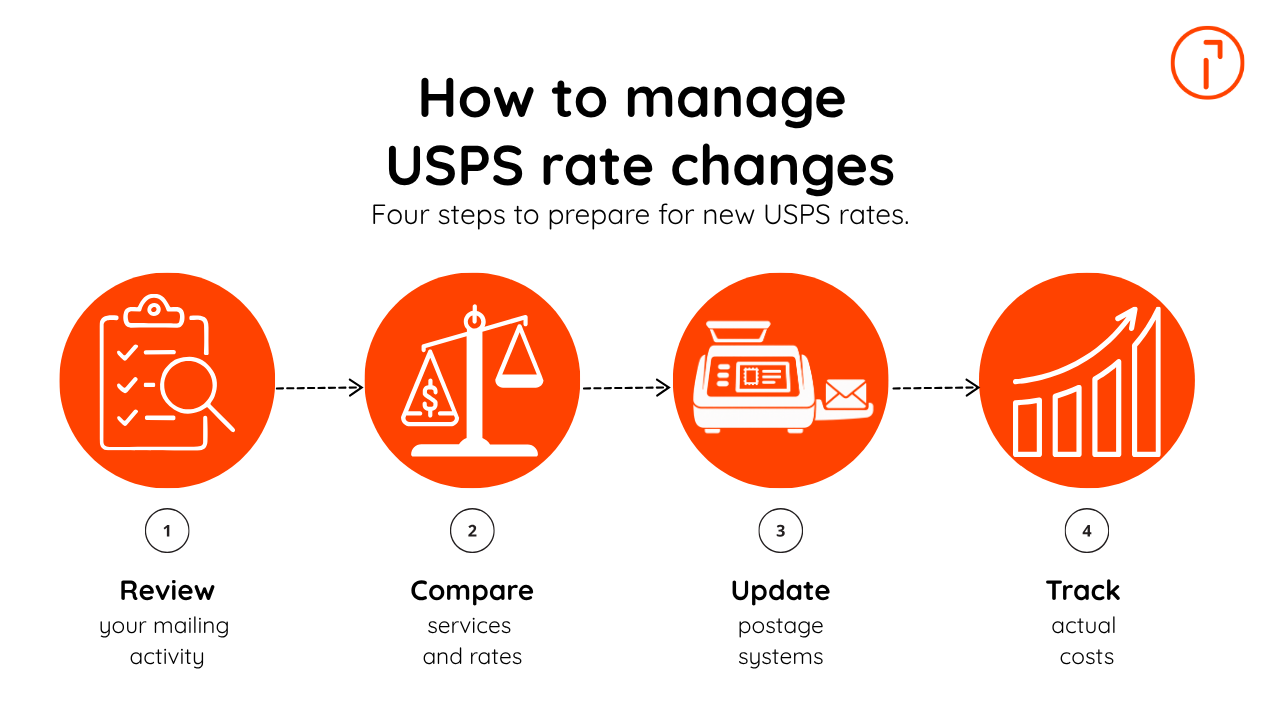
Once the new rates are in place, check your actual postage costs against your forecast for the first 30 to 90 days. This can help you spot any unexpected increases and make further adjustments if needed.
How can businesses prepare for future USPS rate changes?
Make rate-change planning part of your normal mailing operations. Business mailers should monitor official USPS announcements and PostalPro for upcoming pricing and mailing-standard changes.
A repeatable process can help:
Monitor USPS announcements.
Review the services and prices that are changing.
Audit your mailing and shipping activity.
Forecast the financial impact.
Update postage systems and workflows.
Prepare employees for process changes.
Review actual costs after the new rates take effect.
Conclusion
USPS rate changes are easier to manage when they become part of your regular mailing process.
Quadient postage meters and connected mailing solutions help businesses apply current rates, track postage costs, and make everyday mailing easier to manage.
Explore Quadient mailing solutions to prepare for future USPS rate changes.
