


















Introduction
A postage meter helps businesses weigh mail and print the correct postage from the office. Internet-connected models can also receive USPS rate updates and track spending.
It's not possible to purchase a postage meter in the US. You have to lease or rent one from a provider authorized by the United States Postal Service® (USPS).
Read on to learn how postage meter leases work, related fees to be aware of, and how to choose a model that best fits your business.
What is a postage meter?
A postage meter is a device that weighs letters and packages, determines the correct postage, and then prints postage on an envelope or on adhesive meter tape for larger items.
Most modern postage meters are connected to the internet, so they can automatically download rate updates. They also provide tools to track postage costs across your business. Models that can handle larger mail volumes often also include automatic feeding, envelope sealing, and more detailed reporting.
Can you buy a postage meter?
No. USPS rules state that postage meters must be leased or rented from an authorized provider. They cannot be purchased, sold, or resold.
A customer normally signs a postage meter rental or equipment lease with an authorized provider. The provider also helps complete the required USPS authorization.
USPS currently lists four authorized postage meter providers:
Quadient
Pitney Bowes
FP Mailing Solutions
Data-Pac Mailing Systems
Is a postage meter worth it for a small business?
A postage meter can be a good fit if your business sends mail on a regular basis and you want to save time preparing it.
A postage meter can help you:
Prepare invoices and customer letters
Weigh outgoing letters and packages from the office
Track postage spend across your business
Take fewer trips to the Post Office
We suggest comparing the total cost of leasing and running a postage meter with the time and effort your team spends preparing and sending mail without one.
How does using a postage meter reduce postage costs?
Using a postage meter to send eligible First-Class Mail® saves $0.04 per letter. USPS rates effective July 12, 2026, are $0.82 for a one-ounce letter with a stamp and $0.78 for a one-ounce letter with metered postage.
That means that a business that sends 500 one-ounce letters each month can save $20 per month, or $240 per year. This estimate does not include lease fees, supplies, software, or other operating costs.
Accurate weighing also helps prevent overpaying for postage. Faster mail preparation reduces the time employees spend applying stamps or visiting the Post Office, adding to the potential savings.
Rates for packages depend on the service, size, weight, and destination. Be sure to check current USPS pricing before sending.
What does a postage meter lease cost?
Costs vary depending on several factors, including the machine type, processing speed, contract length, and included services. A tabletop meter usually costs less than a larger mailing system with features like automatic feeding and higher-capacity scales.
The advertised lease price may not include the cost of supplies, software, and other services. Postage is also charged separately. Some providers allow you to prepay for postage. Others let you pay later by invoice.
What postage meter fees should you check before signing?
Ask for a written quote that shows the full cost over the contract term.
Check:
The contract length and terms of renewal
Fees for setup and delivery of the device
Charges to download postage
Software and connectivity fees
Costs for maintenance and repairs
Equipment insurance, if required
Costs for mailing supplies like ink, meter tape, labels, and sealing fluid and whether you must buy them from the provider
Fees for early termination of the contract and equipment return
How long is a postage meter contract?
Contract length varies by provider. Some rentals are month-to-month, while equipment leases can last several years.
Before signing, check:
The total cost over the full contract
Renewal and cancellation terms
Upgrade or downgrade options if your mailing needs change during the contract
A longer contract may reduce the monthly payment, so compare the total cost and cancellation terms before signing.
Which postage meter fits your mail volume?
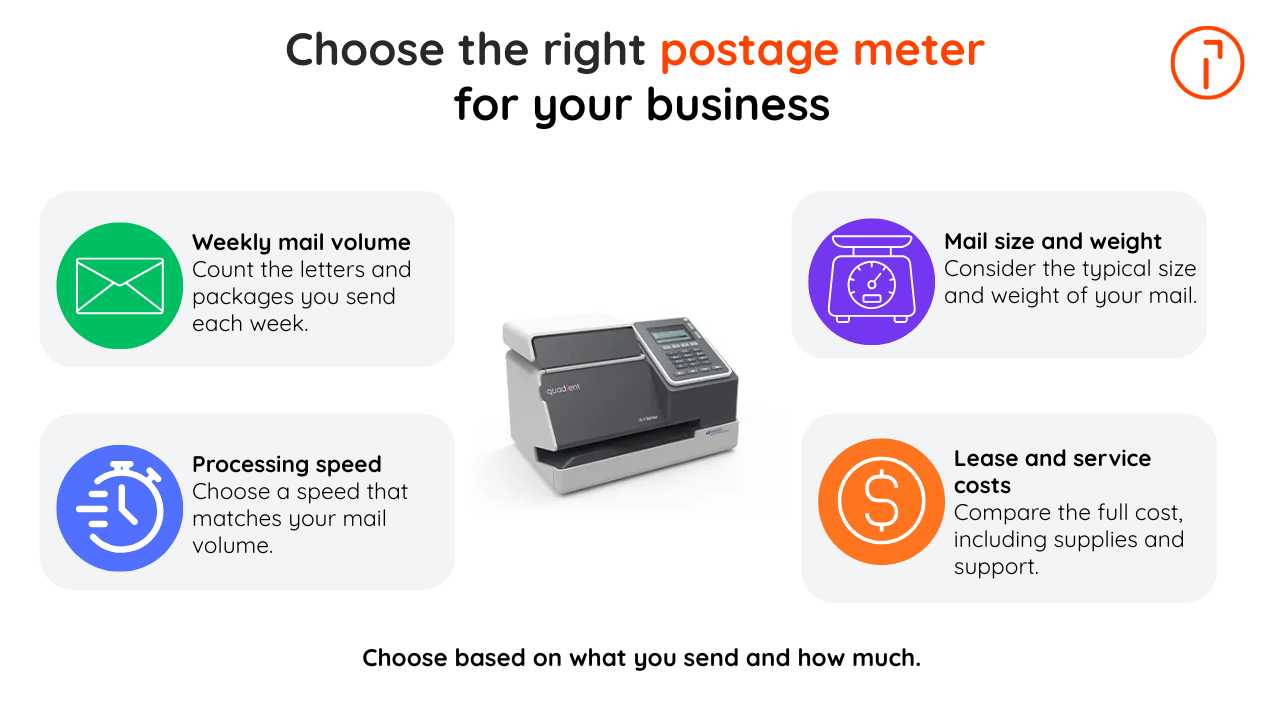
Start by tracking how many letters and packages your business sends in a typical week. Consider the size and weight of each item, too. A five-pound integrated scale may suit envelopes and small packages, while heavier items may require an external scale.
Compare Quadient iX Series postage meters
Model | Recommended weekly volume | Processing speed | Best suited to |
0 to 200 pieces | Up to 18 letters per minute | Small businesses with low mail volumes | |
100 to 500 pieces | Up to 45 letters per minute | Growing offices with moderate mail volumes | |
300 to 1,000 pieces | Up to 110 letters per minute | Busy offices with higher mail volumes | |
1,000 to 3,000 pieces | Up to 175 letters per minute | High-volume offices | |
More than 3,000 pieces | Up to 300 letters per minute | Production mail centers |
Each iX Series system can process packages and meets USPS Intelligent Mail Indicia requirements.
What features should you compare?
Choose a postage meter that fits your team’s current mail volume and has enough capacity to support future growth.
Feature | What to consider | Why it matters |
Integrated scale | Check the maximum weight capacity and whether a larger connected scale is available. | Accurate weighing reduces postage errors and helps you select the right mail class. |
Processing speed | Compare the number of letters processed per minute and the envelope sizes the system can handle. | Faster processing saves time when mail volumes increase. |
Automatic feeder | Check whether the system automatically feeds and seals envelopes. | Automatic feeding reduces manual handling and speeds up mail preparation. |
Postage accounting | Check how many users, departments, clients, or cost centers the system can track and whether reporting costs extra. | Detailed reporting provides a clearer view of postage spending across the business. |
Package and shipping support | Confirm whether the system can print meter tape and shipping labels, compare services, and provide tracking. | Package support helps your team manage letters and packages in a single workflow. |
Rate and software updates | Check whether updates are automatic and whether connectivity, download, or rate protection fees apply. | Current rate data helps your team calculate postage accurately when USPS prices change. |
What is Intelligent Mail Indicia?
Intelligent Mail Indicia (IMI) is the current USPS standard for postage meters.
It uses a two-dimensional barcode to transmit postage and mailpiece data. This supports more accurate reporting and stronger postage controls.
Confirm that any meter you lease is IMI compliant. USPS has decertified systems that do not produce compliant IMI.
How should you compare postage meter providers?
Bring a recent sample of your outgoing mail when speaking with providers. Ask each USPS-authorized provider for a written quote based on the same mail volume and requirements.
Compare:
Total cost over the full contract
Processing speed, feeding method, and scale capacity
Package support, software, and reporting
Supply, connectivity, and maintenance charges
Upgrade, renewal, and cancellation terms
Intelligent Mail Indicia compliance
Using the same requirements for every quote gives you a clearer comparison than advertised starting prices.
Conclusion
The right postage meter should match your mail volume, package weights, and reporting needs. Before signing a lease, compare the full contract cost and choose a system that fits your mail volume, package weights, reporting needs, and support requirements.
Find the right Quadient postage meter for your business.