







Short answer: In 2026, choose an e-invoicing platform that is certified for the countries where you invoice and integrates cleanly with your ERP and finance systems.
It depends on:
- Your country scope today and in the next 12–24 months
- Invoice volume and exception rates
- The required delivery model (network, Peppol, or clearance/CTC)
- ERP and finance system integration complexity
- Whether real-time reporting or compliance monitoring is required
What is a certified e-invoicing platform?
Definition: A certified e-invoicing platform is software that creates and transmits invoices in the structured format required by a tax authority or approved network, so invoices are accepted as compliant e-invoices — not just PDFs.
In simple terms, it’s the difference between sending an invoice and sending an invoice that the compliance system will accept.
Why this matters: If an invoice is rejected, you don’t just “retry.” You often get delays, rework for finance, and a messier audit trail.
One key clarification: “Certified” is not a global badge. It’s tied to a country’s rules, a delivery route (like a network or clearance model), and sometimes a specific provider registration. That’s why the safest buying move is to start with your country list, not a vendor shortlist.
What factors matter when choosing a certified e-invoicing platform in 2026?
- Country coverage: certified support for the countries you invoice in (now + next 12–24 months)
- Delivery model fit: network/Peppol vs clearance/CTC, plus any reporting requirements
- Proof of certification: clear evidence per country (not a generic “certified” claim)
- ERP integration: prebuilt connectors vs. custom work, and support for your P2P/O2C tools
- Exceptions handling: how rejections, status messages, and corrections are managed
- Compliance operations: who monitors rule changes and how updates are delivered (and how fast)
What is the real decision when choosing a certified e-invoicing platform in 2026?
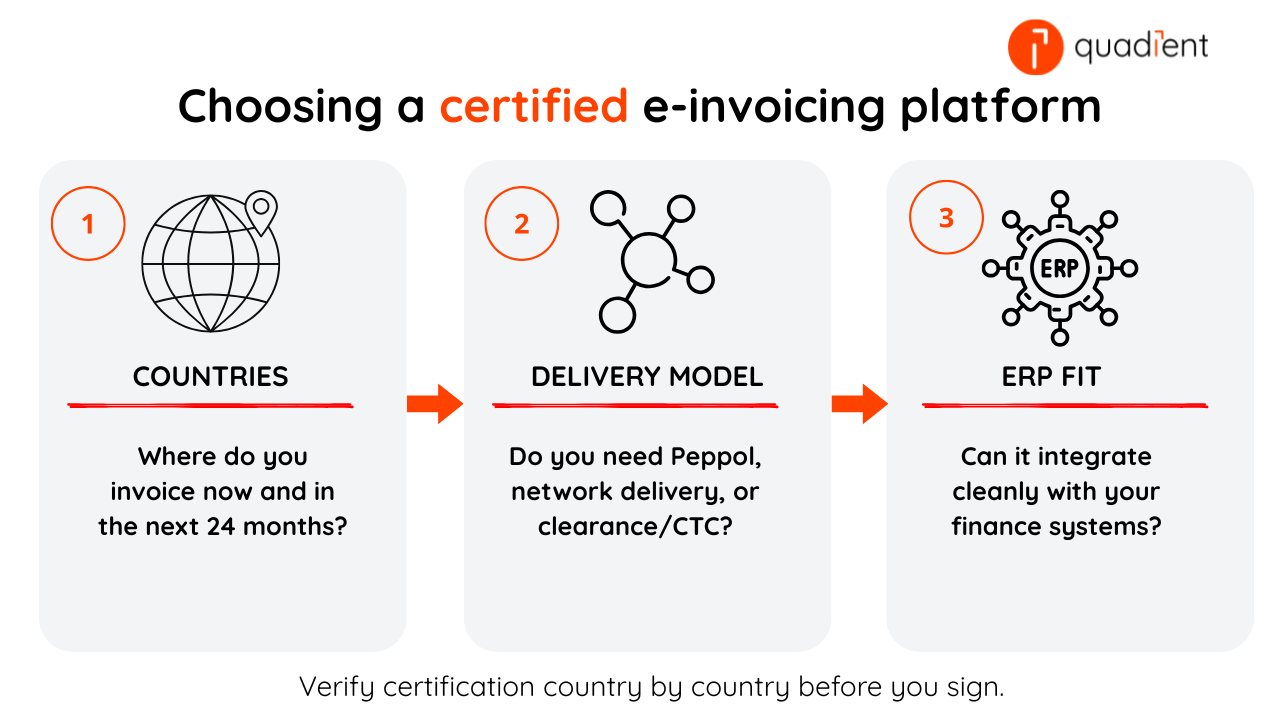
There is no single “best” platform in 2026 because certification hinges on a number of factors. You’re matching countries, delivery model (network vs. clearance/CTC), and ERP integration.
This matters most when you operate across multiple countries or expect to expand. The wrong fit usually shows up as rejected invoices, last-minute change requests, or a compliance “upgrade” that turns into a full re-implementation.
What types of certified e-invoicing platforms can you choose from?
Most certified e-invoicing platforms fall into four categories:
- Peppol-focused providers
- Clearance/CTC-ready providers
- Network-first providers
- Managed service providers
The best fit depends on your country's rules, the delivery model, and how much onboarding and compliance ops you want the provider to handle.
What factors should drive your e-invoicing platform choice?
Most “wrong platform” decisions come from missing one of these drivers:
- Countries in scope
- Required model/route
- ERP + integration complexity
- Volume + exceptions + trading partner onboarding load
- Compliance operations
Which type of certified e-invoicing platform fits your situation?
Platform type | Best for | Trade-off | What to verify before you sign |
Peppol-focused provider | Organisations operating in Peppol-enabled markets | Does not cover all country mandates or clearance models on its own | Peppol access point status, country coverage, supported formats (e.g., BIS profiles), monitoring of rule changes |
Clearance / CTC-ready provider | Organisations operating in clearance or CTC-mandated markets | Coverage and timelines vary by country | Proof of certification/registration per country, end-to-end status flow, archiving/evidence handling, update SLAs |
Network-first provider | Organisations with large, complex trading partner networks | May add unnecessary cost if network capabilities are not required | Onboarding tooling, directory/reach, validation rules, partner experience, pricing tied to volume/partners |
Managed service layer | Organisations needing ongoing compliance and change management support | Less direct control unless internal governance is well defined | SLAs for regulatory updates, support model for exceptions, reporting visibility, escalation paths |
How do you choose a certified e-invoicing platform quickly?
- List every country where you send or receive invoices today, plus the next 24 months.
- Map each country to the required model: Network route (like Peppol) vs. clearance/CTC (validation/reporting through an approved route).
- Confirm certification the boring way: Ask for proof per country (not a general “we’re certified” slide).
- Test one real flow end-to-end: ERP → invoice creation → validation → delivery → status/acknowledgement → archive.
- Price the real scope: Integration effort, compliance updates, support for exceptions, and volume-based fees (send + receive).
Is a certified e-invoicing platform worth it in 2026?
Worth it when
- You invoice in mandated markets and rejections or delays are already hitting cash flow.
- You need a provider that can absorb regulatory change without constant internal projects.
- Your ERP and billing stack is complex enough that “DIY compliance” becomes fragile fast.
Not worth it when
- Your invoicing is low volume, mostly domestic, and you have no near-term mandate pressure.
- You can’t resource integration or process change at all this year (you’ll likely stall mid-rollout).
What’s the bottom line for 2026?
In 2026, the right certified e-invoicing platform is the one that is certified where you trade and fits your ERP reality without heavy custom work. The real question isn’t which platform has the longest feature list. It’s which one stays compliant as rules change—without turning every update into rework.
Frequently asked questions
What does “certified” mean for e-invoicing in 2026?
It usually means the provider is approved or recognised to exchange structured e-invoices under a specific country’s rules and delivery route. Certification can be tied to a network (like Peppol), a clearance/CTC model, or a formal registration list. Always verify certification per country, not as a generic claim.
Is a PDF invoice the same as an e-invoice?
No. A PDF is usually just a digital document. A compliant e-invoice is structured data (often XML/EDI) that systems can validate and process automatically, and that meets local rules for delivery, acknowledgements, and archiving.
Is Peppol enough for every country?
Not always. Peppol is widely used and a strong fit in many scenarios, but some countries require clearance/CTC flows or local requirements beyond Peppol routing. If you invoice across borders, assume you may need more than one rail unless your provider confirms full coverage.
What should I ask for in the SLA before I sign?
Ask who owns: (1) monitoring legal changes, (2) updating formats and validation rules, (3) support response times, and (4) evidence and archive retention. Also ask how rejections and exceptions are handled, and what reporting you get for audit readiness.
Do I need one certified e-invoicing platform for every country?
No. Many providers support multiple countries and mandate models through a single platform. However, you should still verify certification, approval status, and network support for each country where you invoice.