







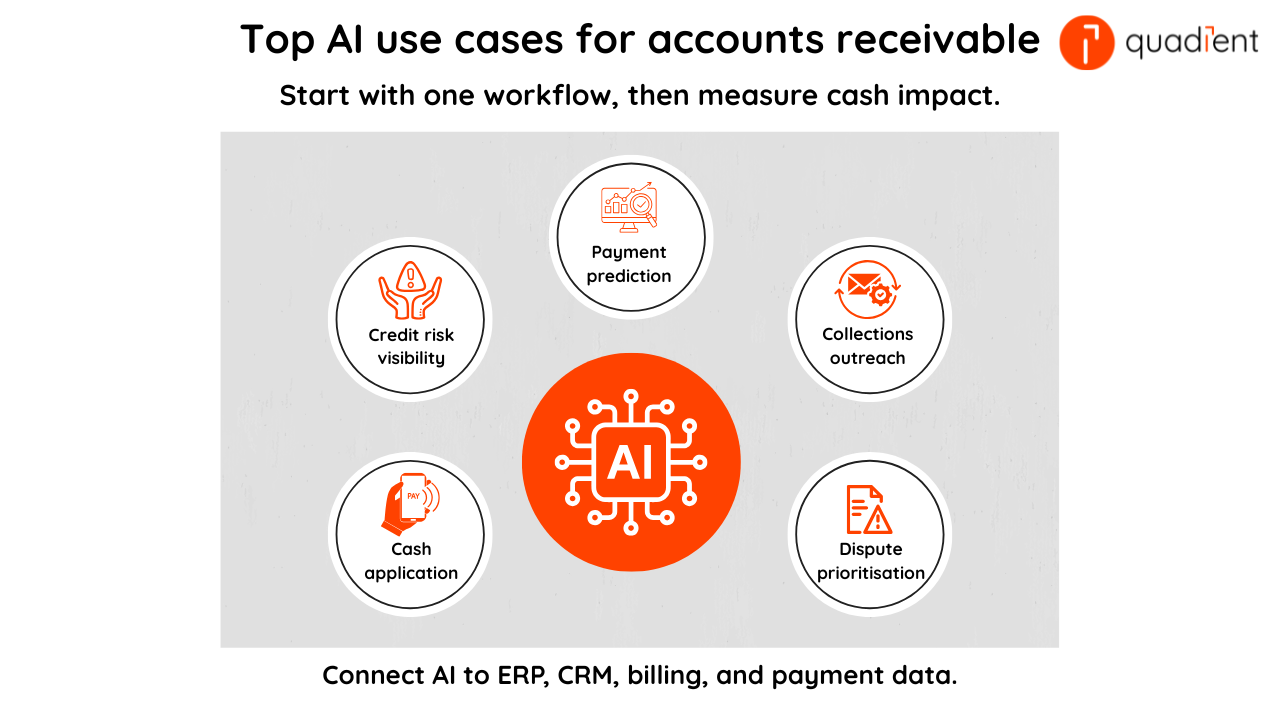
Short answer: Of its many uses, the top ways to implement AI in accounts receivable (AR) in 2026 include using it for payment prediction, automated collections outreach, dispute and exception prioritisation, cash application, and credit risk visibility. For most finance teams, the best approach starts with one focused use case, connecting it to ERP and payment data, and measuring the impact on DSO, team productivity, and cash flow.
Artificial intelligence (AI) in accounts receivable means using software, machine learning, and workflow automation to help finance teams predict payments, prioritise collections, automate outreach, and reduce manual work. This article focuses on practical implementation in 2026, and not theory.
This page covers:
- the best AI use cases for AR
- a simple rollout plan
- a comparison on where to start
- common questions finance teams ask
What does AI in accounts receivable mean in 2026?
AI in AR is moving beyond simple reminders and dashboards. In 2026, finance teams are using predictive models, generative AI, and workflow automation to support invoice matching, collections outreach, dispute handling, and payment forecasting. The use of intelligent software improves invoicing, collections, cash application, credit decisions, and payment forecasting.
A simple way to think about it: AI should help AR teams decide who to contact, when to contact them, what to say, and what risk to act on first.
What key statistic shows why AI matters in AR?
In March 2026, Gartner advised finance leaders to shift investment toward accounts receivable and predictive analytics, with a specific focus on AI for cash flow forecasting and collections. Gartner included AR among the top finance technology priorities for 2026. That matters because it shows AI in AR is no longer a niche experiment. It's now a practical finance priority tied to cash flow, collections performance, and measurable business value.
What are the top ways to implement AI in accounts receivable in 2026?
1. Start with payment prediction
Payment prediction is often the best first AI use case because it gives finance teams a clearer view of likely late payers. Quadient’s AR automation platform includes built-in AI that predicts payor behaviour with up to 94% forecasting accuracy.
This helps teams prioritise the right accounts instead of chasing every invoice in the same order.
2. Automate collections communications
AI works best when paired with workflow automation. Instead of relying on collectors to manually send reminders, teams can automate email sequences, escalation rules, and follow-ups based on customer risk, invoice age, and payment history.
This is usually one of the fastest wins because it cuts repetitive work without changing core ERP processes.
3. Use AI to prioritise disputes and exceptions
Not every invoice issue needs the same response. In 2026, AI is increasingly used to flag anomalies, sort disputes, and surface exceptions that are most likely to delay cash collection.
The practical benefit is simple: collectors spend less time triaging and more time resolving.
4. Improve cash application and matching
A strong AI rollout should include transaction matching and cash application. This is where AI can learn from payment patterns, remittance formats, and customer behaviour to reduce manual matching work.
This use case matters most for teams with high payment volume or messy remittance data.
5. Connect AI to your ERP, CRM, and payment systems
AI does not work well as a silo. To be useful, it needs access to invoice data, customer history, payment records, and collections activity.
Checklist
- Is invoice data flowing from the ERP?
- Can AI see payment behaviour by customers?
- Are collections actions logged in one place?
- Can finance review and override AI decisions?
- Are audit trails kept for compliance?
Which AI use cases should AR teams start with first?
AI use case | Best for | Main benefit | Trade-off |
Payment prediction | Organisations with high volumes of late payments and a need for better payment prioritisation | Better prioritisation | Requires sufficient historical payment data to generate accurate predictions |
Automated collections outreach | Organisations with small or mid-sized AR teams looking to reduce manual collections work | Fast time savings | Requires review workflows and message governance |
Dispute and exception routing | Organisations with complex B2B invoicing and frequent disputes or exceptions | Faster resolution | Requires upfront workflow mapping and exception-routing rules |
Cash application support | Organisations with high payment volume and manual cash application challenges | Less manual matching | Depends on payment and remittance data quality |
Credit and risk monitoring | Organisations managing large customer exposure and credit risk | Earlier risk signals | Requires integration across ERP, CRM, and payment systems |
How should you implement AI in AR?
Here’s a step-by-step plan to roll out AI into your AR workflows.
1. Audit your current AR bottlenecks
Map where time is lost today. Focus on late payments, manual follow-up, disputes, unapplied cash, and weak forecasting.
2. Pick one narrow use case
Do not start with “AI across AR.” Start with a single workflow, such as payment prediction or automated collections emails.
3. Connect core systems
Make sure the AR platform connects to ERP, CRM, billing, and payment tools. AI quality depends on data quality.
4. Keep humans in the loop
Finance leaders still want AI to operate within defined limits. In practice, the best AR teams use AI to support decision-making, not replace it.
5. Measure cash impact
Track DSO, collector productivity, promise-to-pay accuracy, dispute cycle time, and cash application rate. If AI is not improving those numbers, it is not implemented well.
What expert view explains the shift toward AI in finance?
“Artificial intelligence (AI) is reshaping how finance operates, makes decisions, communicates, and drives enterprise value.” –Deloitte
This matters for AR because receivables is one of the clearest places where AI can improve daily work and working capital at the same time.
Why is 2026 the right time to implement AI in AR?
The shift in 2026 is not just because AI is available — it’s that AR teams can now use it inside real workflows.
That makes implementation less about experimentation, and more about controlled rollout. Finance teams now have clearer use cases, stronger platform support, and better ways to measure results than they did even a year or two ago.
What is the final takeaway for finance teams?
The top ways to implement AI in accounts receivable in 2026 are clear. Start with payment prediction, automate collections communications, prioritise disputes and exceptions, improve cash application, and connect AI to the systems your team already uses.
For most finance teams, the best start isn’t a full transformation project. It’s improving one workflow with measurable cash impact.
Learn how Quadient AR Automation helps finance teams automate collections, improve forecasting, and accelerate cash flow.
Frequently asked questions
What is AI in accounts receivable?
AI in AR is software that helps automate and improve collections, forecasting, cash application, and risk monitoring. It turns payment data into actions, not just reports.
What is the best first AI use case for AR?
Payment prediction and automated collections outreach are usually the best starting points. They’re easier to launch and tie directly to DSO and collector efficiency.
Can AI replace an AR team?
No. Most teams use AI to assist human decision-making, not replace it. The goal is to remove repetitive work and help collectors focus on higher-value tasks.
What systems should AI connect to in AR?
At a minimum, AI should connect to ERP, CRM, billing, and payment systems. Without that data, predictions and workflows remain limited.
How do you measure success?
Track DSO, productivity, dispute resolution time, cash application speed, and forecast accuracy. Those are the clearest signs that AI is improving AR performance.