





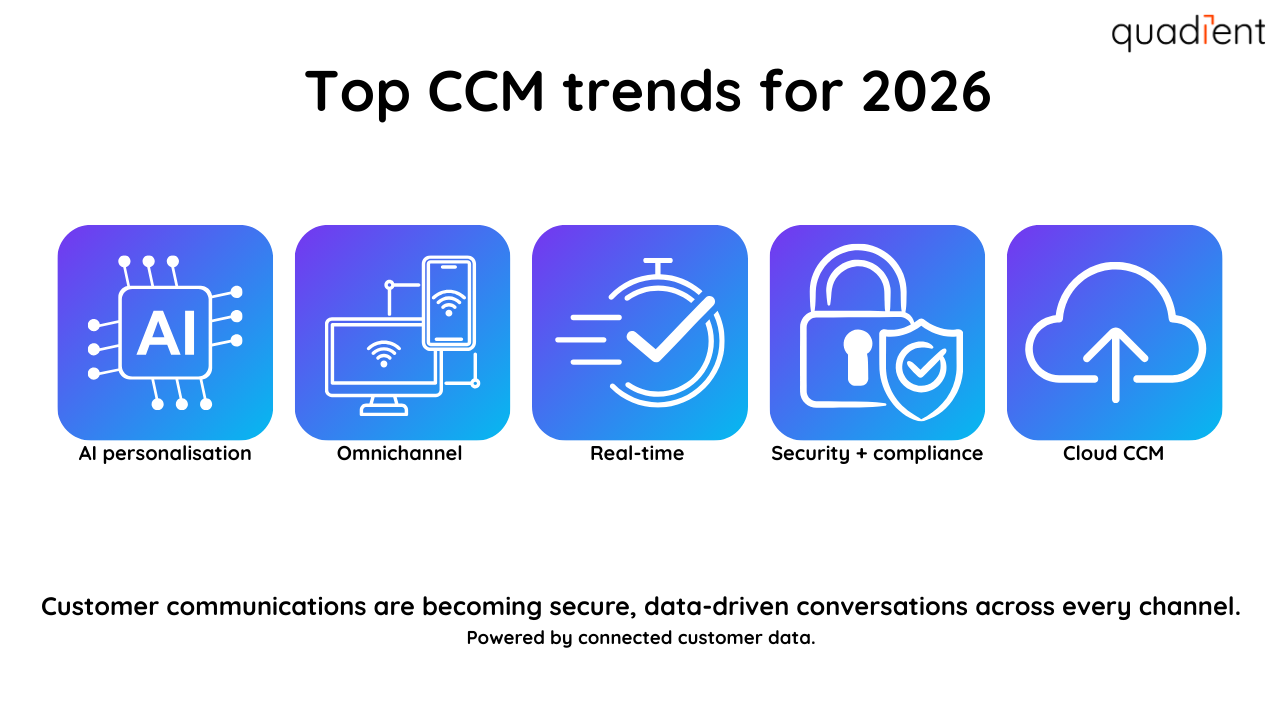
Short answer: The top customer communications management (CCM) trends for 2026 are AI-driven personalisation, true omnichannel delivery, real-time customer communications, stronger data security and compliance, and cloud-based CCM platforms that connect customer data across channels.
In 2026, customer communications management has become a strategic part of the customer experience.
CCM is the technology used to create, manage, and deliver customer messages across print and digital channels. In practical terms, modern CCM systems reduce call volume, speed up payments, and improve customer satisfaction and loyalty by making communication clearer between businesses and their customers.
Top CCM trends for 2026 at a glance
2026 CCM trend | What it means | Example |
|---|---|---|
AI-driven personalisation | AI-assisted systems to personalise content using customer data | A bank statement shares relevant insights customised for each customer |
Omnichannel delivery | One consistent message across print and digital | A utility bill is delivered via portal, email, and print |
Real-time communications | Messages are triggered by events instead of schedules | Fraud alerts, outage notifications, and claim updates |
Data integration | CCM platforms connect to CRM, ERP, billing, and content systems | An insurer pulls policy and claims data into one workflow |
Governance and compliance | Approvals, audit trails, and controls reduce risk | A healthcare provider delivers secure results with retention |
Cloud-based CCM | Legacy tools are replaced with one scalable platform | An enterprise consolidates fragmented communication systems |
1. From documents to real customer conversations
CCM used to focus on output: bills, policies, letters, and PDFs. In 2026, the focus is shifting toward customer conversations across the full customer journey.
That includes bi-directional communications, push notifications, portal messages, clearer onboarding, and stronger customer feedback loops. Instead of sending static messages, businesses are building contextual engagement across digital channels.
This shift is especially visible in regulated industries where clarity and timing directly affect customer satisfaction.
Quadient Inspire, the #1 CCM platform, helps organisations connect communication touchpoints across channels and customer journeys. Learn more at https://www.quadient.com/en-gb/news/pr-quadient-takes-number-one-position-in-global-CCM-market-shares.
2. Artificial intelligence (AI) becomes built-in and emerges as the norm
AI is now embedded in most modern CCM software solutions. The new AI-assisted tools help teams personalise communications using customer data, improve clarity and tone with natural language processing, and reduce manual work through workflow automation.
For IT leaders, the value is scale. For business leaders, the value is better customer engagement without sacrificing compliance.
To make sure AI delivers results without compromising the quality and authenticity of the communications, human-in-the-loop systems are increasingly chosen.
For example, Quadient’s CCM platform embeds AI-assisted capabilities within workflow management, centralised content templates, and compliance controls, helping teams deliver secure, audit-ready customer communications across every channel, while retaining a clear human overview of all the tasks.
Quadient is recognised as the #1 CCM platform in the market. Read the announcement at https://www.quadient.com/en-gb/news/pr-quadient-takes-number-one-position-in-global-CCM-market-shares.
3. True omnichannel delivery is now expected
Customers move between channels constantly and new channels appear regularly. Email, SMS, mobile apps, WhatsApp, web portals, print communications, and even social media play a role.
Brands with strong omnichannel strategies achieve up to 89% customer retention compared with 33% for those without one, underscoring the business value of consistent cross-channel experiences.
Omnichannel communication means customers receive a consistent message across delivery channels. An omnichannel cloud CCM platform supports this by enabling organisations to design a document or communication once and to deliver it everywhere with formats adapted for each communication channel. These systems also directly connect to customer relationship management (CRM) and enterprise resource planning (ERP) systems to improve the precision of the data shared with customers.
Print is still an important channel, even if it's evolving. Variable data printing, QR codes, and personalised inserts connect paper to digital experiences and make print communications more measurable.
4. Real-time, event-driven communication complements batch processing
Legacy communication systems relied on batch-oriented file synchronisation and overnight jobs. In 2026, customer communications are increasingly triggered by events, while batch processing is used for high-volume statements, bills, and regulatory notices.
Common examples include fraud alerts, outage notifications, claims updates, and payment reminders with text-to-pay links. These messages make it easier for customers to act immediately.
5. Data integration is a competitive advantage
Customer data lives in many systems, including CRM, ERP, billing platforms, and document management systems. If data synchronisation fails, the customer experience suffers.
Modern CCM platforms are expected to connect transaction data, digital communication records, and secure file exchange systems. Cloud CCM platforms securely and automatically connect systems, reducing manual effort and integration complexity.
6. Security and compliance shape every decision
Regulatory compliance is no longer a back-office issue. ISO 27001 and comparable data security frameworks, along with industry-specific regulatory controls, now play a central role in CCM platform selection.
In sectors like financial services, life insurance, and healthcare, teams must ensure secure delivery, audit trails, document retention, and strong data protection. Customers want to know their information is safe. Verified links and trusted digital experiences build confidence and reduce risk.
7. Cloud-based platforms replace legacy systems
Market growth in CCM is driven by digital transformation. Organisations are moving away from fragmented tools toward unified customer communications platforms that are easier to scale and easier to integrate.
Across the market, vendors are expanding cloud-first capabilities and technology partnerships that strengthen CRM and ERP connectors, payment integrations, identity verification, analytics tools, and secure file exchange. The focus is no longer just document generation. It's about building connected customer ecosystems.
What IT leaders should prioritise in 2026
- Integration with CRM and ERP systems
- Workflow automation and approval controls
- Data synchronisation and API connectivity
- Omnichannel delivery across print and digital channels
- Data security, audit trails, and compliance readiness
Final thoughts
In 2026, customer communications are no longer static messages. They are secure, data-driven conversations delivered across every channel. Organisations that modernise their CCM solutions will improve customer satisfaction, protect compliance, and strengthen long-term customer relationships.
If your CCM setup still relies on disconnected tools and batch-only workflows, 2026 is the year to modernise.
Would you like to see what a modern CCM platform looks like in practice?
Explore how Quadient, the #1 CCM platform in the world, helps enterprises simplify omnichannel delivery, improve governance, and create much more engaging customer communications with a cloud-based CCM platform built for scale.
Frequently Asked Questions
What is customer communications management (CCM)?
CCM is the technology and process for creating, managing, delivering, and tracking customer communications across digital and print channels. It ensures consistent, compliant messaging across the customer journey.
What are the top CCM trends for 2026?
The top CCM trends for 2026 include AI-driven personalisation, omnichannel delivery, real-time, event-driven communications, stronger data integration, increased focus on security and compliance, and the replacement of legacy systems with cloud-based CCM platforms.
What should you look for in a CCM platform in 2026?
Look for AI-assisted personalisation, workflow automation, omnichannel delivery, secure CRM and ERP integration, compliance controls, audit trails, and cloud-based scalability.
What are the signs you need to replace a legacy CCM system?
The signs are usually obvious, even if sometimes the habit of relying of outdated legacy systems makes the pain of running them invisible. Key points to keep in mind: the reliance on batch-only processing, the use of disconnected tools for each communication channel, limited CRM and ERP integration, manual template updates (with IT support needed), and difficulty meeting compliance requirements quickly.
To make it easy: if your team cannot support real-time communications or make changes quickly without needing heavy IT involvement, it may be time to modernise your CCM platform.
Why is omnichannel communication important?
Omnichannel delivery ensures customers receive consistent messages across email, SMS, portals, mobile apps, and print communications. As new delivery channels appear, it's important to be able to talk to customers where they're already ready to listen.