


















Introduction
Running a business without tracking expenses is like driving a car without a fuel gauge. You might be moving forward, but you have no idea when you’ll run out and have to stop. A business expense calculator helps small businesses, freelancers, and startups clearly see where their money is going. By organizing costs into simple categories and automatically totaling them, such a calculator supports better budgeting, smoother tax preparation, and, more importantly, smarter long-term financial planning.
This guide outlines common expense categories, explains how a business expense calculator works, and shows how to use it effectively. We’ll also cover tips to keep your numbers accurate and stress-free.
What is a business expense calculator?
A business expense calculator helps you estimate and total your business costs over a specific period, such as a month, quarter, or year.
Think of it like a “cost checklist with math built in.”
Instead of guessing what it takes to run your business, you enter your expenses into categories like rent, payroll, software, marketing, and taxes. The calculator then adds everything up and provides a clear total.
Why a business expense calculator is useful for SMBs, startups, and freelancers
If you’re running a small business, you’re often wearing five hats at once. Expense tracking usually falls into the “I’ll do it later” pile. The problem is: later becomes tax season, and tax season becomes panic.
A business expense calculator helps you:
Understand your true cost of doing business
Set a realistic budget
Forecast cash flow
Spot spending that’s creeping up
Plan for tax payments and deductions
And because it works whether you’re tracking monthly, quarterly, or annual costs, it’s useful for both day-to-day decisions and long-term planning.
Common types of business expenses
Every business is different, but most expenses fall into a few predictable categories. The table below provides a quick snapshot before we break down each one in detail.
Expense category | Common examples | Why it matters |
|---|---|---|
Operating expenses | Rent, utilities, internet, supplies, insurance | Forms your monthly baseline and affects profit margins |
Employee-related expenses | Wages, payroll taxes, benefits, contractor payments | Hiring costs are often higher than expected when fully tracked |
Business taxes | Income tax, sales tax, payroll tax, self-employment tax | Impacts cash flow and affects deductions and filing accuracy |
Marketing and admin | Ads, software subscriptions, hosting, legal/accounting fees | Easy to underestimate and often grows quietly over time |
Other expenses | Travel, loan interest, maintenance, depreciation, R&D | Adds up fast and can cause budget surprises if overlooked |
If you include these in your calculator, you’ll cover most of what matters. If you’re not sure where to start, focus on the categories you pay every month. Those are usually the biggest drivers of your total cost.
Operating expenses
Operating expenses make up the biggest part of your regular spending. They have a direct effect on your profit margin. If your operating expenses go up, your profits go down.
If your operating expenses are controlled, your business has room to grow. Small increases can add up quickly over a year. A good habit is regularly reviewing operating expenses to track cost increases.
Common operating expenses include:
Rent or lease payments (office, studio, co-working space)
Utilities (electricity, water, gas)
Internet and phone service
Office supplies (paper, ink, shipping materials)
Business insurance (general liability, property, etc.)
Equipment leases
Cleaning or maintenance services
If you work from home, you may also have home office costs that count as operating expenses. This could include a portion of your rent, mortgage, internet, and utilities.
Why operating expenses matter
Operating expenses usually make up the biggest chunk of your regular spending. They also have a direct effect on your profit margin.
In plain terms:
If your operating expenses go up, your profits go down
If your operating expenses are controlled, your business has breathing room
Even small increases, like a few new subscriptions or rising utility bills, can add up quickly over a year.
One of the smartest habits you can build is regularly reviewing operating expenses, because this is where “quiet” cost creep tends to occur. A few small increases across utilities, subscriptions, and services can slowly raise your baseline costs without you noticing.
Employee-related expenses
Hiring people can become your largest cost category. Employee-related expenses include more than salary. Common employee-related costs include:
Salaries and hourly wages
Payroll taxes
Health insurance
Retirement contributions
Workers’ compensation insurance
Bonuses and commissions
Contractor payments (freelancers you hire)
Training and onboarding costs
Equipment for employees (laptops, phones, software access)
If you’re self-employed, you should still track similar costs for yourself, such as:
Self-employment taxes
Health insurance premiums
Retirement savings contributions
Why this category is easy to underestimate
Many business owners budget for salary but forget the extras. Payroll taxes and benefits can significantly increase the true cost of employment.
Tracking employee-related expenses helps you:
Stay compliant
Avoid payroll surprises
Plan future hiring realistically
Keep your books clean for tax time
A helpful way to think about this category is “fully loaded cost.” That means wages plus payroll taxes, insurance, tools, and any benefits you provide. Tracking the full cost makes hiring decisions clearer and prevents budget surprises.
Business taxes
Taxes can feel confusing, especially if you’re a freelancer or running a business for the first time. But here’s the simple truth:
Taxes are a business cost that must be planned for and tracked carefully.
Common business taxes include:
Federal income tax
State or local income tax (depending on your location)
Sales tax (if you sell taxable products or services)
Property tax (if you own business property)
Payroll taxes (if you have employees)
Self-employment tax (for freelancers and solopreneurs)
Why taxes belong in your expense calculator
If you don’t plan for taxes, you can end up with a huge bill at the end of the year.
Expense tracking also makes it easier to:
Prepare your return
Claim deductions
Prove expenses if audited
Avoid missing deductible categories
A strong expense-tracking habit is one of the best ways to reduce stress during tax season.
If you’re self-employed or running a small business, it can help to treat taxes like a recurring expense instead of a once-a-year surprise. Even a rough monthly estimate can protect your cash flow and reduce year-end pressure.
Marketing and administrative costs
Marketing and admin costs often feel “optional” until they’re not.
Many small businesses underestimate these because they show up as small charges spread across the month.
Common marketing and admin expenses include:
Advertising (Google Ads, social media ads, print ads)
Website hosting and domain fees
Email marketing platforms
Graphic design and branding services
CRM tools and customer support software
Accounting software
Project management tools
Payment processing fees
Legal services
Bookkeeping services
Business banking fees
Why these costs sneak up
It’s easy to sign up for “just one more tool” at $19 per month. But with 10 tools, that’s $190 per month. Over a year, it’s $2,280.
Marketing and admin costs are essential, but they need to be tracked so you can:
See what’s worth the cost
Cut tools you don’t use
Understand your customer acquisition cost
Plan your budget more realistically
A good rule of thumb is to review your software and subscription stack at least once per quarter. These costs are easy to forget because they’re “small,” but they can become one of your largest controllable expense categories over time.
Other common expense categories
Depending on your business, you may also have expenses in these areas:
Travel and entertainment
Flights, hotels, rental cars
Gas and mileage
Meals while traveling
Client meetings or networking events
Loan interest and repayments
If your business uses financing, it’s important to track these costs too.
Include:
Business loan payments
Line of credit payments
Credit card interest
Financing fees
Quick note: Loan interest is a true business expense. The part of the payment that goes toward paying down the loan itself (the principal) isn’t technically an expense, but it still affects your cash flow. That’s why it belongs in your planning.
This is one of the most common places small businesses get caught off guard. A loan payment might look manageable on paper, but it still reduces the cash you have available each month. Tracking it alongside your other recurring costs helps you avoid overcommitting.
Equipment maintenance and depreciation
Repairs for equipment
Vehicle maintenance
Replacement parts
Depreciation (for accounting purposes)
Research and development (R&D)
Product development costs
Testing and prototyping
Market research
Software development
Professional development
Courses and certifications
Conferences
Industry memberships
Training subscriptions
How the business expense calculator works
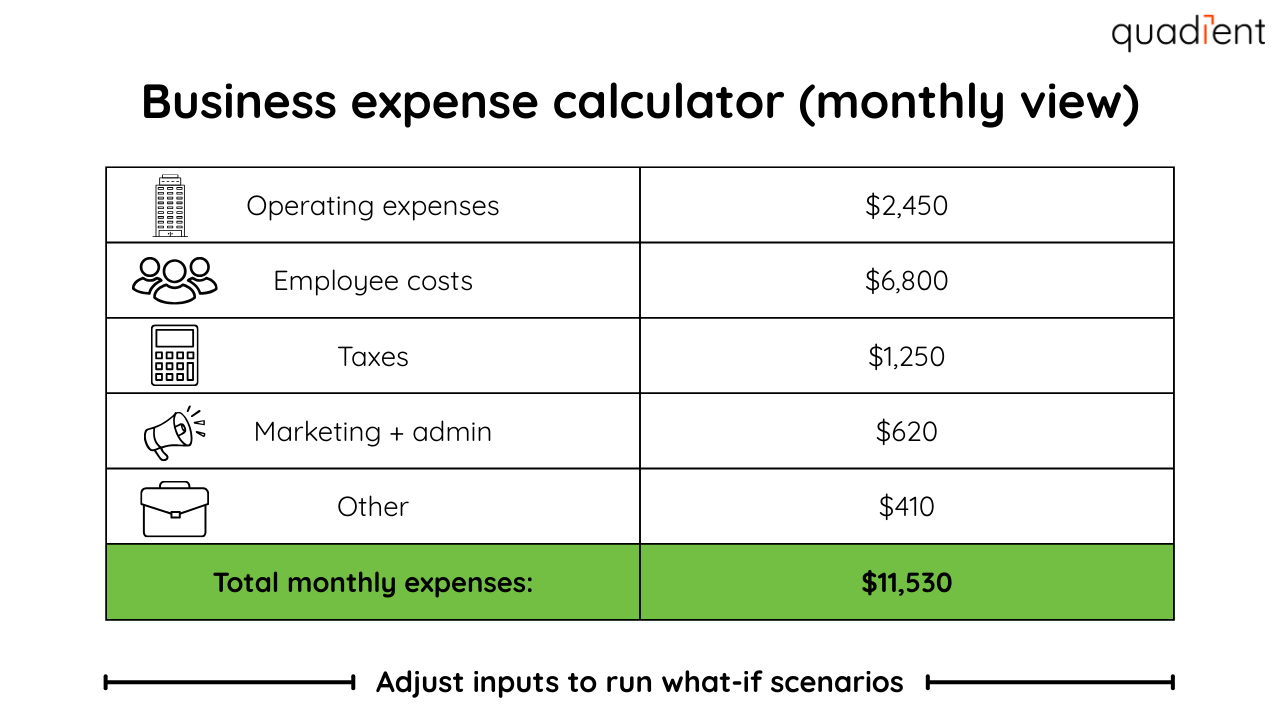
Most business expense calculators use a very simple formula:
Total expenses = Salaries + rent + utilities + insurance + supplies + loan payments + miscellaneous
The calculator totals your expenses so you can quickly see the cost of running your business over a specific period, such as a month or a year. Organizing costs into clear categories provides a structured view of where your money is going and helps highlight recurring or growing expenses.
As Dean Olevson, Director of Finance at Radisson Blu Minneapolis Downtown, explains:
“Before Quadient AP Automation, our AP clerk was spending 30 to 40 percent of their time doing data entry and keying in invoices. Quadient AP has eliminated a lot of that. We’re saving at least 50 percent of our time in accounts payable.”
Even simple tools that organize financial data can reduce manual effort and make it easier to analyze spending.
The real value of a calculator is that it helps you run “what if” scenarios.
For example:
What if you hire an employee next quarter?
What if your rent goes up?
What if you cancel a few subscriptions?
What if you increase marketing spend?
You can adjust the numbers and instantly see the impact on your total expenses.
This makes the calculator useful not only for tracking expenses but also for planning future decisions.
This kind of scenario planning is one of the easiest ways to reduce financial risk. Instead of making decisions based on gut feel, you can see how a change affects your monthly baseline and cash flow before you commit.
Why tracking business expenses matters
Tracking expenses isn’t just about staying organized. It’s about running a healthier business.
Manual financial processes can quickly slow down business operations. On average, AP teams take about 9.2 days to process a single invoice from receipt to payment.
While expense calculators are much simpler tools, they follow the same principle: structured financial data helps businesses understand costs faster and make better financial decisions.
When you track business expenses consistently, you gain:
1. Better budgeting
You can’t build a realistic budget without knowing your actual costs.
Tracking helps you:
Set spending limits
Plan for slow months
Avoid overspending
Allocate money to the right areas
2. Stronger forecasting
Expense tracking helps you predict future costs based on real trends.
Instead of guessing, you can forecast:
Monthly expenses as you grow
Hiring costs
Seasonal spending
Tax obligations
3. Easier tax filing
Expense tracking makes tax season smoother because:
You know what you spent
You have records ready
You can confidently claim deductions
You avoid last-minute scrambling
4. Healthier cash flow
Cash flow is the difference between “my business is doing great” and “why is my bank account empty?”
Tracking expenses helps you:
See where money is going
Identify expensive months
Avoid cash shortages
Stay ready for surprise costs
5. Better decision-making
When you know your expenses, you can make smarter choices like:
Whether you can afford a new hire
Whether your pricing is too low
Whether a marketing channel is worth the cost
Whether you should cut costs or invest more
6. Cleaner records for loans and investors
If you apply for financing, lenders want to see your financials.
If you bring on investors, they want to understand:
Your spending habits
Your profitability
Your cost structure
Your operational efficiency
Good expense tracking makes your business look more stable and trustworthy.
Key benefits of a business expense calculator
Here’s a list of the top advantages of tracking expenses consistently:
Improves cost control and efficiency
Helps identify unnecessary spending
Aids in tax deduction preparation
Supports data-driven financial planning
In short, these calculators help you stay in control.
Even if you’re using older accounting tools, consistent expense tracking gives you the same advantage: you’re making decisions based on real numbers. That’s one of the biggest differences between businesses that stay stable and businesses that constantly feel reactive.
How to calculate business expenses
This is one of the most common questions, and the answer is refreshingly simple.
Step-by-step plan to calculate your expenses
List all your different expense categories: Start with the biggest ones such as rent, payroll, utilities, insurance, software, taxes or marketing.
Add up your recurring expenses: These are expenses that happen every month, like subscriptions, rent, and payroll, they can quickly add up.
Also add your annual costs: Things like yearly insurance premiums or tax payments. You can include them as annual expenses or average them monthly.
Total everything: This gives you your total business cost for the considered period.
Compare expenses to income: This is where the real insight comes in. If your income isn’t consistently higher than your expenses, you may need to adjust pricing, cut costs, or increase sales. Otherwise, your business may struggle to stay financially stable.
For a clearer view, calculate both your monthly baseline (recurring costs) and your “true annual cost” (recurring plus one-time expenses). These numbers will make it easier to plan for the real year.
How to use the business expense calculator
Using a calculator is easy, but using it well makes a big difference.
Here’s a simple process you can follow.
1. Enter each major expense category
Start with your biggest costs, such as:
Salaries or contractor payments
Rent or co-working fees
Utilities and internet
Insurance
Software
Marketing
Taxes
If you’re a freelancer, your “salary” might be what you pay yourself, or it might be better to track business income separately and focus on business costs.
2. Add up recurring and one-time expenses
Recurring expenses are monthly. One-time expenses may occur annually or per project.
Examples of one-time expenses:
New laptop
Business license renewal
Annual insurance premium
Conference travel
Website redesign
3. Review your total monthly or annual cost output
Once the calculator totals everything, review:
Does it match what you expected?
Are any categories surprisingly high?
Did you forget anything?
This is often the moment where people realize their “small” business has very real operating costs.
4. Adjust categories to simulate growth or changes
This is where the calculator becomes a planning tool.
Try:
Increasing marketing spend to see what it does to your monthly cost
Adding a new employee or contractor
Estimating higher tax payments as income grows
Increasing rent or utilities to account for inflation
How often should you use it?
For most SMBs and self-employed professionals:
Monthly is best for day-to-day management
Quarterly is great for reviewing trends
Annually is essential for tax prep and long-term planning
If you only use it once a year, it’s still useful, but you’ll miss opportunities to catch issues early.
If you’re short on time, a simple monthly review of just your top 5 expense categories is still better than doing nothing. You can always add more detail later.
Which expenses should I include in a business expense calculator?
Include any cost that supports your operations, generates income, keeps you compliant, or helps your business grow.
A simple rule: If you paid money to run or support your business, it belongs in the calculator.
The goal is not just to list obvious expenses like rent and utilities. It’s to understand the full cost of doing business. When you see everything together in one place, you get a clearer picture of profitability, cash flow, and where adjustments might be needed.
When in doubt, include it. You can always group smaller items into a miscellaneous category, but leaving expenses out gives you an incomplete view of your financial reality.
If you’re unsure whether something is a business expense, ask yourself: “Would I still pay for this if I weren’t running the business?” If the answer is no, it probably belongs in your calculator.
Conclusion
A business expense calculator is one of the simplest tools you can use to improve your financial planning. It helps you understand your real monthly and annual costs, build a realistic budget, prepare for deductions, and make smarter decisions as your business grows. For growing businesses, visibility is the difference between reacting to financial surprises and planning with confidence. The earlier you build the habit of tracking expenses, the easier it becomes to scale without losing control of costs.
And when you’re ready to reduce manual work and gain better visibility into spending, Quadient’s expense management solutions can help streamline the process through automation and smarter workflows.
